Why Your B2B Website Conversion Rate Is Stuck And How to Fix It Without More Headcount
April 28, 2026



TL;DR
Most CMOs reaching this diagnosis face the same three-way constraint: the board wants more pipeline, the CFO won't approve more SDR headcount, and the agency wants more budget. The instinct is to pick one of those levers and push harder. None of them are the answer to a conversion architecture problem. Adding headcount scales the response layer. It doesn't fix the layer where evaluation actually happens — which is on your website, in real time, before any human is involved. The data below shows what the problem actually is and what changes when you fix it at the source.
You check your conversion rate. The number looks low. The instinct is to improve it: tighten the copy, shorten the form, push SDRs to respond faster.
None of those interventions will move the number — not because they are wrong in isolation, but because they optimize within the same architecture that produced the problem in the first place.
The real question is not "how do we get more from the system we have?" It is "why does the system produce these numbers, and is it possible to produce different ones?"
The answer is in the data. And the data is more specific than most conversion-rate analyses admit.
B2B conversion failures are not randomly distributed across your traffic. They concentrate in a specific layer of the funnel, at specific times, with buyers your current system was never designed to reach.
Here is what the production data shows.
Across Docket's production deployments, Saturday delivers the highest overall conversion rate at 16.7%. Evening sessions between 6pm and 8pm run at 15–16% CTA rates. These are not casual browsers. They are buyers doing focused mid-funnel evaluation — researching without distraction, at the exact hours your sales team is offline.
In one deployment (a B2B marketing analytics company), 77% of high-value conversations occurred outside business hours. The pipeline was always there. The old system had no mechanism to act on it.
Across production conversations, 12% of inbound conversations generate 30% of all captured pipeline. That layer is not randomly distributed. It consists of buyers who arrive with real questions, engage deeply, and signal genuine purchase intent. A form-based system has no way to identify or prioritise them while the conversation is happening.
91% of converting conversations include a documented next step — a meeting booked, a CTA clicked, a follow-up agreed. Only 13% of non-converting conversations do.
That next step cannot be manufactured by an SDR the following morning. It has to emerge inside the conversation, at the moment the buyer is still on your website and still engaged. Your current architecture has no mechanism to create it.
Combined conversion across production agents ranges from 11.4% to 26.9%. The fleet median is 13.0%. The agents at the bottom of that range are not underperforming because of traffic quality. They are underperforming because of configuration gaps: missing CTAs, no email capture path, no next-step design built into the conversation.
The ceiling is not where most teams think it is.
Every standard optimisation moves the same lever: make the form shorter, respond faster, score leads more accurately.
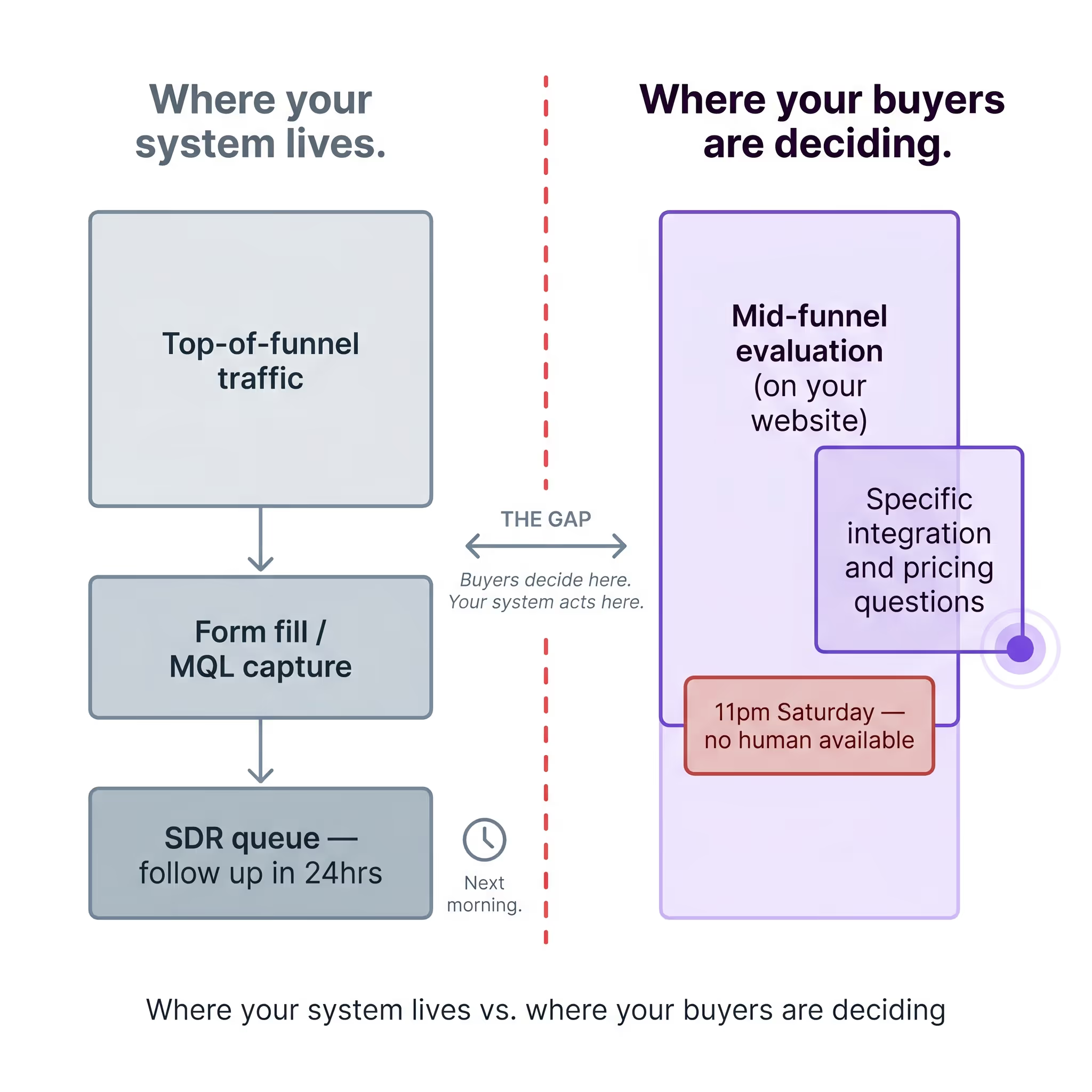
Each intervention operates within the same constraint: nothing happens until a human takes an action. A buyer submits a form at 11pm and nothing moves until someone opens their inbox. A buyer asks a specific integration question mid-evaluation and the system captures their email and defers the answer to a human. A buyer returns to your pricing page three times in one session and your system logs the event and waits.
This is not a speed problem. It is an architecture problem. The system requires a human to be present before any meaningful action occurs. That made sense when buyers moved slowly and linearly. It breaks when evaluation happens in real time, in a time zone where your team is asleep.
Read more: https://www.docket.io/blog/how-ai-agents-like-docket-cut-sales-cycles-by-10-30
The numbers above are not a performance diagnosis. They are an architecture diagnosis.
A 1.1% visitor-to-lead conversion rate — the B2B SaaS baseline — is not proof that your team is executing poorly. It is proof that the system was designed around an assumption (early-stage buyer who fills a form and waits) that no longer describes the majority of your high-intent traffic.
By the time a buyer lands on your pricing page at 11pm with a specific question about deployment complexity, they are not at the top of the funnel. They are mid-evaluation, pressure-testing a shortlist. The form treats them like they are at the start of a journey they are almost done with.
The fix is not a better form or a faster SLA. It is a system that exists at the funnel layer where evaluation actually happens: mid-funnel, on your website, in real time.
That means answering buyer questions in the session — not deferring them to a human the next morning. Docket's Sales Knowledge Lake™ makes this possible by pulling answers from approved, versioned sources across product, pricing, security, and enablement, with permissions enforced so the agent never improvises on sensitive information. The buyer who arrives with a specific integration question at 11pm gets an answer at 11pm, grounded in your approved knowledge. Every answer is auditable.
It means qualification that happens inside the conversation, at the moment the buyer is engaged — not after a form submission routes them into a review queue. An Agent-Qualified Lead (AQL) carries mid-funnel conversation context, stated intent, and a documented next step. An MQL carries a behavioral score assembled from page views. The difference is not cosmetic.
And it means routing that happens in real time, so the right rep receives the right opportunity while the buyer is still in the session — not hours after the moment has passed.
Across Docket deployments, customers observe 40–60% higher website conversion from the same traffic and a 20–40% lift in qualified meetings without adding headcount or increasing ad spend (observed ranges; results vary by ICP, traffic quality, and agent configuration).
Factors.ai saw this directly: in two weeks, Docket's AI Marketing Agent generated 23 meetings at 5.3x their baseline conversion rate. 77% of those high-value conversations occurred outside business hours.
The conversation start rate on Docket's AI Marketing Agent runs at 36%, against approximately 13% on legacy form flows.
If you're trying to diagnose where your specific conversion gap is, start with the 5-point diagnostic here. It will tell you whether your failure is timing-based, configuration-based, or happening at the handoff.
If the gap is structural — if your system cannot act without a human present — the diagnostic will confirm it. And the fix starts here.
See what your inbound system looks like when it can act at the moment buyers are deciding. Book a demo.
Why is my B2B website conversion rate stuck even though traffic is increasing?
More traffic doesn't fix a conversion architecture problem. The most common cause of a flat conversion rate despite growing traffic is that the system requires a human to take action before anything meaningful happens — a form gets submitted, an SDR follows up, a meeting gets booked the next day. By the time that sequence completes, the buyer has moved on. B2B SaaS websites convert an average of 1.1% of visitors to leads. The data shows that the ceiling is 26.9% when the architecture is right — the gap isn't traffic volume, it's what happens during the visit.
Can a CMO increase website conversion without hiring more SDRs?
Yes. The conversion gap in most B2B funnels is not a headcount problem. It is a timing and architecture problem. 68% of qualified inbound conversations happen outside business hours. No SDR headcount solves that. What solves it is a system that can engage, qualify, and book in the session — without a human required at each step. Docket customers observe 40–60% higher website conversion from existing traffic and a 20–40% lift in qualified meetings without adding headcount or increasing ad spend (observed ranges; results vary by ICP, traffic quality, and configuration).
What is a realistic B2B website conversion rate benchmark?
Across Docket's production deployments, combined conversion ranges from 11.4% to 26.9%, with a fleet median of 13.0%. The B2B SaaS baseline for visitor-to-lead conversion is approximately 1.1%. The gap between the baseline and the upper range is not explained by traffic quality — it is explained by whether the system can act at the moment of intent, or whether it defers action to a human.
What is an Agent Qualified Lead (AQL) and how is it different from an MQL?
An MQL is inferred from behavioural signals — page views, email opens, content downloads. It tells a rep that someone showed interest. An Agent Qualified Lead (AQL) is produced from a structured AI-led conversation where the buyer articulated their use case, answered qualification questions, and took a documented next step. It carries stated intent, qualification status, and full conversation context. The rep arrives at the first call knowing what the buyer asked, what objections surfaced, and where the conversation left off — not starting from a lead score. The term AQL was coined by Docket.
Why do B2B buyers convert at higher rates on evenings and weekends?
Because evening and weekend visitors are doing focused, distraction-free evaluation — not casual browsing. Across Docket's production data, Saturday delivers the highest overall CTA conversion rate at 16.7%. Evening sessions between 6pm and 8pm run at 15–16%. In one deployment, 77% of high-value conversations occurred outside business hours. These buyers are mid-funnel, pressure-testing a shortlist. The problem isn't buyer intent — it's that the standard B2B system is offline when the highest-intent evaluation is happening.
For the operational breakdown of what this system looks like end to end: How to Respond to Every Inbound Website Inquiry 24/7 Without Scaling SDR Headcount"
For the pipeline quality argument — why more MQLs won't fix a flat win rate: 5 Ways AI Agents Improve Pipeline Quality for B2B