How AI Agents (Like Docket) Cut Sales Cycles by 10–30%
December 28, 2025




TL;DR
A buyer hits your site with real intent. Real questions. Usually the kind that decide the deal early:
And what do we make them do?
Fill out a form. Wait for a reply. Sit through a 15-minute "qualification call" where an SDR asks BANT questions but can't answer anything technical. Then schedule the real call. Then re-explain everything they already typed.
That's the B2B version of being put on hold.
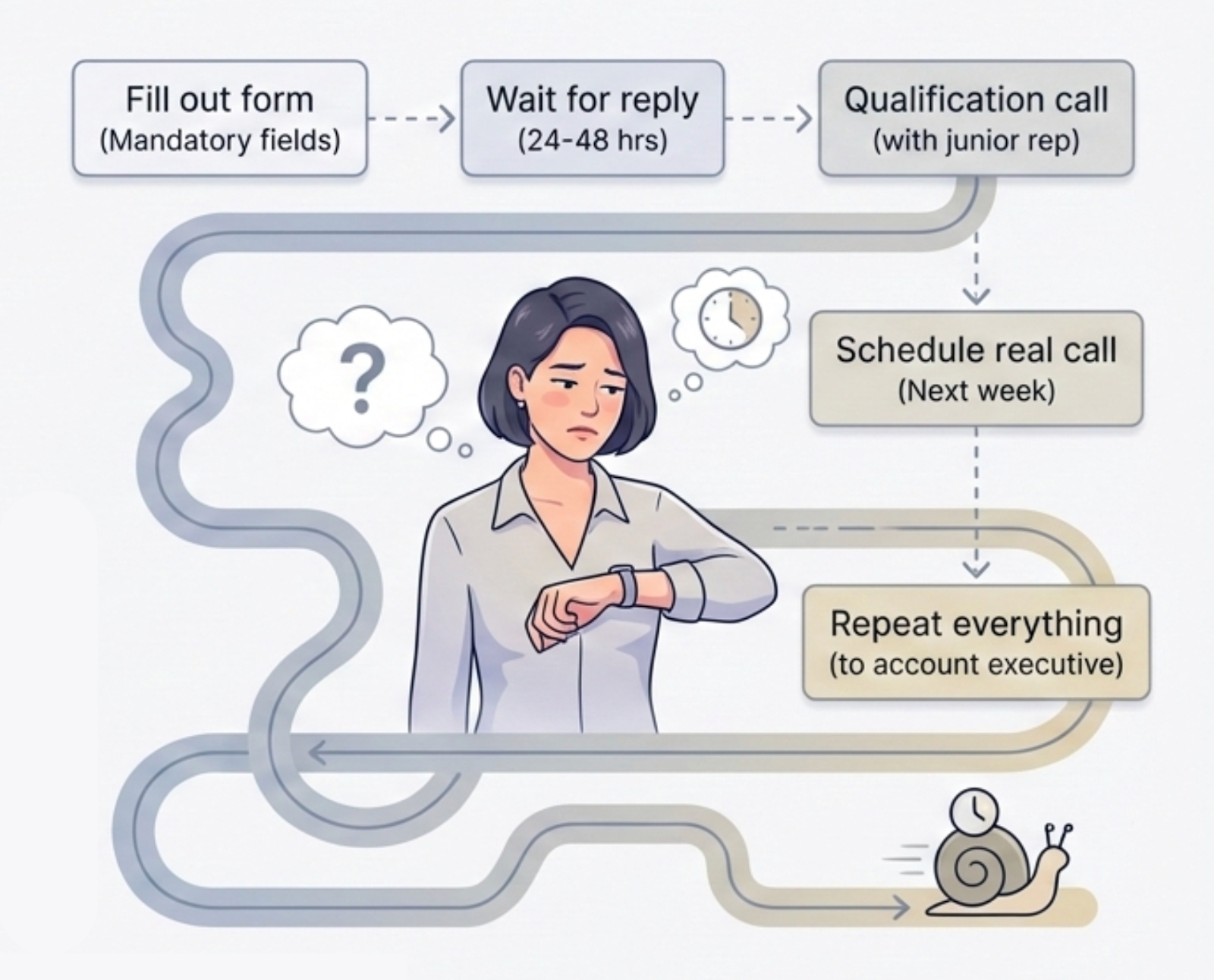
You can't control your buyer's procurement department. You can't control their legal redlines. But you can control your own internal friction.
The claim isn't that AI "deletes" the 6-month enterprise sales cycle. The claim is that it compresses the first 30% of the cycle (the discovery and qualification phase) down to minutes.
That 10–30% reduction in total cycle time comes entirely from eliminating your delays.
We invented inbound SDRs for a rational reason: AEs were drowning. But the handoff model creates three silent killers of deal velocity:
The result: High-intent leads convert at 75-80% when handled instantly, but drop to 5-10% when subjected to the standard queue.
Let's define terms, because "AI" spans everything from autocomplete to sophisticated autonomous systems.
An AI Agent for Sales is a system that can maintain conversational state, reason over technical knowledge bases, and execute complex workflows autonomously—combining expert-grade technical answers with SDR-grade qualification capabilities.
It is fundamentally different from the chatbots of 2018.
Legacy Chatbots (Pre-2020)
Built on decision trees and keyword matching, these systems followed rigid if-then logic and answered FAQs from static scripts.
AI-Enhanced Chatbots (2020-2024)
Platforms like Drift and Intercom added natural language processing and LLM capabilities. Drift's Bionic Chatbots train on company content, while Intercom's Fin AI uses GPT-4 to resolve support queries. However, they remain constrained by predefined playbooks and single-domain focus (sales or support).
Sales-Grade AI Agents (2024+)
Today's most capable systems add autonomy and reasoning: they plan multi-step workflows, maintain state across conversations, reason across diverse knowledge sources, and execute end-to-end tasks from answering technical questions to booking the right specialist and logging structured data to your CRM.
The difference is fundamental: chatbots respond to inputs; AI agents autonomously pursue goals. AI agents decompose complex objectives into subtasks, gather information, reason about alternatives, execute actions, and adapt based on results.
Table: Chatbots vs. Sales-Grade AI Agent
| Capability | Earlier Chatbot Generation | Sales-Grade AI Agent (Docket) |
|---|---|---|
| Core Function | Lead routing & basic qualification | End-to-end technical selling & discovery |
| Knowledge Depth | Single knowledge base or playbook scripts | Unified reasoning across docs, security, pricing, calls, CRM |
| Logic | Playbook-driven or intent classification | Contextual reasoning with source grounding |
| Data Capture | Conversation transcripts | Structured CRM fields (MEDDIC, tech requirements, timeline) |
| Workflow Execution | Meeting booking via connector | Native multi-system orchestration (calendar, CRM, routing, alerts) |
| Governance | Basic or platform-specific | RBAC, citation-backed answers, audit logs, safe failure modes |
(Want the deep dive? Read Why AI Agents for Sales and Marketing Beat Chatbots)
Ask yourself: Would you put a top salesperson on your website for every visitor?
Obviously. But you can't scale that. Agents are the only way to give buyers a real conversation at scale, without lowering the bar to "please submit this form."
An agent turns "we'll get back to you" into "let's do this now."
The agent answers technical questions immediately and accurately. This eliminates the common pattern where buyers ask integration or security questions that require escalation to technical experts—a handoff that typically adds 8.3 days to technical qualification.
Result: buyers receive answers while their intent is highest. After just 5 minutes of delay, the odds of qualifying a lead drop by 80%. AI agents respond in under a minute, compared to the 42-hour average for human teams.
Here's what a real agent discovery flow looks like:
Buyer: "Do you support rate limiting per tenant? And Salesforce Campaigns?"
Agent: "Yes, we support API rate limiting (default 500 req/min). For Salesforce, our browser plugin provides access. Can I learn more about your use case?"
Buyer: [Explains use case]
Agent: [Shares relevant docs] "Great. I can connect you with an AE who specializes in this. Want time today?"
That's not chat. That's discovery + solutioning + booking in a single conversation. AI agents extract qualification data like budget, authority, need, timeline by detecting specific linguistic patterns in natural conversation. This means AEs walk into first meetings with structured intelligence, not a cold transcript.
And when the agent doesn't know? It fails gracefully: "I don't have approved sources to answer that precisely. Let me bring in a specialist and share our full conversation."
Humans are inconsistent. Different SDRs ask different questions. Manual data entry introduces errors. Moreover, sales reps spend over an hour daily on admin work that creates incomplete CRM fields.
Agents do the opposite:
Done right, the agent behaves like an SDR + expert hybrid: it qualifies like an SDR while answering technical questions like a solutions expert—a combination that reduces technical qualification time.
The trade-off to understand: AI agents excel at consistency, speed, and technical accuracy. Humans remain better at complex objection handling, reading emotional cues, and building relationships in enterprise deals. The highest-performing teams use both: AI handles initial qualification and technical questions at scale, freeing human sellers to focus on relationship building and strategic conversations where their judgment matters most.
The core issue with many so-called AI agents: they're either underpowered or untrustworthy. Some lack the reasoning layer to handle nuanced technical questions. Others generate plausible-sounding answers that sound confident while being completely wrong.
Docket addresses both problems (and some) through deliberate architecture, not just better LLM.
Ungrounded LLMs hallucinate 15-48% of the time, including leading models like ChatGPT. For sales, this is unacceptable. An agent that invents pricing, makes up integration capabilities, or fabricates security compliance isn't helpful. It's dangerous.
The standard: AI-driven sales tools should maintain hallucination rates below 5% (95%+ accuracy). Most generic agents don't.
Grounding means connecting AI responses to real sources of truth, not letting the model hallucinate. Docket unifies your organization's knowledge like product docs, security specs, pricing matrices, call transcripts into the Docket Sales Knowledge Lake™
How it works:
Instant connect to humans (when it matters)
Industry research confirms: 78% of customers buy from the company that responds first. Not the smartest, not the cheapest, just the fastest. Speed builds trust.
An AI agent running 24/7 on your website answers technical questions instantly while humans sleep, travel, or handle complex deals. The buyer's intent peaks at that moment. Every minute of delay is a lost conversion.
But also, the best agents know when they don't know.
This isn't a handoff. It's a warm transfer. The buyer has already been qualified, technical questions answered, and context loaded, so the first human conversation is strategic, not transactional.
BANT and MEDDIC are frameworks, not laws. Different industries and deal types require different qualification signals.
Rather than forcing buyers into predefined buckets, Docket extracts what actually matters to your business:
Structured. Automatically. Every time. This delivers consistency that human SDRs can't match. And without the false positives of rigid scoring models.
Sellers depend on technical experts to answer product questions: feature details, objection handling, competitive positioning, technical fit. When there are three AEs for every expert, that's a problem.
The cost: deals stall while reps wait for expert availability. Technical questions go unanswered. Discovery calls miss critical details. And new reps can't reach productivity without an expert mentoring them.
Docket built a system that understands your product the way an expert does. Not just features, but integration patterns, security requirements, deployment constraints, and how your product compares to competitors.
It's the difference between prep consuming a rep's morning versus enabling them to take another call. Multiply that across a team of 20 reps, and you're talking about 40+ additional selling hours per week without adding headcount.
We practice what we sell. We have deployed Docket's AI Agent on our website, and here's what we consistently see:
Faster qualification and higher intent signals
Richer pre-call context
Instead of walking into discovery cold, AEs get:
This shifts prep time from "research and re-qualification" to "plan how to close."
How our AEs use agent insights in calls
Reported results (our own)
AI agents don't shorten sales cycles because they "save reps time." They shorten cycles because they remove the dead time you actually control:
That's where the typical 10-30% compression comes from.
Ready to compress your deal cycles? Book a demo!