How B2B Buying Decisions Happen Before Reaching Your Website
December 26, 2025




If you spend enough time in B2B marketing, you start noticing patterns that don’t announce themselves. They don’t break dashboards or trigger alerts. They just sit there, quietly, until you realize they’ve been reshaping outcomes for a while.
For me, one of those patterns showed up in how buyers behaved before they ever reached our website.
You probably experienced this too.
Traffic was declining. Conversion rates were improving. Sales conversations felt sharper, more informed, and oddly more decisive. Buyers arrived with opinions instead of questions.
Something in the middle had changed.
Recently, we unpacked this with Praveen Das, Co-Founder of Factors, using data from more than 100 B2B companies. What emerged wasn’t a single dramatic shift, but a consistent pattern. Buyers were doing most of their evaluation before marketing ever had a chance to engage them directly.
By the time someone landed on a website, they already knew the category, the alternatives, and often where they were leaning. The website hadn’t disappeared from the journey. It had simply moved later.
You’ll see why this matters in a moment, especially when you look at where buyers are actually making their decisions today. It’ll give you a clear picture of how these shifts are showing up inside your pipeline numbers.
Inbound worked for a long time because buyers depended on vendor content to understand the market. Blog posts framed problems. Guides created language. Webinars helped buyers compare approaches.
That dependency created leverage.
What has changed is not effort or to a certain extent even quality. Most teams are producing more content than ever. The difference is that buyers now have ways to learn without relying on vendors at all.
Answer engines and LLMs can synthesize dozens of perspectives in minutes. Review platforms compress years of customer experience into a few scrolls. Community conversations surface unfiltered opinions without any marketing wrapper.
Across the companies that the Factors team analyzed, a few signals appeared repeatedly:
Each of these trends is manageable on its own. Together, they point to a loss of early-stage leverage.
Inbound still plays a role, but it no longer shapes the buyer’s thinking as early as it once did.
The “dark funnel” used to feel like a side channel. Today, it describes how most B2B buying actually unfolds.
Buyers research across AI tools, review sites, private communities, peer conversations, and advertising impressions that never convert directly. Much of this activity leaves no trace in traditional analytics.
By the time intent becomes visible, buyers are rarely starting from scratch. They are checking alignment. They are validating assumptions. They are deciding whether a conversation is worth having.
This shifts how marketing influence works. Attribution becomes less useful. Repeated exposure, category framing, and quiet credibility matter more. Influence happens upstream, long before a form fill or demo request.
One of the clearest signs of this shift shows up in on-site behavior.
Scroll depth has declined. Reading is selective. Questions are pointed and specific.
Buyers arrive with context and urgency. They want to know whether you understand their environment and constraints. They want confirmation, not orientation.
Today, websites increasingly function as the first sales conversation. Most of them were never designed for that role. They were built as libraries, while buyers now treat them as interrogation rooms. When answers aren’t immediate or relevant, buyers move on without friction or feedback.
That mismatch has a name: it's the gap between Assisted Marketing and Agentic Marketing.
Assisted Marketing gave us better content, smarter forms, and faster routing. It made humans move faster. But the buyer arriving on your website with a specific use case, a loaded tech stack question, and zero patience for a follow-up email — that buyer doesn't need a human who moves faster. They need an agent that executes the conversation autonomously, without creating friction at the moment they're closest to a decision.
That's the operating model shift the website problem is actually pointing at.
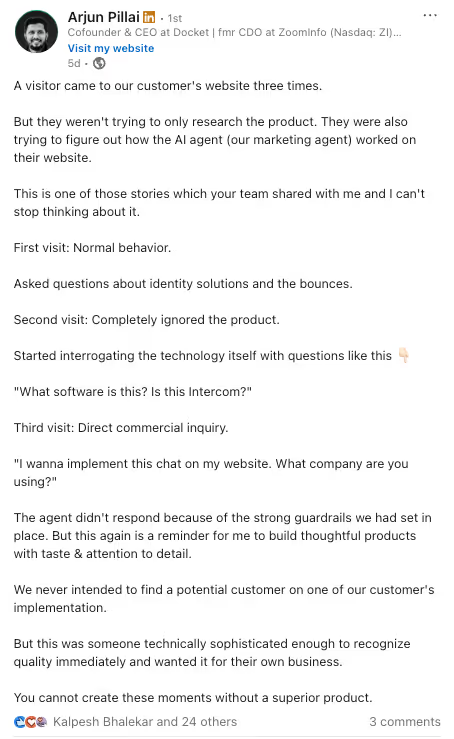
Inbound SDRs exist for good reasons. Sales time is expensive. Qualification matters. Process protects efficiency.
However, buyers experience these systems differently.
They experience delay, repetition, and unnecessary ceremony. They already know what they want to ask. They want answers, not delays. This is a structural problem, not a staffing one. Buyers experience delay because humans are still the execution layer for everything — every discovery call, every qualification touchpoint, every first answer. As volume grows and buyer expectations accelerate, that bottleneck gets worse, not better.
AI-driven agents are beginning to absorb this friction.
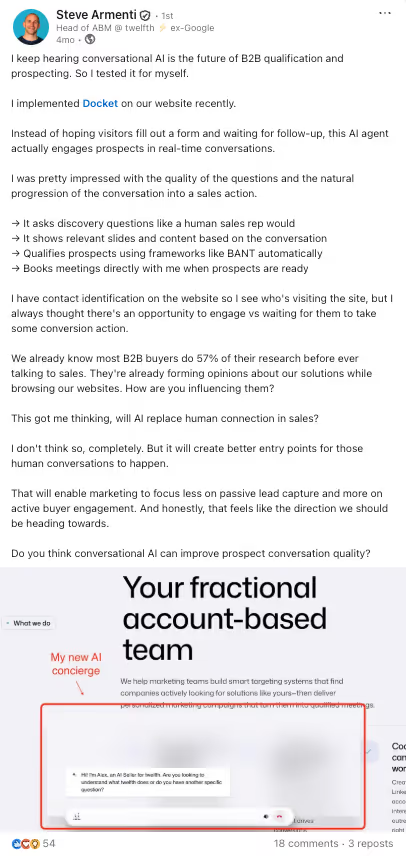
This is Agentic Marketing in practice. When our customers deploy Docket's AI Marketing Agent on their website, it doesn't just automate a task — it executes a meaningful part of the sales conversation autonomously. It draws from product knowledge, sales collateral, CRM data, and call recordings. It qualifies in conversation, handles discovery, and routes — all within human-defined guardrails. No human required for every exchange. No friction introduced at the moment it matters most.
For lower-ACV products, this carries a buyer through much of the journey independently. For higher-ACV deals, it prepares the buyer for a more productive human conversation. The handoff improves because the agent has already done the work a human used to do manually.
What I’ve changed most over the last year is how I define progress. I no longer start with volume. I start with whether we’re showing up in the right places, for the right buyers, often enough to matter.
I’ve stopped optimizing primarily for traffic growth.
Traffic still matters, but only when it represents repeated exposure among accounts that could realistically buy from us. A smaller group of the right companies encountering us consistently does more work than a larger audience that shows up once and disappears.
In practice, I spend less time watching aggregate sessions and more time looking at whether the same accounts keep reappearing across touchpoints. Visibility compounds when it’s concentrated. Diffuse attention rarely turns into pipeline.
I’ve also changed how I evaluate channels.
Clicks are easy to measure and comforting to report. Recall is harder to quantify, but far more predictive of future action. Buyers rarely act the first time they encounter an idea. They act after it becomes familiar.
That’s why I now favor channels that allow for repeated, lightweight exposure over those that promise immediate conversion. The work is about shaping how buyers remember the category and our point of view, not forcing them into action before they’re ready.
The biggest shift has been how we think about the website.
Most of the most valuable content already exists. It lives inside sales calls, demos, objections, and the questions our reps answer every day. Buyers arrive with those same questions, often sharpened by research they’ve already done elsewhere.
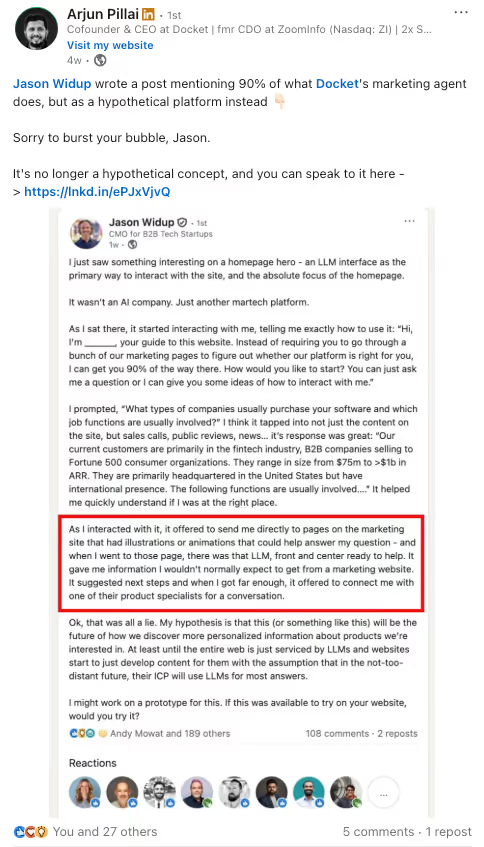
So instead of treating the website like a static library, we’re treating it as a place where those conversations can start earlier. We’re making it easier for buyers to ask direct questions and get grounded answers immediately, in the language sales would use.
This is the move from Assisted to Agentic Marketing made concrete. Assisted Marketing says: publish better content so buyers find better answers. Agentic Marketing says: deploy an agent that executes the answer conversation autonomously, the moment the buyer is ready to have it. The content still matters. But now there's an agent in front of it — one that doesn't wait for a human to dial in.
At Docket, this has changed the quality of downstream conversations in a very visible way. Buyers aren’t arriving for orientation anymore. They’re arriving to confirm fit, edge cases, and constraints. When the website supports that moment, the sales conversation starts at a much higher altitude.
I’ve also changed what I pay attention to week over week.
Some metrics move quickly and feel reassuring. Others move slowly but signal real progress. I prioritize the latter.
I look at engagement depth from target accounts, visibility across answer engines, and whether qualified meetings are trending upward over time. These indicators lag slightly, but they align far more closely with pipeline health than early-stage vanity metrics ever did.
When demand engines optimize for volume, they create noise. When they optimize for familiarity, relevance, and timing, they create motion.
The website hasn’t become less important. Its role has moved closer to the moment of decision. The same is true for channels, metrics, and visibility itself.
Once you accept that buyers are arriving later and better informed, the work becomes clearer. The job is to meet them with confidence, context, and answers… without adding friction where none is needed.
B2B buying has become more compressed, more indirect, and more buyer-controlled.
Exploration happens earlier. Decisions harden faster. Visibility precedes intent.
Marketing teams that continue to optimize primarily for early lead capture will see diminishing returns. Teams that focus on influence before intent will accumulate advantage quietly and steadily.
Websites still matter. Sales still matters. Inbound still matters. They no longer own the beginning of the story.
Once that reality sets in, the work becomes clearer. The job is to reduce risk for the buyer early, earn trust gradually, and reawaken curiosity where it now begins.
The marketing teams that navigate this transition well won't just publish better content or run tighter campaigns. They'll deploy agents that execute the first sales conversation autonomously — on behalf of the human, at the moment the buyer is actually ready. That's what Agentic Marketing looks like when the operating model finally catches up to how buyers actually behave.