TL;DR: Buyer journeys are changing: prospects self-educate with AI and expect real answers fast. Docket keeps you on-message with an inbound AI SDR that answers scenario questions, qualifies intent, and routes the right next step. The payoff: fewer stalled evaluations, better-qualified meetings, and cleaner pipeline with CRM-ready context.
Buyers have changed. They’re getting used to ChatGPT, and Perplexity. So by the time they land on your website, they’ve already done vendor discovery, narrowed options, and show up with specific questions that decide the deal early.
And the experience is still weirdly broken.
The only way to ask a couple of questions is filling out a form
Then waiting hours (or days) for a response
And when the response comes, it’s often from someone who can’t answer the technical stuff
So they schedule a call
Then the buyer waits again, just to ask the same questions they already had
That mismatch between “I want answers now” and “we’ll get back to you” creates a real cost.
Speed-to-lead is not a nice-to-have. A widely cited Harvard Business Review analysis of 2.24 million leads found companies that attempted contact within an hour were nearly 7x more likely to qualify a lead than those that waited longer.
And most teams are slow. One B2B lead response benchmark reports an average response time around 42 hours.
This is why AI SDRs like Docket are showing up.
Not as “better chat widgets,” but as always-on sales development that can respond instantly and qualify in real time, while the buyer is still in motion.
And Docket is an inbound AI SDR built for technical qualification. It answers from approved sources, runs discovery, writes structured context into your CRM, and routes and books calls with the right rep.
What AI SDRs Are and What They Can Actually Do
What is an AI SDR?
An AI SDR is an AI-powered agent that automates sales development work traditionally done by human SDRs. It can engage prospects in natural language, qualify them in real time, and move the workflow forward without waiting on a human inbox.
In practice, an AI SDR helps with four jobs:
Answer buyer questions in real time (especially product, integration, security basics)
Run qualification (BANT or your custom framework) and capture it as structured data
Educate and personalize (assets, slides, role-based explanations) so meetings start deeper
Modern AI SDRs use natural language processing to understand what a prospect is asking, respond conversationally, and keep the interaction moving. (This is also why they outperform legacy chatbots that just capture info and escalate.)
What an AI SDR does in the first 2–5 minutes on your site
The best way to understand an AI SDR is to watch what it does immediately after a buyer lands on your site.
Visitor intelligence It figures out who it’s talking to.
Returning visitor: recognized via cookies, so it can pick up where the last conversation ended.
Unknown visitor: uses IP-to-company resolution to infer the company and start with relevant context.
Instant personalization using real company context Once the company is known or inferred, it can do lightweight research and tailor the conversation. Not “Hi there!” energy. More like: “I see you’re in fintech with a Salesforce stack. Are you evaluating this for pipeline capture or qualification?”
A conversation with memory If the buyer comes back later, the AI SDR doesn’t restart from zero. It remembers what was asked, what was answered, and what’s still unresolved.
Discovery while it answers It doesn’t force a form. It learns as it helps. It can ask baseline discovery questions like role, use case, urgency, constraints, while simultaneously answering buyer questions as they come in.
Pull the right assets in real time As the conversation narrows, it can surface the most relevant supporting material: slides, docs, demos, security pages, integration guides.
Capture email at the right moment Instead of asking for an email up front like a toll booth, it asks after it’s delivered value. That’s how you capture contact info without killing intent.
Route, hand off, or book instantly Once there’s intent and context, it can route to the right rep, do calendar coordination, hand off live when needed, or book a meeting immediately.
Write everything back to the CRM This is the part most teams underestimate. A real AI SDR logs the actual substance: discovery answers, pain points, key questions, objections, next steps, routing decisions, and meeting details. No more “notes later.” No more context lost between website → SDR → AE → CRM.
Why real AI SDRs Are systems, not single LLM calls
A common mistake is thinking an AI SDR is one big prompt plus one model response.
That approach breaks fast in real sales workflows because it can’t integrate, can’t remember context, and can’t execute actions safely.
Here’s the difference:
Aspect
Single model call
Orchestrated AI SDR system
LLM invocations
One API call
Multiple coordinated calls
Tool access
None (text-only)
CRM, calendar, enrichment, knowledge sources
State management
No persistence
Memory layer tracks context across turns
Action execution
Can’t take actions
Routes, books, logs, triggers workflows
Multi-step reasoning
Single pass
Iterative plan → check → act loop
Real-world analog
“ChatGPT chat widget”
SDR systems like the ones used at scale (e.g., multi-step agent workflows)
Buyer impact: this is why systems can do technical discovery safely. They can retrieve approved answers, keep context, and take actions without guessing.
Inbound vs Outbound AI SDRs: What’s the Difference?
Inbound AI SDRs: respond to buyers already in motion
Inbound AI SDRs work warm leads. These are prospects who have already shown intent by:
Revisiting your pricing page
Requesting a demo
Downloading bottom-funnel assets
Asking specific questions on your site
Inbound is about speed + depth.
Outbound AI SDRs: create motion from cold starts
Outbound AI SDRs proactively reach out across email, LinkedIn, and sometimes voice. They focus on:
List building
Sequencing and follow-ups
Personalization at scale
Testing targeting and messaging
Outbound is higher volume, lower intent. Success depends heavily on targeting, deliverability, and message quality.
Why inbound vs outbound AI SDRs need different playbooks
Most teams end up using both. But inbound usually pays back faster because the buyer is already evaluating.
Inbound is also where qualification gets harder. Cold prospects rarely open with technical constraints. Inbound prospects do. They ask scenario questions. They expect answers now.
That’s where generic AI SDRs and many human SDR workflows struggle.
Inbound vs Outbound AI SDRs comparison
Category
Inbound AI SDR
Outbound AI SDR
Lead intent
High
Low to medium
Goal
Convert interest into qualified meetings
Create interest and start conversations
Speed requirement
Immediate
Fast, not always real-time
Core capability
Qualification + technical discovery
Prospecting + sequencing
Common failure mode
Can’t handle scenario-specific questions
Spammy personalization, weak targeting
Best metrics
Speed-to-lead, qualified meeting rate
Reply rate, meeting rate, CPL
The AI SDR vs Chatbot Debate: What’s the Real Difference?
Most website chatbots are just:
Scripted flows
FAQ deflection
Lead capture forms in a chat window
They might collect an email. They don’t qualify. And they definitely don’t move the deal forward.
AI SDRs are built to do the opposite:
Handle multi-turn discovery (with context)
Ask and answer in the same conversation
Take actions like routing, booking, and CRM writeback
Preserve context across the funnel
A side by side: chatbot vs AI SDR on your website
Chatbot
Buyer: “Do you integrate with Salesforce Campaigns?”
Bot: “Leave your email and someone will reach out.”
AI SDR
Buyer: “Do you integrate with Salesforce Campaigns?”
Agent: “Yes. Are you syncing campaign membership only, or also pushing events back to marketing automation?”
Buyer: “Both. Plus custom objects.”
Agent: “Got it. That’s supported. Are you on Salesforce Enterprise, and do you need field-level permissions?”
That’s the difference. One captures a lead. The other qualifies it.
Most importantly: a good AI SDR is excellent at high-frequency, high-impact questions, like:
Product feature questions
Integration questions
Security questions
Competitor questions
Common objections
The parts of sales AI SDRs can’t (And shouldn’t) replace
You don’t want the agent doing everything. You want it to know its lane.
Areas that still need humans:
Negotiation
Custom solution design
Deep pricing (it can handle basic pricing, not edge-case commercial structure)
Deep SKU/configuration details
Complex, multi-stakeholder political buying
Anything messy when data is missing or unclear
The winning model: AI SDRs qualifies, AEs close
The clean hybrid looks like this:
AI SDR handles first response, product education, baseline discovery, qualification, and routing
Humans handle nuanced discovery, solution shaping, negotiation, and relationship building
The critical detail is escalation. When something is out of scope, the agent shouldn’t bluff. It should hand off cleanly:
“I don’t have the exact answer for that question. How would I connect you with the right human being for this?”
Then it either:
hands off in real time, or
routes to the right person and books the meeting instantly
That’s how you get speed and trust. Without the “confident but wrong” problem.
Why Most AI SDRs Struggle with Technical Fit
Why technical discovery is hard in B2B sales
Technical discovery is hard because it’s not “qualification.” It’s problem-solving.
To do it well, you have to:
Map the buyer’s stack and constraints to what your product can actually support
Ask the right follow-ups to remove ambiguity
Handle objections without guessing
Know what “yes” means in implementation terms
When a buyer asks, “Will this work with our stack?” they’re not asking for marketing copy. They’re trying to reduce risk.
Most AI SDRs fail here because they were built for generic qualification, not product-specific reasoning.
How the sales engineer bottleneck slows deals
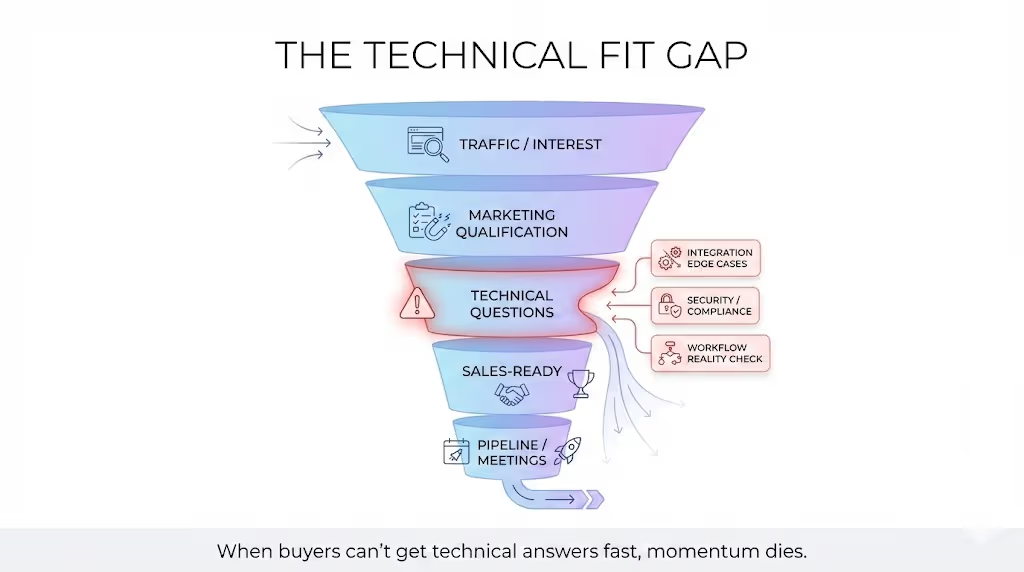
When AI SDRs can’t answer technical questions, the org reverts to the standard chain:
SDR captures the lead and schedules a “quick call”
AE realizes it’s technical and pulls in an SE
Buyer waits days to get a real answer
SEs end up spending time on early-stage, repetitive questions. The cost isn’t just SE time. It’s lost momentum. Buyers don’t pause their evaluation because your calendar is full.
What “SE-level expertise” looks like in an AI agent
SE-level expertise isn’t “knows your features.” It’s:
Understanding requirements and constraints
Translating a scenario into a workable implementation shape
Catching deal-breakers early
Answering integration and security questions accurately
Knowing when to escalate
This is where outcomes come from: faster qualification, fewer wasted meetings, fewer SE cycles burned on bad-fit deals.
How Docket Solves the First and Hardest Sales Conversation
Meet Docket: The AI SDR agent built for technical qualification.
From lead capture to true technical qualification
Docket is built to handle technical fit and scenario discovery before a meeting gets booked.
In practice:
It runs real discovery while answering buyer questions
It validates feasibility before scheduling
It routes to the right human when needed
It hands off full context so the rep starts prepared
Result: fewer meetings, better meetings.
What Sales gets in the CRM (not a transcript)
Docket writes structured context like:
Use case + urgency
Stack + constraints
Objections (security, procurement, integration)
Qualification fields (your schema, not generic notes)
Assets shared
Next step + meeting booked + routed owner
That’s what turns “website conversation” into “sales-ready call.”
What improves for buyers, AEs and SEs
For buyers
Get technical answers immediately
Self-serve discovery on their timeline
Know whether it’s worth taking a meeting
For reps
Fewer bad-fit demos
Clear context before the call (stack, requirements, objections, urgency)
More time spent on deals that can close
For sales teams
Scalable technical discovery without hiring more SEs
Faster cycles because the early technical loop closes sooner
More consistent qualification across inbound conversations
How Docket’s AI SDR works in practice
A typical flow:
Prospect visits the site or submits a demo request
Docket engages instantly
It runs technical discovery (stack, constraints, requirements)
It answers objections using approved knowledge
It captures contact info when it’s earned (not as a form wall)
It routes and books the meeting
It writes the full interaction back to the CRM as structured context
Docket AI SDR use cases
High-intent buyers get answers immediately
Scenario: A buyer hits your pricing page and asks security, integration, or compliance questions before they’ll even consider a demo.
Result: Docket answers in-session, keeps momentum, and turns that intent into a booked meeting or a sales-ready opportunity.
Personalization for unknown visitors
Scenario: A buyer lands on the site without filling anything out. No email. No form. Just vibes. Result: Docket infers the company via IP-to-company, tailors the conversation to their likely context, and gets to relevant qualification faster.
Returning visitors resume where they left off
Scenario: A buyer comes back days later with follow-up questions after internal discussions. Result: Docket recognizes the returning visitor and continues the thread instead of restarting discovery from zero.
Discovery without the form wall
Scenario: A buyer isn’t ready to “book a demo,” but will answer a few questions if the conversation is useful. Result: Docket collects qualification in a natural flow while answering questions, then captures email only when it’s earned.
Intelligent routing and instant scheduling
Scenario: The buyer is ready to talk, but it needs to be the right person (segment, territory, product line, or technical depth). Result: Docket routes correctly, books instantly, or hands off live, without the SDR relay race.
CRM writeback that preserves context
Scenario: The buyer has a real conversation on the site, but the context usually dies in a notes field or never gets logged. Result: Docket writes the substance to the CRM: requirements, pain points, key questions, objections, responses, and next steps.
How Docket answers technical questions reliably
Most AI SDRs answer quickly, but not safely. Docket answers from a curated, company-specific sales knowledge lake built from approved sources like:
Approved slides, demo snippets, security and integration assets
So when a buyer asks a technical question, Docket responds from approved material and escalates cleanly when something is out of scope.
The Shift: From Simple Lead Capture to True Technical Qualification
AI SDRs are evolving from basic automation into real qualification systems.
But most still can’t handle the conversation that actually decides momentum: technical fit.
That’s where Docket represents the next step. An inbound AI SDR that can do technical discovery, answer real product questions reliably, and hand off clean context so humans can close.
The result is simple:
Buyers get answers fast
Reps get better meetings
Deals move faster because the first conversation is finally useful
See how Docket handles the technical qualification conversation your AI SDR can’t. Talk to our inbound agent and watch it in action.