AI Voice Agent vs. Text Agent: What 13 Weeks of B2B Data Showed
August 4, 2026



We built an AI Marketing Agent that works the way a good rep would. This is agentic marketing in practice, an agent that doesn't just answer questions but moves a buyer toward a decision. It listens, it answers, it moves the conversation forward instead of parking a visitor in front of a form. Docket’s agents have the option to be text or voice as their main engagement modalityWe had a clear hypothesis going in about why voice would win. We were wrong about it, the way we were wrong is the actual story.
We had the obvious bet going in: voice keeps people around longer, and more time in the conversation means more pipeline out the other end. That was the whole hypothesis.
Here's how we tested it. We took Docket's AI Marketing Agent, already live on customer sites, and monitored engagements between voice mode and text mode. Same features, same 13-week window, comparable traffic, that left modality as the only variable separating the two.
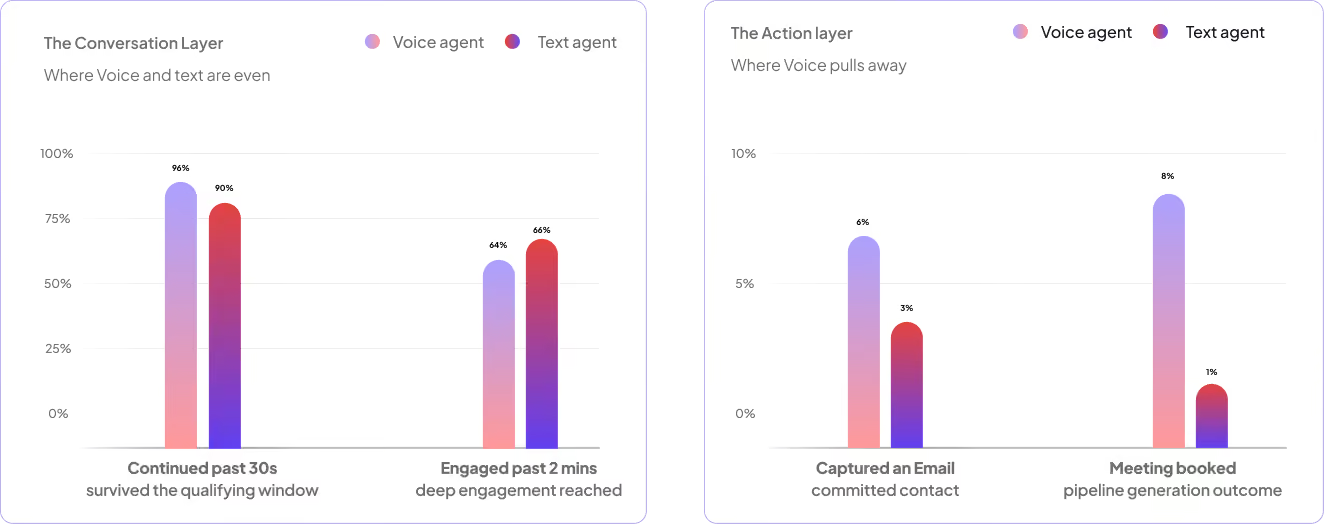
Visitors on voice and visitors on text stuck around for close to the same length of time (195s vs 185s) and reached deep engagement at close to the same rate. By every measure of how long a conversation held someone's attention, the two modes were even.
The two modes were the same conversation right up until it was time to act. At the moment a visitor had to hand over an email or commit to a meeting, voice converted emails at 1.8 times the rate of text, and meetings at 7.4 times the rate. Both modalities load the identical booking step, so the gap isn't about one having an extra step, it's about what happens in the conversation before the ask.
Here's why that gap matters more than it might first appear. According to Gartner, B2B buyers now spend only 17% of their total purchase journey in direct contact with any supplier, and when a deal involves multiple vendors, that shrinks to roughly 5-6% per supplier. The majority of the decision happens before anyone from your team is in the room. 75% of buyers say they'd prefer a rep-free buying experience entirely.
That sounds like an argument for pure self-service, it isn't quite. Gartner's own research also found that self-service purchases are more likely to end in buyer regret. What this tells us about B2B buyer behavior is that buyers want to do the research alone, but somewhere in that process they still need a signal that says this is real and worth trusting. Pure self-service, with nothing to supply that signal, leaves them less confident in what they picked, not more.
For most companies, the only thing left standing in that gap is whatever conversation the website itself can hold. That's the moment a buyer-facing AI agent has to carry, doing real-time B2B lead qualification instead of just collecting a form fill. It's doing the job a rep used to do, at the one moment that decides the deal
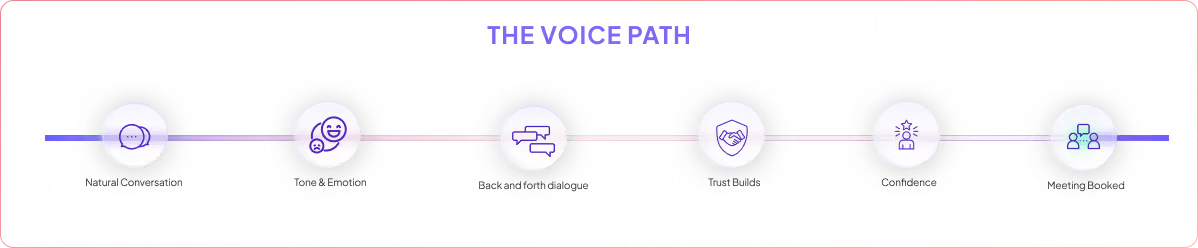
A sense of rapport, that is a signal buyers are looking for right before they commit. Tone, warmth, the pause before an honest answer, is carried in how something sounds, not just in the words themselves. Text can be completely correct and still land like a machine, which is the worst possible feeling at the exact moment someone is deciding whether to trust you enough to act.
That's the real difference between a scripted B2B website chatbot and a true conversational marketing experience: a chatbot follows a decision tree, an agent actually carries the conversation. A voice conversation carries that signal by default. A text conversation has no channel to carry it at all, no matter how well it's written.
By the time the booking step shows up, the visitor who's been talking to the voice agent already trusts who they've been talking to. The one who's only been typing is still deciding.
Buyers who turn into pipeline are probably on your site right now. They get to the exact moment they're ready to act, and then a form shows up instead of a person, so they leave.
A voice conversation gets them past that moment. Not just a meeting, a real conversation that ends in something documented and useful, more than a name and a pageview history. We've started calling that an AQL, an Agent Qualified Lead, our own shorthand for what it looks like when an AI agent actually qualifies someone in real time instead of just catching a form fill. It's a different animal from an MQL or an SQL, because it comes with the reasoning attached, not just a score.
That's the whole reason we built our Docket Marketing Agent the way we did. To have the real conversation, to answer from your actual product knowledge, to qualify intent while it's happening, and to hand your rep something they can act on instead of something they have to decode.
For us, the modality question is settled. Your pipeline probably isn't leaking from one broken step in the funnel, it's leaking because your website has never been able to give buyers the one thing they need before they'll act, something that feels like talking to a person instead of filling out a form.