The Revenue Math Behind Agentic Marketing for B2B SaaS
May 4, 2026



More than half of B2B organizations increased their marketing investment in 2025 and the pipeline numbers that followed didn't add up. Traffic budgets went up. Conversion rates didn't move.
What's changed isn't buyer intent; high-intent visitors are still arriving. What's changed is buyer behavior at the moment of interest. They're researching faster, self-qualifying in real time, and making shortlist decisions before a sales rep ever gets notified. The window between "interested" and "moved on" has compressed in ways that form fills and 48-hour SLA response targets weren't designed to handle.
For CMOs and CROs, this shows up as a frustrating ambiguity: the funnel looks fine in the reporting, but the revenue math doesn't close. The average B2B SaaS company converts just 1.1% of website visitors yet most budget conversations never surface that number as a line item. The leakage is real. It's just invisible at the budget level, which means it never gets fixed.
This post gives you the framework to find it, quantify it, and evaluate whether agentic marketing pencils out as the fix.
Most B2B SaaS marketing teams are not losing pipeline because their strategy is wrong. Their positioning is sharp. Their content is strong. Their paid spend is well-targeted.
They're losing pipeline because of what happens or doesn't happen the moment a buyer arrives.
According to FirstPageSage's 2024 B2B SaaS conversion benchmarks, the average website converts 1.9% of visitors into leads. That means 98 out of every 100 people who land on your site leave without entering a sales motion.
Some of those 98 were never going to buy. But a meaningful number were qualified, evaluating, and ready to engage and left because the right thing didn't happen when they arrived.
Read more: Why Inbound Is Broken (And How an AI Marketing Agent Fixes It
The execution gap is the window between the moment a buyer signals intent and the moment your team responds.
On a form-first website, that gap is structural. The buyer submits. The notification lands in a queue. The SDR picks it up… if it's during business hours, if the routing worked, if the rep isn't already on three other follow-ups.
Chili Piper's 2023 Inbound Lead Management Report puts the stakes clearly: companies that respond to demo requests within 5 minutes are 100x more likely to connect with that lead than those who wait 30 minutes. Most B2B SaaS teams aren't operating anywhere near that window.
Here's what the math looks like in practice. If your website receives 10,000 visitors per month and your current visitor-to-meeting rate is 1.5%, you're generating roughly 150 conversations from that traffic. At a $50,000 ACV, each percentage point improvement in conversion is worth $500,000 in pipeline — per month, from the traffic you're already paying for.
The traffic isn't the variable. The execution at the moment of intent is.
The form is not a neutral handoff mechanism. It's a filter that removes friction from your process and transfers it entirely to the buyer.
Docket's AI Marketing Agent achieves a 36% conversation start rate, compared to 13% on legacy form flows — observed across Docket deployments. For every 100 high-intent visitors who arrive on a form-first website, 87 leave without a conversation. They didn't bounce because they were unqualified. They bounced because the form asked them to do more work than the moment warranted.
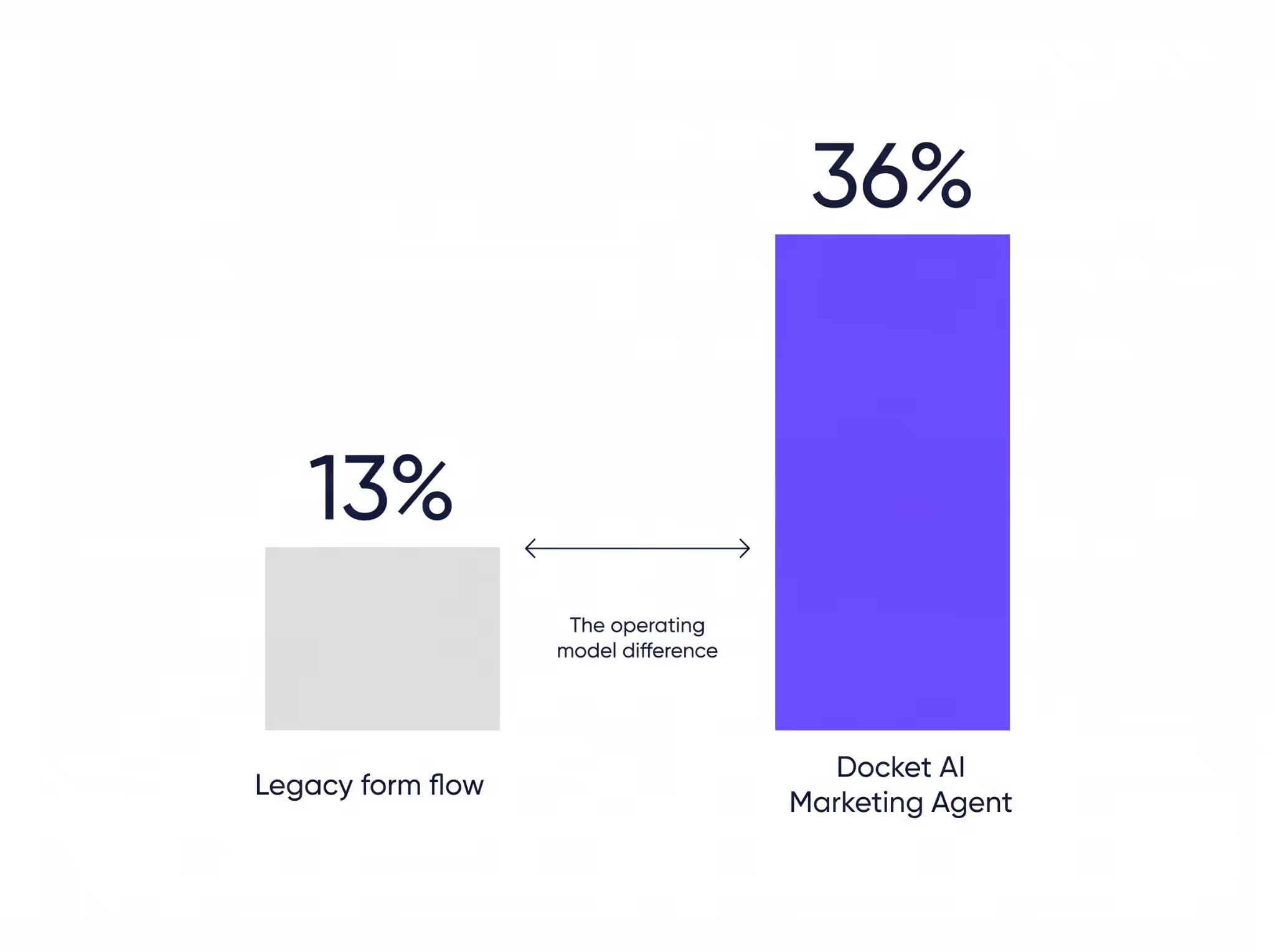
The gap between 13% and 36% isn't a design improvement. It's an operating model difference.
B2B SaaS buyers do not evaluate on your schedule. They read comparison pages late at night. They return to your pricing page on Saturday morning after a difficult week with their current vendor. They arrive with a specific technical question — how your API handles authentication, whether you support SAML 2.0, what your EU data residency policy is — after doing their own research.
Docket's data shows 68% of qualified conversations happen outside the 9–5 window. You cannot hire your way out of this. Three SDRs on night shift doesn't solve a structural coverage problem.
A B2B marketing analytics company that deployed Docket's AI Marketing Agent saw exactly this dynamic play out. In two weeks, the agent generated 23 meetings, i.e., 5.3x their baseline conversion rate. 77% of those meetings were booked outside business hours.
"What surprised us most? 77% of those meetings were booked outside business hours. That's pipeline we simply would have missed." — VP Marketing, B2B marketing analytics company
The third leak is subtler, and often the most expensive.
When an SDR receives a form fill, they get a name, an email, and a company. No context. No intent signals. No understanding of what the buyer actually cares about, what evaluation stage they're in, or what question almost closed them.
The rep starts from zero. The buyer has to repeat everything. The first call feels like admin.
Docket's Conversion Patterns Report, drawn from 4,736 production conversations across 17 companies, tells a different story for agent-qualified leads: 71.5% of conversations include discovery questions, 64% surface specific pain points, and 91% document a concrete next step before the first human call.
The SDR isn't cold-calling. They're picking up a warm file.
A mid-market SaaS company that deployed Docket saw response time drop from 4–5 hours to near-instant and trimmed 3 days from a 30-day sales cycle. And this is not by adding headcount, but by removing the cold handoff from the process entirely.
Read more: 5 Ways to Improve Pipeline Quality for B2B Teams in 2026
"Agentic" is a word that's getting overloaded fast. Here's what it means in revenue terms, not category terms.
Assisted AI: AI helps humans go faster. The human still initiates every action. The rate-limiter is still your team's availability, bandwidth, and working hours.
Agentic AI: The agent executes the engagement motion. The human reviews outcomes. The rate-limiter shifts from people to pipeline quality.
What that looks like in practice: it's 10:53pm and a buyer lands on your pricing page. In an assisted model, the buyer hits a form, a notification queues, and a rep picks it up tomorrow morning — cold. In an agentic model, the agent engages immediately, answers the SSO question accurately, qualifies intent, and routes the conversation to the right rep before the buyer closes the tab. Same buyer. Same Tuesday night. Completely different outcome.
This is not a marginal productivity improvement. It's a different operating model. Gartner's 2023 Future of Sales research found that B2B buyers spend just 17% of their entire purchase journey meeting with potential suppliers — divided across every vendor in their consideration set. The evaluation is already happening. The question is whether your website is participating.
Read more: The AI Marketing Maturity Model: Which Stage Are You In?
Not all AI agents are the same, and the difference matters to your business risk profile.
An agent that generates answers from open-ended LLM inference can hallucinate your pricing, misrepresent your security posture, or make a capability claim your product can't back. That's creating liability.
Docket's AI Marketing Agent is grounded entirely in your Sales Knowledge Lake™ — your approved product documentation, CRM data, security materials, competitive positioning, and call recordings. Every answer comes from verified knowledge, not inference. You define what the agent can say, what it can't say, and when it escalates to a human.
The guardrails aren't a feature you configure once and forget. They're the foundation the agent runs on.
The business case looks different depending on how your SaaS company goes to market. Here's how it plays out across three common motions.
For product-led growth companies, the highest-value qualification event is not the initial trial signup. It's when an activated user returns to the upgrade or pricing page.
That visitor already knows your product. They've used it. They have a specific question about what the paid tier unlocks, whether the enterprise plan includes SSO, what happens to their data at scale. They are 80% through the evaluation and need one more answer.
A static pricing page gives them a form. Docket deploys on the upgrade path, answers the specific question, qualifies intent depth in the same conversation, and routes upgrade-ready users into the expansion sales motion while they're still in the session.
OpenView Partners' 2023 SaaS Benchmarks puts median free-to-paid conversion at 4–5%. The gap between median and top quartile (8–10%) is rarely a product gap. It's usually a response gap at the highest-intent moment in the journey.
For high-volume, lower-ACV motions, qualification throughput is the primary constraint.
The economics of SDR-led qualification for small ACV deals are structurally difficult. A fully loaded inbound SDR (base, commission, benefits, tools, ramp) runs $95,000–$130,000 annually at a mid-market B2B SaaS company (Bridge Group, 2024). Against a $10,000 ACV, the math is tight before you factor in ramp time or first-year attrition.
Agentic Marketing reverses that math. The agent qualifies every inbound lead in real time, routes only ICP-fit, intent-confirmed conversations to the SDR team. The SDR starts with an Agent-Qualified Lead, not a form fill.
A B2B data governance company saw a 5.6x above-baseline meeting book rate (28.2%) after deploying Docket — not by generating more traffic, but by converting the intent that was already arriving.
For enterprise SaaS, the early-stage evaluation frequently stalls on technical questions that require a solutions engineer to answer. API authentication. SAML 2.0. EU data residency. Uptime SLA.
These are not sales questions. They're qualification questions. And routing them to a human SE introduces exactly the kind of delay that kills evaluation momentum.
Docket's Sales Knowledge Lake™ handles security documentation, integration architecture, compliance certifications, and technical specifications — accurately, in real time, grounded in your approved knowledge, not open-ended inference.
This is precisely what happened at Demandbase. Before Docket, the most common complaint from sales reps was that solutions consultants were too slow to respond. Three quarters after deployment, Jack Torlucci, Senior Director of Solutions Consulting at Demandbase, described the shift:
"We don't have situations now where sales reps are going to a leader and saying, 'This person is not responsive enough.' Because now, the SCs are not spending all that time digging for the answer. They're just giving the answer."
— Jack Torlucci, Senior Director of Solutions Consulting, Demandbase
Demandbase automated 93% of queries through Docket and went live in under two weeks.
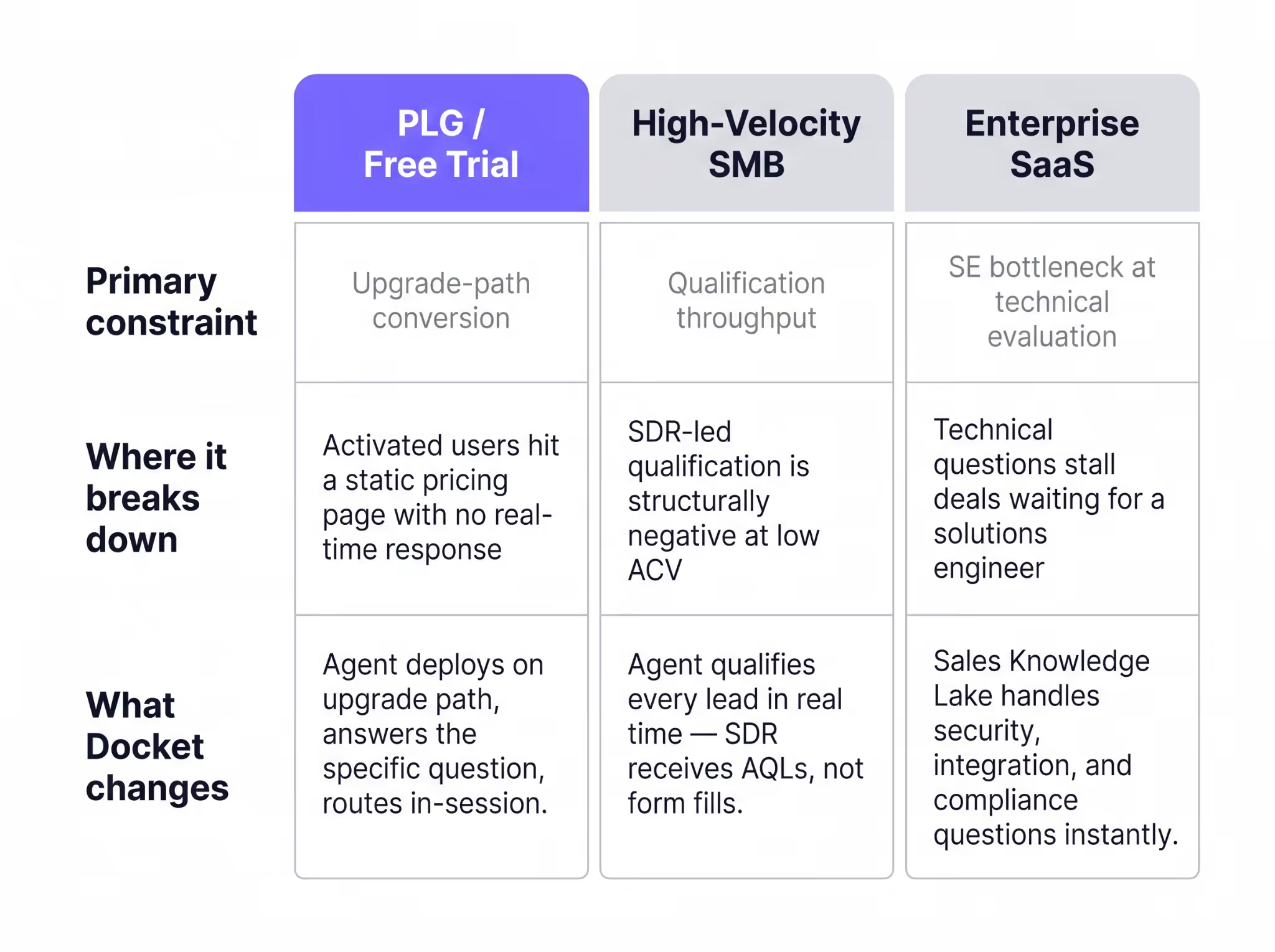
Across GTM motions, company sizes, and industries, the dynamic is consistent: the intent was already there. The capture architecture wasn't.
Read more: Agentic Marketing Examples: Real Deployments and Outcomes from Docket Customers
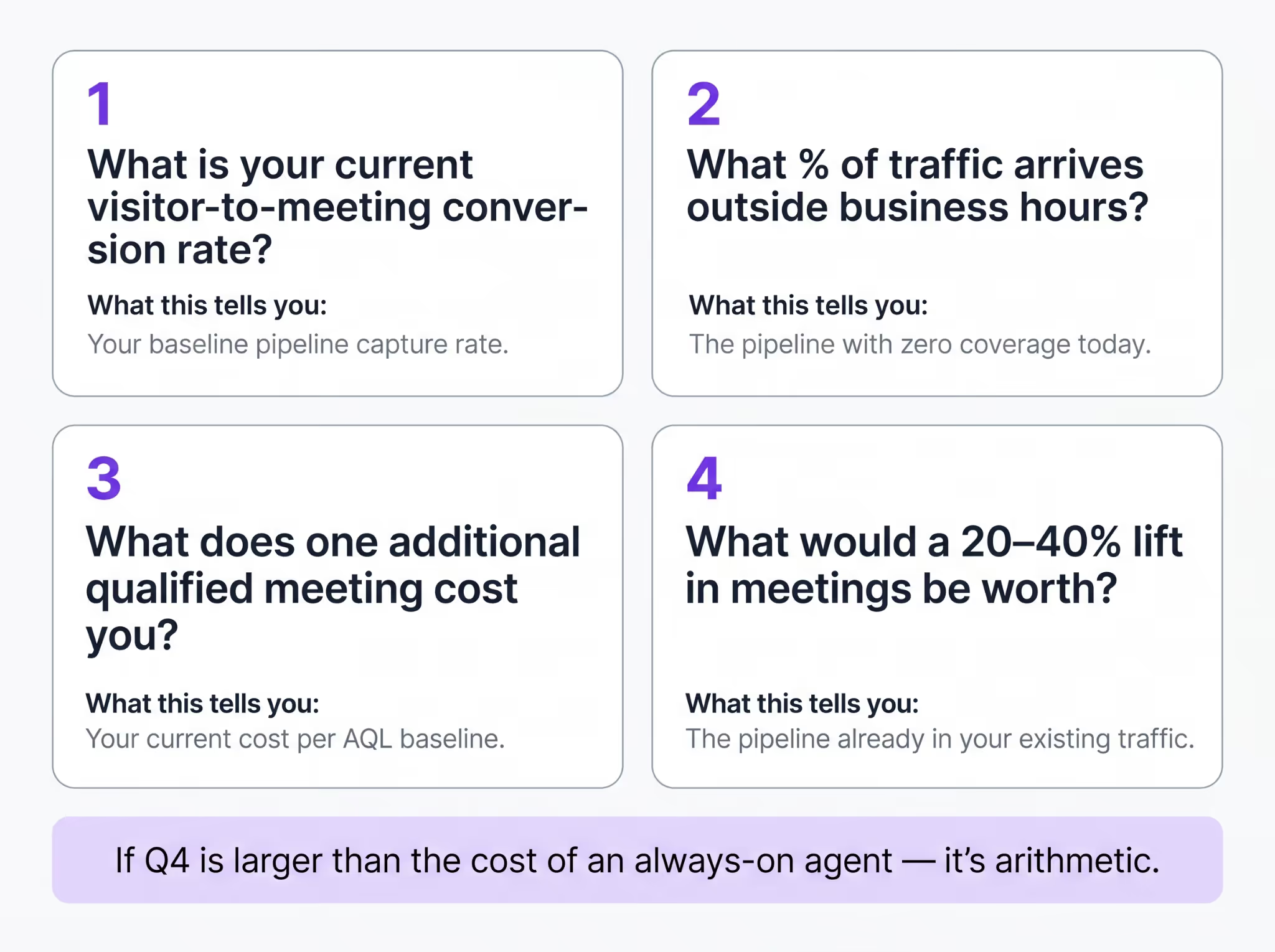
Before any vendor conversation, run these four numbers. They'll tell you whether the business case is worth building.
Before you take this internal, here are the three ways this conversation typically goes sideways.
Docket goes live in 1–2 weeks. No engineering resources required. Docket's CS team handles the knowledge build — ingesting product documentation, CRM data, call recordings, security materials, and competitive positioning into the Sales Knowledge Lake™. Key integrations: HubSpot or Salesforce (bidirectional sync), Calendly or Chili Piper (direct booking), Gong or Chorus (call recordings as knowledge source), Slack (live rep notification for priority leads).
The timeline objection is almost always about the last platform someone tried to deploy, not this one. Demandbase went live in under two weeks.
Across 25 production agents, combined conversion ranges from 11.4% to 26.9%. The agents at the lower end aren't failing because of traffic quality. They're failing because of configuration gaps — missing CTAs, no email capture path, no next-step design in the conversation.
Volume is a vanity metric. Qualified meetings booked and sales time recovered are the right measures.
Agent-qualified leads don't replace SDRs. They remove SDRs from the manual work they shouldn't be doing — routing form fills, cold follow-up, re-asking questions buyers already answered.
A mid-market SaaS company reduced its qualification overhead from 3 FTE to 0.5 FTE — not because three people lost their jobs, but because three people stopped doing the work that shouldn't have been theirs. They reclaimed 6 hours per week per seller. The SDR team now handles conversations that require a human. The agent handles everything before that point.
The investment frame matters, because it usually gets compared to the wrong things.
Docket runs at $36,000–$72,000 annually. Compare that to:
Deployment timeline: 3–7 business days to first live Agent-Qualified Lead.
The opportunity cost of waiting is not abstract. Every week a high-intent buyer lands on your website, gets a form, and leaves is a week the current model is costing you pipeline you've already paid to acquire.
McKinsey's 2024 State of AI report found that 65% of organizations now regularly use generative AI — double the rate from 2023 — with sales and marketing as the top two deployment functions.
Most of that deployment is assisted AI. Reps using Copilot. Marketers using content tools. Humans going slightly faster.
Agentic Marketing is a different bet. It's the bet that the first sales conversation — the one that happens at 10:53pm on a pricing page, or at 2pm on a Saturday, or during a technical evaluation at a $1M+ enterprise — shouldn't require a human to initiate it.
The buyers are already there. The intent is already real. The only question is whether your website is built to meet them when it matters, or ask them to wait.
See what your website could be converting. Talk to Docket's AI Marketing Agent → docket.io