The AI Marketing Maturity Model: Which Stage Are You In?
March 24, 2026



The shift from Assisted to Agentic Marketing isn't a product upgrade. It's a new operating model. Here's the framework for understanding where your team sits — and what the ceiling looks like from inside it.
Here's the assumption most marketing and revenue leaders are quietly operating on: the more AI tools you've added, the more advanced your AI marketing is.
It sounds reasonable. It's mostly wrong.
AI maturity isn't measured in tools deployed or workflows automated. It's measured in how much your AI does with buyer intent without waiting to be asked.
By that definition, a lot of orgs that feel advanced are still early in the journey. They've automated repetitive tasks. They've added a chatbot. They've connected a few signals. But the system isn't learning, it isn't self-correcting, and it still depends heavily on human intervention to close the loop.
This post introduces a three-stage model for honestly assessing where your AI marketing program stands. The goal isn't to make you feel behind — it's to give you a shared language for the gap, because you can't close a gap you haven't named yet.
Three years ago, using AI at all was a differentiator.
In 2026, it's table stakes and the bar has moved faster than most teams have. BCG found that average marketing AI maturity fell between 2021 and 2024. Not because companies got worse. Because the definition of "mature" changed.
The problem isn't that B2B marketing teams aren't trying. Seventy-four percent of B2B marketing and sales leaders expect GenAI to meaningfully enhance their key metrics. But nearly half — 47% — aren't confident their current AI strategy is the right one].
That gap between intention and architecture is exactly what this model is built to close.
Meanwhile, the external problem is compounding. Buyers aren't waiting for your website anymore. They're researching with AI and they're getting generic answers that make every vendor sound the same. By the time a high-intent buyer lands on your pricing page, they've already formed a view of your product based on information you didn't control, from a source you didn't influence. The copilot ceiling isn't just an internal efficiency problem. It's a competitive exposure.
Before walking through the three stages, here's the line that separates the old operating model from the new one:
If your AI requires a human to open a tab, type a prompt, and review output before anything happens, you're in the assisted era. If your AI can engage a buyer, qualify them, route them, and log the outcome without human initiation at each step, you're in the agentic era.
That distinction (not the sophistication of the model, not the quality of the output) is what determines which stage you're in.
The model isn't about how much AI you use. It's about where AI sits in your buyer engagement motion — and who (or what) is still the rate-limiter.
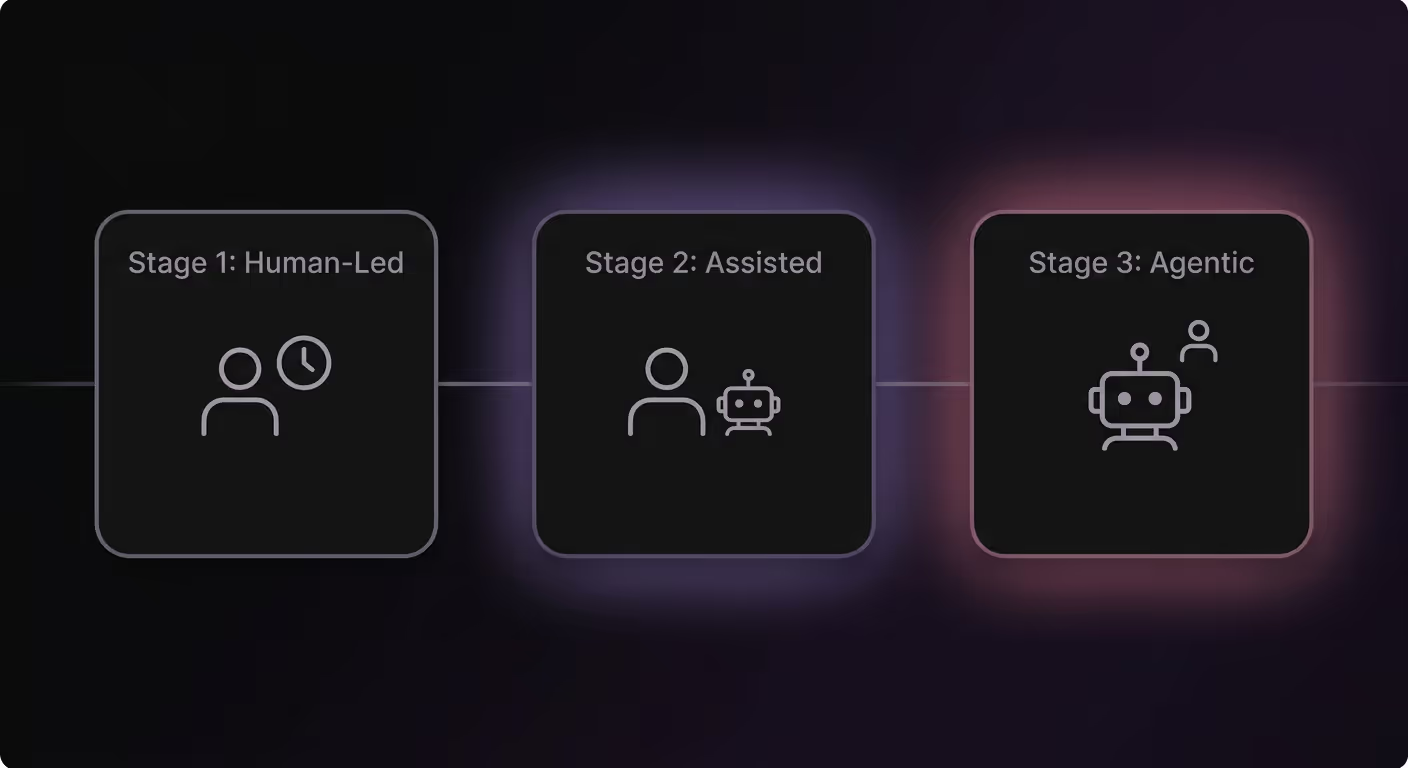
Every buyer touchpoint requires a human to initiate, respond, and follow up.
A prospect lands on your website. They submit a form. An SDR picks it up during business hours, sends a templated email, and waits. If that reply comes at 11pm, it sits until morning. If the buyer has a technical question, the SDR schedules a call with a solutions engineer.
The ceiling here is obvious: 9-to-5 availability, human memory, and manual CRM entry. Most B2B companies operated here in 2020. Some still do.
Telltale sign: Your inbound SLA is measured in hours. Your CRM has blank fields where discovery data should be.
This is where most B2B marketing and sales teams sit in 2026.
AI is present and genuinely useful. Reps use ChatGPT to draft follow-up emails. HubSpot AI summarizes call notes. Salesforce Einstein Copilot suggests the next best action. Jasper generates five landing page variants in the time it used to take a week. The team feels productive. Metrics improve at the margin.
Someone in the last all-hands called it "transformative."
Here's what's actually happening: the human is still the rate-limiter. Every one of those tools is reactive. They wait for a human to open them, type a prompt, and review output before anything happens. The AI is a very smart intern. Useful when you're in the room. Absent when you're not.
The buyer doesn't know or care about your internal AI stack. They know whether they got an answer.
The copilot ceiling appears at precisely the moments that matter most: A high-intent buyer lands on your site after hours with a qualifying question.
None of these are edge cases. They're Tuesday afternoon at a company running AI tools that are fundamentally waiting for humans to drive them.
This is also not the same as traditional marketing automation. Marketo, Pardot, and HubSpot workflows execute predetermined rules on a schedule. They're powerful, but they're conveyor belts — useful for known sequences. They don't respond to live signals, make real-time decisions, or adapt to buyer behavior in the moment. That's the gap Stage 3 fills.
Telltale sign: Your AI usage is measured in hours saved. Your buyer engagement is still measured in response time.
The architecture flips. Instead of AI assisting the human at the task level, the human sets the goal and the agent executes the motion end-to-end — autonomously, continuously, without requiring a prompt for each step.
This is what Agentic Marketing looks like in practice. Not a tool upgrade, not a new workflow, but a structural shift in where intelligence sits in your revenue motion.
Agentic doesn't mean unsupervised. It means marketers set the objectives, constraints, and escalation rules. The agent executes within them.
When a high-intent account lands — a target account you've been chasing for six months — your team knows immediately. The agent acts. The human decides what happens next. That's not unsupervised AI. That's supervised execution at scale.
Before the first word is typed, the agent already knows who's on the other side — company, industry, likely use case, based on account intelligence running in the background.
A buyer lands on your website. An agent engages them immediately, with a real question: "What are you trying to figure out — is this a fit question, a technical question, or a timeline question?" It answers from approved knowledge. It qualifies intent in the conversation itself. It routes to the right rep, books the meeting, logs the full context to CRM, and sends a follow-up email before anyone on your team checks Slack in the morning.
The rep doesn't start from zero. They open a fully populated context card: company, question asked, objection raised, qualification status, suggested first move. The handoff is clean. The context is complete.
What changes operationally isn't just speed. It's the structural location of intelligence in your revenue motion. AI is no longer accelerating the human layer. It's running the buyer engagement layer and handing off to humans exactly when human judgment is required.
Customers in Stage 3 see conversation start rates of 36% compared to 13% on legacy form flows. Website conversion lifts of 40–60% are not unusual.
What a Stage 3 marketing team actually does differently: They don't draft emails, prompt AI for follow-ups, or manually route leads. They set objectives, define guardrails, review outcomes, and escalate edge cases. The agent handles execution. The human handles judgment. That shift — from doing work to managing systems — is the new operating model.
Telltale sign: Your AI is measured in conversations started, pipeline generated, and meetings booked without human initiation.
Most teams reading this will self-identify as Stage 2. Some will claim Stage 3 because they've deployed a chatbot. Here's how to tell the difference.
Hours saved vs. pipeline generated. That's the distinction that matters. Stage 2 measures productivity. Stage 3 measures revenue contribution.
A quick test: What happens on your website right now, at this exact moment, if a qualified buyer lands and has a question?
Stage 2 is dangerous because it's good enough to create complacency. Copilot tools produce visible, measurable output: emails drafted, summaries generated, suggestions surfaced. That output gets reported upward. The org starts to believe the AI problem is solved. Budget is allocated. Headcount is defended. The AI initiative has results.
Meanwhile, the structural problem — that your buyer engagement motion still requires a human to be present, paying attention, and prompting an AI to act — remains completely unchanged.
This isn't a critique of copilot tools. They do what they're designed to do. The problem is architectural, not product-level. Copilots optimize the human layer. They don't change what happens when the human isn't there.
Take Salesforce Einstein Copilot. It surfaces a next-best-action — when a rep is in the CRM, looking at the record. It doesn't engage the buyer who's on your website right now without a rep in the loop. It's reactive by design.
BCG's research found that nearly half of B2B marketing and sales leaders lack confidence in their current AI strategy — even while increasing investment in it. This is Stage 2 in aggregate: heavy tooling, marginal architecture change, growing uncertainty that something important is being missed.
The competitive consequence is straightforward. Every hour your team isn't watching, a Stage 3 (Agentic marketing) competitor is running buyer engagement autonomously. They're qualifying leads you're losing to a form. They're booking meetings at 2am that your SDR will learn about at 9am — from a closed-lost notification.
That's not hypothetical. That's the asymmetry the maturity model exists to make legible.
It's not a tool swap. It's an architecture decision but a smaller one than most teams assume.
Four things need to be in place:
The agent needs to answer from your approved product knowledge. Not from generic LLM output. Without this, you get confident hallucinations at the worst possible moment: mid-evaluation, to a buyer who hasn't decided yet. The knowledge layer needs to cover product, pricing guardrails, security responses, and competitive positioning — with clear rules on what the agent can and can't say. This is the governance layer that makes autonomous execution enterprise-safe.
The agent can run MEDDIC, BANT, or your custom criteria but only if someone has defined what "qualified" looks like. This isn't engineering work. It's a conversation between sales, marketing, and RevOps that most teams should have had anyway.
The agent's output needs to land somewhere useful.A structured record: qualification status, intent signals, questions asked, next step recommended. The rep opens CRM and knows what to do.
The first agent you deploy is never the last one you need. Start with inbound buyer engagement. The same governed knowledge layer that powers your AI Marketing Agent on the website should extend to email, nurture, and every demand capture motion that follows. That's not a roadmap promise — it's an architecture decision you make on day one.
What you don't need: a six-month implementation, a $100K enterprise contract, or a new department. Demandbase automated 93% of seller queries without replacing their sales team. The deployment timeline was under two weeks, not six months.
The implementation barrier to Stage 3 is smaller than most Stage 2 teams believe. The organizational barrier — admitting that the current architecture has a ceiling — is the harder one.
Once you do, your next step is clear: move the intelligence from the human layer to the buyer engagement layer, govern it properly, and connect it to your CRM.
The buyers who will tell you tomorrow whether your product makes their shortlist are deciding right now. Some of them are on your site. The question is whether anyone's home.
You can't close a gap you haven't named yet. Now you've named it.
The AI Marketing Agent is where the Agentic Marketing platform begins. Not where it ends.
Your site already has visitors. See what the first layer of your Agentic Marketing platform looks like on a live website → docket.io