Agentic Marketing Examples: Real Deployments and Outcomes from Docket Customers
April 28, 2026



Most marketing teams adopted AI as a copilot: faster copy, better segmentation, cleaner reporting. Useful, but incremental. The efficiency gains don't compound. They don't convert. The assumption baked into the copilot model is that a human still needs to be in the loop at every high-stakes moment: qualification, technical Q&A, mid-funnel nurture. That assumption is now worth examining.
Agentic marketing flips the model. Instead of AI assisting a rep, an AI agent owns discrete parts of the buyer journey autonomously, operating from your actual product knowledge, your competitive positioning, and your ICP criteria.
This post isn't making a theoretical argument for that shift. It's showing you what it looks like when real companies cross that line: what they deployed, what moved, and what you'd need to replicate the results internally.
Here are four deployment patterns from Docket customers, with outcomes.
Three things commonly get confused with what's described in this post. A quick orientation before the deployments.
The distinction that matters: an assistant helps a human do work faster. An agent executes a bounded piece of work autonomously, within defined guardrails, and hands off context to a human when judgment is required. Agentic Marketing doesn't mean unsupervised. It means the human sets goals and reviews outcomes while the agent handles execution.
What that looks like across four real deployment patterns is below.
Agentic Marketing isn't one use case. Across deployments, four recurring patterns emerge. Each maps to a different structural gap in the B2B buyer engagement motion: a place where the human team is unavailable, too slow, or too expensive to be present at every buyer moment.
Most B2B sales teams operate on a coverage model built around business hours in one geography. Most B2B buyers don't.
A common deployment pattern: a company generating strong inbound traffic discovers that a meaningful slice of that traffic, often 30 to 40 percent, arrives outside the window their SDR team covers. For companies with European traffic and US-based sales teams, this isn't a scheduling inconvenience. It's a structural pipeline leak.

A B2B marketing analytics company ran into exactly this. In the two weeks after deploying Docket's AI Marketing Agent, they generated 23 meetings from 10,012 visitors. The number that stopped them: 77% of those high-value conversations happened outside business hours.
"What surprised us most? 77% of those meetings were booked outside business hours. That's pipeline we simply would have missed." — VP Marketing, A B2B marketing analytics company
The overall conversion rate was 31%, running at 5.3x their prior baseline. The agent ran on approved knowledge, answered questions the team would have answered if they'd been awake.
The structural fix isn't hiring more SDRs in more time zones. It's deploying an agent that handles the engagement motion autonomously, at the moment the buyer is actually on your site.
What makes this deployment work: The Sales Knowledge Lake built before launch. In the A B2B marketing analytics company deployment, that meant knowledge optimized specifically for marketing buyer journeys: LinkedIn Ads integration messaging, demo acceleration content, attribution and analytics documentation. The agent's accuracy, tone, and qualification logic are only as good as the knowledge it can access. Docket's implementation process starts there, before the agent speaks to a single buyer.
What good looks like at 90 days: Calendar booking rates from after-hours conversations in the 25 to 35% range. AQL volume growing without headcount addition. CRM populated with context from conversations that previously produced nothing.
After-hours coverage is the most visible pipeline leak. The next one is quieter and harder to measure.
There is a moment in most B2B website evaluations where the buyer hits a wall.
They have read the product page. They have checked the pricing. Now they have a specific question: how does data residency work in their region, what does the SOC 2 audit actually cover, how does the API behave under rate limiting in their specific stack.
The page doesn't answer it. The form doesn't answer it. There is no one to ask at 10pm on a Wednesday. So they leave. Not because they weren't interested, but because the evaluation stalled at the exact moment it needed to move forward.
This is the mid-funnel dead-end. It's quiet, it's common, and it doesn't show up in your bounce rate data because the buyer left without signaling why.
A B2B AI sales intelligence company put it clearly after deploying Docket's AI Marketing Agent on their site: "Your website is having buyer conversations you never see. We didn't realize how much that was costing us until Docket made them visible."
What became visible: 757 real buyer evaluation conversations in 30 days, across 94,000 visits. Not support chats. Not surface-level questions. Buyers actively trying to understand whether the product fit their setup, how it compared to alternatives, and whether it was worth bringing into an internal discussion. Buyers spent over 15 hours actively engaging. None of those conversations existed under the prior model because under the prior model, those buyers hit a dead-end and left.
The agent's ability to handle evaluation-depth questions is what creates that conversation in the first place. A buyer who gets a real answer to a technical question in the first session doesn't need to leave and come back later, or wait for an SDR to follow up the next morning, or find a competitor's website that answers the question instead. They stay in the conversation. They qualify. They book.
Across Docket's fleet of 25 production agents, the gap between the lowest and highest performing deployments — 11.4% to 26.9% combined conversion — almost always traces back to knowledge depth. Agents with shallow knowledge produce generic answers. Generic answers don't resolve the question that was actually blocking the evaluation. The buyer leaves anyway.
What makes this deployment work: The knowledge build has to go deep enough to answer the questions that actually stall mid-funnel evaluations. General product overviews won't do it. Security architecture, compliance audit scope, API behavior in specific environments, data residency by region — that is the layer buyers are evaluating when they leave without converting. Build the knowledge for those questions specifically, not the FAQ layer.
What good looks like at 90 days: Evaluation-depth conversations happening in the first session without human involvement. Buyers progressing to a meeting rather than going quiet after hitting a knowledge gap. Conversation transcripts documenting buyer requirements before the first human call is made.
This is the deployment pattern that surprises teams most. They deploy an AI Marketing Agent expecting a conversion tool. They get a conversion tool. They also get a market intelligence layer they had no idea was coming.
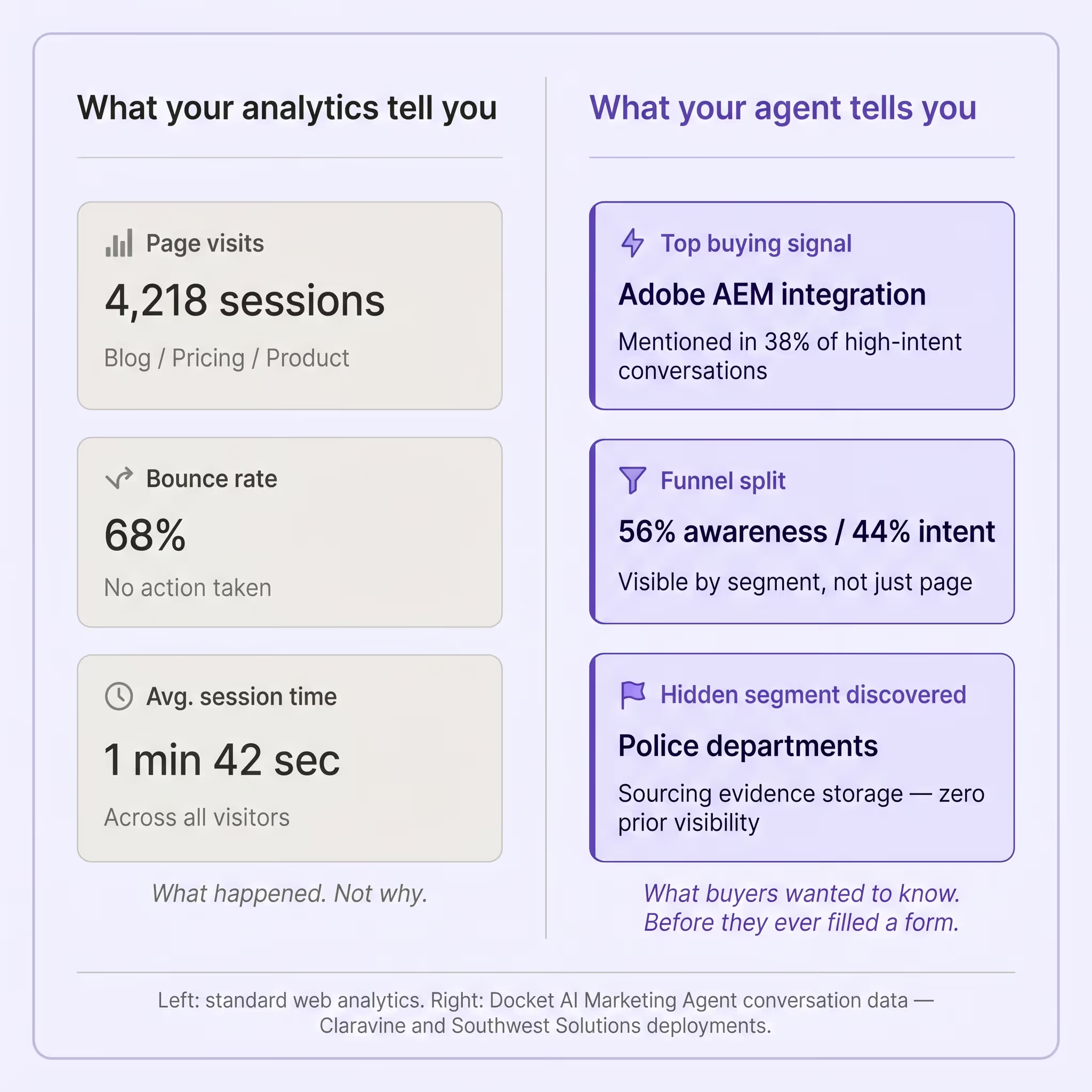
Three deployments illustrate how differently this surfaces, depending on your business.
A multi-brand industrial supply company operates four distinct brands across industrial storage, office solutions, and BIM models. They deployed four AI agents across those four brands, unified by a shared intelligence layer, to engage 37,383 visitors. The conversion numbers were strong. But the finding that changed their strategy had nothing to do with conversion rates.
"Docket gave us something we've never had before: real-time visibility into what buyers across all four brands are actually asking for. We even uncovered an entirely new segment: police departments looking for evidence storage." — Digital Strategy Leader, A multi-brand industrial supply company
Police departments. Sourcing handgun lockers and evidence storage. A segment that was actively in market, arriving on their website, asking product-specific questions, and completely invisible in their prior analytics. Traditional web analytics tells you what pages buyers visited and for how long. It cannot tell you what they wanted to know. Conversation data can.
A B2B data governance company saw the same phenomenon from a different angle. In their first two weeks of deployment, across 6,288 visitors and 62 conversations, the agent surfaced something their team hadn't formally identified: Adobe AEM integration was the number one buying trigger. Buyers who mentioned AEM in their conversation had the highest downstream conversion rates.
"Docket doesn't just capture leads — it gives us intelligence. We now know AEM integration is our strongest buying signal, and we have clear visibility into where prospects stall in the funnel." — Enterprise Marketing Leader, A B2B data governance company
Their overall conversion rate was 35.9%, at 5.6x their prior meeting book rate baseline. But the intelligence layer, knowing which pain points drive urgency, which integrations signal high intent, where the awareness-to-consideration gap lives, is what they cited as the lasting business impact.
A Fintech Infrastructure Provider surfaced a third kind of insight: 40-plus LATAM visitors engaged across six countries in the first 30 days, actively asking about pricing and product fit, with multiple visitors proactively sharing budget context in the $1M to $2M range. They had zero structured LATAM engagement prior. The demand existed. They had no mechanism to see or capture it. In 30 days, the agent surfaced 37 pre-qualified leads and 32 hours of sales time was recovered from discovery that the agent handled autonomously.
What makes this deployment work: The agent needs to be configured to do real discovery, not just answer questions. Qualification questions asked in the flow of conversation generate the data. Without them, you get conversion but not intelligence.
What good looks like at 90 days: Funnel intelligence you can act on. Awareness-stage versus intent-stage distribution visible by segment. Buying triggers identified without manual tagging. Hidden demand segments surfaced before you spend budget trying to create demand that already exists. Multi-session return rate above 15% signals buyers finding the conversations worth returning to: the Fintech provider saw 18.2%.
Conversion and intelligence compound over time. The fourth pattern shows what happens when a single visit unlocks an entire deal.
This one Docket can speak to directly, because it happened on their own website.
A Growth Marketing Director from a company valued at approximately $25M arrived on docket.io. No human from Docket's team was present. The visitor spent 17 minutes in conversation with the AI Marketing Agent.
In those 17 minutes: they explored the product in depth, evaluated fit for their specific use case, a PLG motion requiring enterprise-grade qualification, and booked a meeting for the following day. In the same conversation, they identified a strong fit for a product line they hadn't come to the site to evaluate.
Days later, they brought in their Director of Operations. Within weeks, their CISO was conducting an InfoSec review. Docket shared a custom AI Marketing Agent landing page trained on the prospect's website; the prospect used it internally to generate executive-level buy-in before the deal closed.
The entire process, from first conversation to active implementation, started with a 17-minute website engagement at a time when no human from Docket's sales team was available.
This is not a story about a chatbot that captured a lead. It is a story about an agent that ran a complete top-of-funnel motion: engaged the buyer, understood the use case, identified product fit across two product lines, and created the conditions for a deal to move, without a human in the loop at any of those steps.
What makes this deployment work: Knowledge depth and scenario handling. A scripted bot cannot navigate a 17-minute evaluation conversation that explores multiple product lines and a specific motion. The agent needs to be able to reason about the buyer's situation and draw on approved knowledge to answer questions that weren't anticipated in any playbook.
What good looks like at 90 days: Multi-session conversations with a return rate above 15%. Meeting book rate above 30% from first-session conversations. Deal context logged to CRM before the first human call. Reps arriving informed, not starting from a blank slate.
Every pattern above involves the agent handling the part of the buyer journey the human team was structurally unable to cover.
After-hours engagement. Technical question handling without SE involvement. Discovery at the moment of intent rather than hours later. Knowledge retrieval that would otherwise require a human to search, synthesize, and respond.
The Sales Knowledge Lake is the enabler in every case. The conversion metrics, the intelligence output, the accuracy rates are all downstream of the quality of the knowledge the agent runs on. An agent with weak or shallow knowledge produces generic answers. Generic answers don't qualify intent or build the trust required for a buyer to book a meeting.
This is why Docket's implementation process begins with a structured knowledge build: product documentation, security architecture, competitive comparison content, integration documentation, ICP qualification criteria. The agent does not go live until the knowledge foundation is ready to handle real evaluation conversations.
What that means practically:
For teams considering deployment, here is an honest calibration of the timeline.
A calibration on what 'good' looks like: across 25 production agents in Docket's fleet, combined conversion rates range from 11.4% to 26.9%. The fleet median is 13%. The agents at the bottom of that range are not there because of traffic quality. They are there because of configuration gaps. The difference between 11.4% and 26.9% almost always comes down to five configuration decisions:
If those five are in place at launch, you start in a different position than teams that configure them retroactively.
Every deployment in this piece started before any human from the vendor's team was in the room. The agent was there. The buyer had a real question. The conversation happened.
Your website is running the same hours. The question is whether your agent is.
Talk to Docket's AI Marketing Agent at docket.io