How to Win RFQs: Why Speed Without Accuracy Costs You More Deals
June 12, 2026




Everyone chasing faster RFQ turnaround is solving the right problem in the wrong order.
Speed matters — but the assumption underneath most quoting initiatives is that the bottleneck is time. It isn't. The bottleneck is access to accurate, application-specific product knowledge at the moment a quote is being built. When you fix speed without fixing that, you don't improve your win rate. You accelerate your error rate.
A quote that arrives in two hours with the wrong material spec doesn't just lose the deal — it signals to the buyer that your team doesn't understand their application. That's harder to recover from than a quote that arrived late.
The manufacturers winning on RFQ conversion aren't just faster. They're more precise. And the infrastructure that enables precision is the same infrastructure that enables speed. Treating them as separate initiatives is why most quoting improvement projects deliver marginal results. Here's what the combined fix actually looks like — and why it changes the competitive dynamic entirely.
If you have not yet addressed the speed problem at the RFQ stage, Blog 1 in this series covers that ground first. This blog picks up where that argument ends: what happens when speed is fixed but accuracy isn't.
What is the RFQ intent window — and why does it close faster than manufacturers realize?
The RFQ intent window is the period between a buyer submitting a request and their decision calculus locking around a preferred vendor. In manufacturing, this window is shorter than most sales teams assume.
In B2B purchasing — and manufacturing procurement especially — buyers are nearly 60% through the purchase decision before they engage a sales rep at all, according to research from Google and the Corporate Executive Board. By the time the RFQ lands, the buyer has already done the research, set the budget, and narrowed the field. The RFQ is not an inquiry. It is a test of operational readiness.
A fast response opens the door. An accurate response is what keeps you in the room. Governed product knowledge — specs, pricing logic, and inventory status drawn from approved and validated sources rather than rep memory or open-ended search — is what makes accuracy possible at speed.
Most manufacturing sales teams treat the RFQ as the starting gun. Get the quote out fast, then compete on price and relationship. The buyer's perspective is different. By the time they send the RFQ, they have already evaluated your capabilities against their application requirements and in many cases have a preferred vendor in mind.
Research from Responsive found that 61% of B2B buyers begin the RFQ process with a preferred vendor already identified — but nearly half are open to switching based on the quality of the response. The RFQ is the moment where that preference either solidifies or shifts.
A vendor who responds quickly and accurately confirms the buyer's instinct that they are operationally reliable. A vendor who responds slowly, or quickly with errors, confirms the opposite. In manufacturing, where procurement teams are evaluating suppliers on whether they can be trusted with production-critical components, the RFQ response is a direct signal about the organization behind it.
The 35 to 50% of deals that go to the first vendor to respond are not won on price alone. First-responder status anchors the buyer's reference point on price and spec, initiates the relationship before competitors enter the conversation, and signals operational readiness at the exact moment the buyer is forming their impression.
But the first-responder advantage only converts if the quote that goes out in that window is right. A fast wrong quote wastes the position entirely. The manufacturer who gets there first with an accurate quote is not just faster — they are already three exchanges into a relationship before a competitor has responded at all.
Most manufacturers who struggle with RFQ win rates have a speed problem, an accuracy problem, or both. They look like separate issues. They share a root cause.
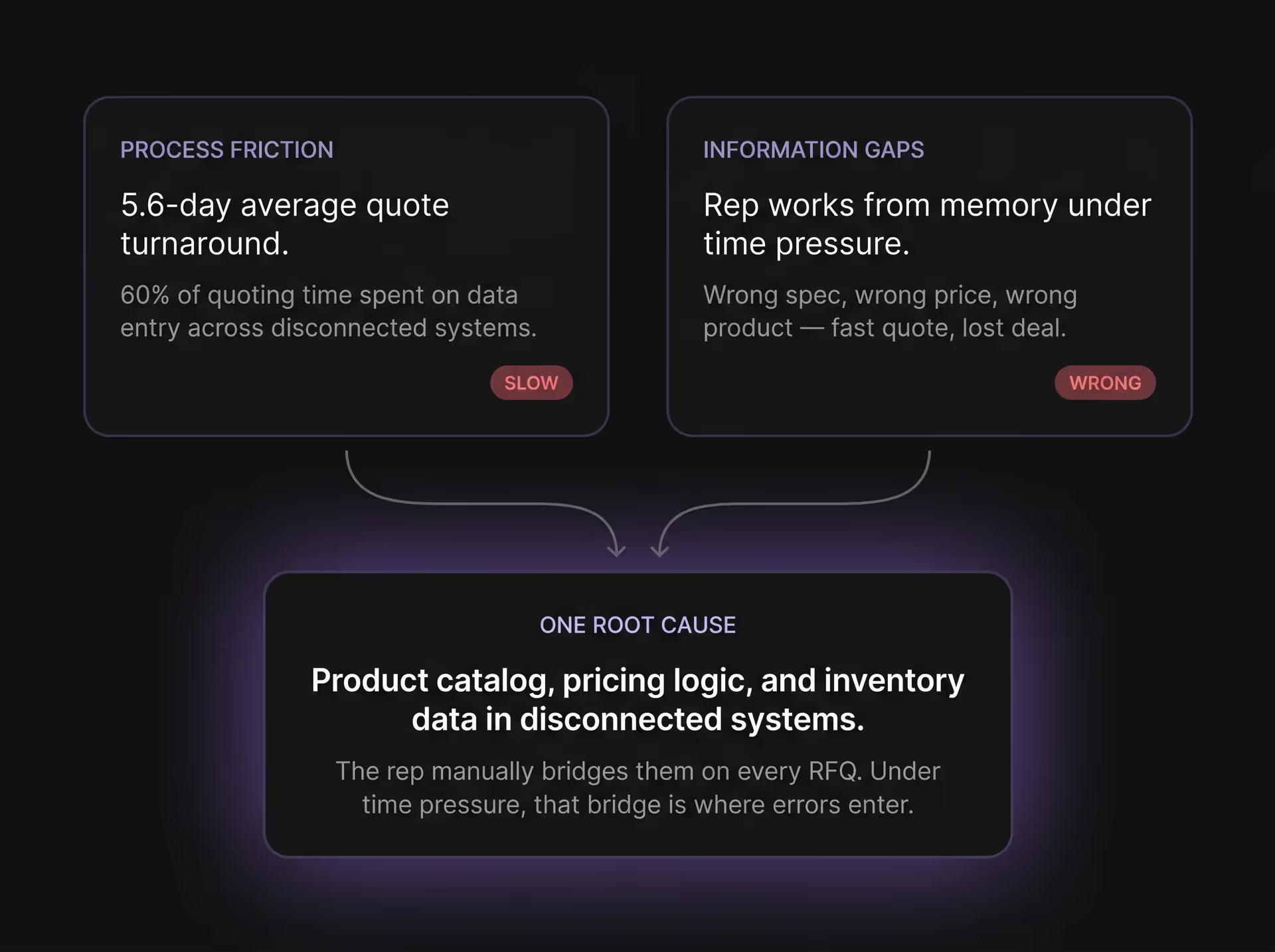
The average manufacturing quote turnaround is 5.6 days, according to Mavlon's analysis of RFQ automation in manufacturing. 60% of that time is spent on data entry — not on pricing judgment, not on engineering review, but on manually extracting information from documents and re-entering it across disconnected systems. Six out of every ten hours your team spends on quoting are spent on data entry. Not on the work that requires expertise. On the work that a connected system should handle.
A single RFQ in a complex manufacturing environment requires a rep to cross-reference product specs in one system, check live pricing in another, confirm inventory availability in a third, and loop in an application engineer for anything outside their immediate knowledge. When everything runs smoothly, that process takes days. When a key person is unavailable or a system is pulling stale data, it takes longer.
As Markovate's research on RFQ automation puts it: the traditional RFQ process is often not integrated with other business systems, leading to inefficiencies and data inconsistencies. The bottleneck is not effort. It is architecture.
The second failure mode is what happens when a rep tries to move fast despite the system working against them. They skip the spec cross-reference. They use a pricing figure from memory. They make a reasonable assumption on a material grade and do not flag it as an assumption.
The quote goes out quickly. It is wrong in ways that may not surface until the buyer pushes back — or worse, places an order that cannot be fulfilled at the quoted price or spec.
As DealHub's research on quote accuracy puts it: a quote is not just a number. It is the foundation of an agreement. When it is off, you are left with two bad options: revise the price and risk upsetting the customer, or absorb the loss. In manufacturing, where buyers are often engineers evaluating technical specifications, a wrong spec does not read as an honest mistake. It reads as a vendor who did not understand the application. That is a trust problem a corrected quote cannot fully undo.
The same dynamic applies at the rep knowledge level — a problem covered in Blog 2 of this series. The accuracy failure at the quoting workflow level and the accuracy failure at the rep specification level are both symptoms of the same root cause: product knowledge not connected to the selling motion.
Process friction and information gaps are both symptoms of the same infrastructure gap: product catalog, pricing logic, and inventory data living in disconnected systems that the rep has to manually bridge on every single RFQ. Fixing one without the other moves the failure mode, it does not remove it.
35 to 50% of B2B sales go to the vendor who responds first, according to research from Google and the Corporate Executive Board. In manufacturing, where buyers are often evaluating near-identical offerings from multiple qualified suppliers, the first-responder advantage is frequently decisive before technical evaluation begins.
Manufacturing compounds this structurally. The average manufacturing sales cycle runs 124 days with a 19% win rate — the longest average cycle and one of the lowest win rates across B2B industries. Those numbers are largely structural and outside a sales team's direct control. RFQ response time is one of the few variables they can actually change.
Deals closed within 50 days carry a 47% win rate. Deals that drag past 50 days see that rate fall to 20%. Speed and accuracy together compress the cycle into the window where win rates are structurally higher. That is not a marginal improvement. It is a structural shift in competitive position.
The immediate cost of an inaccurate quote is visible: the deal stalls, the buyer asks for a correction, the competitor who had it right wins. The downstream cost is less visible and more expensive.
A buyer who receives a wrong quote will factor that into every future interaction. In manufacturing procurement, where approved vendor lists are built over time and relationships carry real switching costs, a trust signal sent at the RFQ stage compounds across the entire account relationship.
Modern Machine Shop's research on manufacturing quoting documents the positive version of this directly: when a manufacturer responds to RFQs faster and more accurately, buyers route future RFQs to them preferentially. As one manufacturer's co-founder put it after addressing their quoting infrastructure: "The quicker you deliver a quote, the more likely you are to win the job." The inverse is equally true. A vendor with a reputation for slow or inaccurate quotes gets fewer RFQs from buyers who have other options.
What is your average time from RFQ received to quote delivered? If you do not know the number off the top of your head, that is the first problem. If you do know it and it is measured in days, that is the second. Here is how to read what the data is telling you.
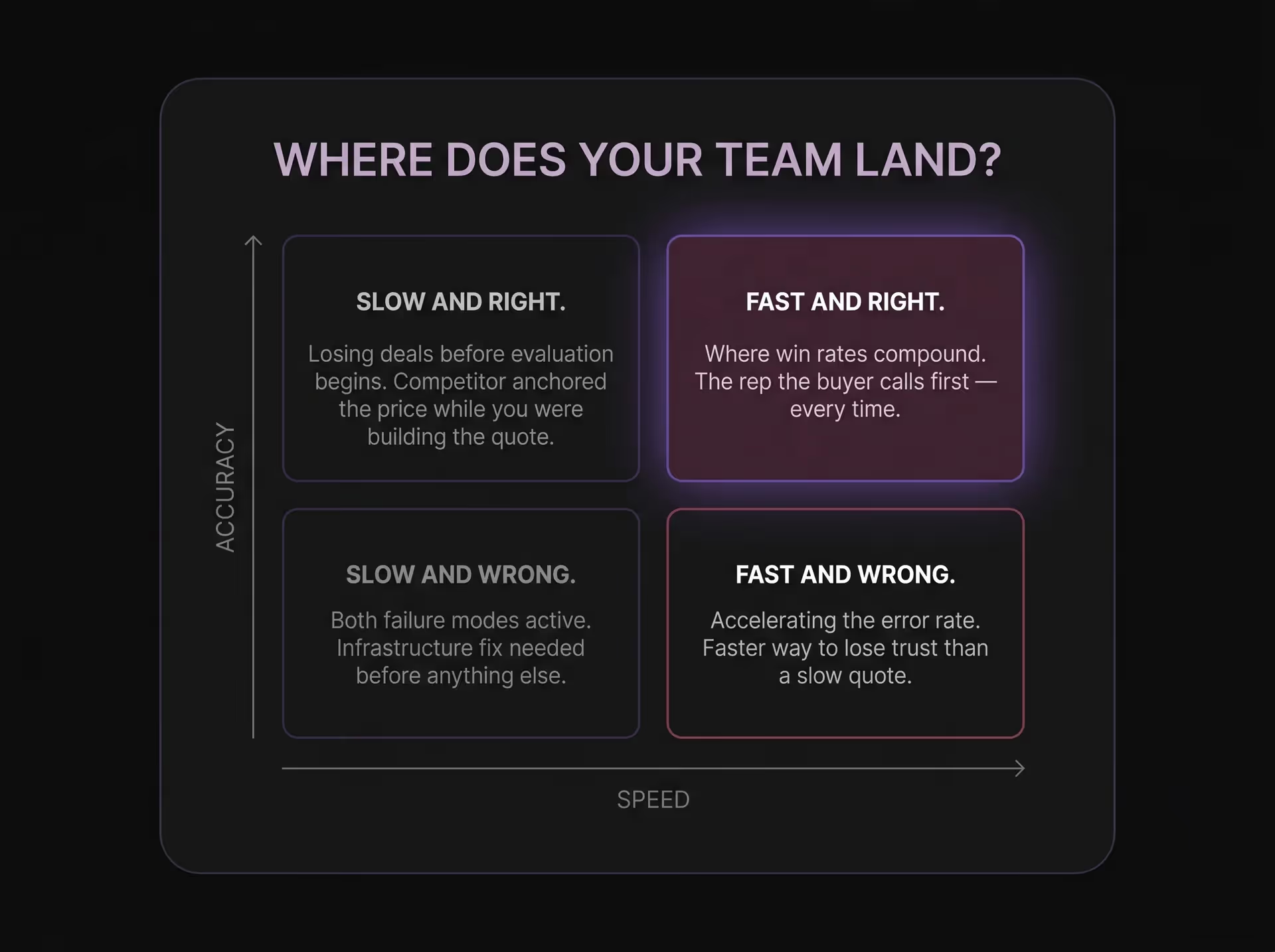
The third row is where most manufacturers with a 6-plus day average cycle land. Not because their team is slow or careless. Because the system requires manual bridging at every step, and manual bridging at speed is where errors enter.
If you have already run a quoting improvement initiative and your win rate did not move proportionally, you fixed the speed problem and left the accuracy problem intact. That is the reader this blog is most useful for — and the infrastructure fix is the same one that would have caught it the first time.
Docket's AI Marketing Agent addresses this as a single infrastructure problem, not two separate initiatives. The governed knowledge layer connects product catalog depth, pricing logic, and inventory availability into one workflow — drawn from approved sources rather than rep memory or open-ended inference. The rep is not guessing. The answer is validated before it reaches the customer. That is what makes speed and accuracy move together rather than trade off against each other.
This is meaningfully different from a CPQ tool or a faster search bar. A CPQ tool manages the quoting process. A faster search returns results more quickly. Docket's governed knowledge layer determines which answer is right for this application, at this tolerance, for this buyer's configuration — before the rep sends it. That distinction is where the accuracy improvement lives.
A faster search returns results more quickly. It does not tell the rep which result is right for this application, at this tolerance, for this buyer's configuration. A rep under time pressure who gets faster search results is still making a judgment call without governed context — and in manufacturing, that judgment call is where errors enter the quote.
Governed product knowledge is different. The answer is drawn from approved, validated sources. It includes application context, not just product specs. It surfaces the right recommendation rather than a list of options for the rep to interpret under pressure. That is the difference between a fast quote that is right and a fast quote that is right enough to go out but wrong enough to cost the deal.
Speed and accuracy are not a tradeoff when the knowledge is governed. They move together because the answer is already validated before it reaches the rep.
A manufacturer Docket works with was fielding 40 to 60 RFQs per week across an inside sales team of six reps. Their average response time was 6.2 days. The bottleneck was not effort. It was that every quote required a rep to cross-reference product specs in one system, check pricing in another, confirm inventory in a third, and loop in an engineer for anything outside their comfort zone.
After consolidating that workflow into a single interface where the rep could match the RFQ to the right product, confirm pricing, and generate a quote without leaving the tool, their average response time dropped below 4 hours. Win rate on competitive RFQs improved by double digits within two quarters.
Same team. Same products. What changed: the infrastructure connecting them to their own product data.
Docket deploys in one to two weeks. The implementation is smaller than most manufacturing teams expect. Connect your product data sources, define pricing guardrails, and go live — typically inside two weeks. The cost of the current system, measured in lost competitive RFQs and quote corrections, is larger than most sales leaders have calculated.
The first-responder advantage is real and documented. But it only converts if the quote that goes out in that window is accurate enough to advance the conversation. A fast wrong quote wastes the first-responder position. A fast accurate quote uses it.
Manufacturing's 124-day average sales cycle reflects procurement complexity, stakeholder sign-offs, technical evaluation cycles, and capital expenditure processes that a sales team cannot simply eliminate. Most of that cycle is outside the rep's control.
RFQ response time is not. It is one of the few variables in the manufacturing sales motion that a sales team can measurably improve within a quarter. And the data shows that improvement at the RFQ stage compresses the total cycle into the window where win rates are structurally higher. Deals that close within 50 days close at 47%. Deals that drag past 50 days close at 20%. Faster and more accurate at the RFQ stage means more deals closing in the high-win-rate window.
The compounding effect runs further than the single deal. Manufacturers who consistently respond quickly and accurately build a reputation among their buyer base that generates more RFQs over time. Buyers route requests to vendors they trust to answer well and fast. A vendor who earns that reputation is receiving more RFQs than they would otherwise, at a higher win rate, from buyers who are not running the same request to five other suppliers simultaneously.
It does under the current system, because speed and accuracy are in tension when the rep is manually bridging disconnected systems. Under time pressure, reps skip verification steps. When product data, pricing logic, and inventory status are connected in a governed workflow, speed and accuracy are no longer in conflict. The answer is already validated before the rep sends it. The only thing moving faster is the delivery.
No. The fix is not replacing the quoting tool — it is the governed data layer underneath it. Most manufacturers have a quoting system. What they are missing is a validated connection between that system and their product catalog, live pricing, and inventory data. Connecting that layer is a different project than a quoting platform replacement, and significantly smaller.
A product database tells you what exists in your catalog. Governed product knowledge tells you what to recommend for this application, at this tolerance, at this price, drawn from approved and validated sources rather than open-ended search results or rep memory. The database is the raw material. Governed product knowledge is the database made accurate and accessible at the moment of the RFQ — without requiring the rep to already know the answer or make a judgment call under time pressure.
The first 60 minutes after an RFQ lands are worth more than the next 60 days. But only if the quote that goes out in that window is right.
Docket's AI Marketing Agent connects your product catalog, pricing logic, and inventory data into a single governed workflow so your reps go from RFQ to accurate quote in minutes, not days. See how manufacturers are cutting quote cycles from days to under 4 hours while improving win rates on competitive RFQs.
See how it works at docket.io/request-for-demo
Related reading:
Why Speed-to-Quote Is the #1 Win Rate Variable in Manufacturing Sales — the case for fixing the speed problem first, before this one applies.
Deep Catalog. Shallow Reps. Why Manufacturing Sales Teams Lose on Specification — the accuracy problem that lives at the rep level, not the quoting workflow level.
How Manufacturers Lose Revenue in Accounts They Think They Own — what happens to the deals you win when account expansion stays unmapped.