Why Speed-to-Quote Is the #1 Win Rate Variable in Manufacturing Sales
April 23, 2026




It's Tuesday morning. A procurement manager at a mid-size OEM sends out three RFQs. Your application engineer pulls specs from the PLM, checks ERP for pricing, loops in inside sales for margin guidance, and gets back to the customer by Friday. Clean execution. Solid quote.
By Thursday, a competitor responded. The buyer already had a number to anchor on. Your quote arrived into a deal that had quietly started without you.
This is not a story about losing on price. It's about being disqualified before the evaluation even began.
Speed-to-quote has become the first filter in manufacturing sales. Before price, before relationship, before product fit. This post breaks down why the 4–8 day cycle is a structural liability, what it actually costs you, and what manufacturers who've fixed it did differently.
Most manufacturers don't have a bad quoting process. They have a slow one and for good reason.
A single RFQ requires pulling engineering specs, cross-referencing live pricing, checking inventory availability, and often getting a sign-off from someone in applications or engineering. When everything goes right, that takes a few days. When your key estimator is out, or the ERP is pulling stale data, it takes longer.
SimScale describes the structural problem clearly: traditional RFQ processes "often stretch over several days or even weeks, involving multiple handoffs between engineering, simulation and commercial teams. Each step is typically done manually and across disconnected tools."
That's not a people problem. It's a systems problem. And it has a compounding cost most sales leaders haven't fully priced in.
The Revalize Smart Manufacturing Report 2026 found that 100% of manufacturing leaders surveyed are using AI in some form but only 10% have it embedded across their operations.
That gap between knowing AI matters and deploying it inside the sales motion is precisely where deals are being lost. A separate survey of 200 manufacturing decision-makers found 91% are now actively adopting AI-powered sales automation, with AI-driven pricing tools as the top priority.
Knowing and doing are separated by a very specific problem: the quoting workflow still runs on disconnected systems and manual handoffs.
The first vendor to submit a quote wins 50% of purchasing decisions in manufacturing. That's not an argument for rushing bad quotes out the door. It's an argument for removing structural delays that have nothing to do with quote quality.
AI quoting tools and CPQ platforms reduce sales cycle time by 28% and enable companies to generate quotes up to 10x faster. Oracle customers who integrated AI-powered CPQ saw self-generated quotes jump from 2% to 79%. One SAP CPQ deployment cut time-to-quote from 4 hours to 15 minutes, while generating 70% more quotes overall.
Manufacturers who respond quickly also price their products up to 3% higher without losing deals. Speed commands a pricing premium.
The obvious cost is lost deals. The less obvious cost is what the slow cycle does to the deals you do win.
When you're last to quote, buyers use your number to negotiate down the competitor's. You didn't just lose the deal — you subsidized the discount.
Application engineers are not cheap. They're also not built to spend their afternoons pulling specs from three systems and reformatting pricing tables.
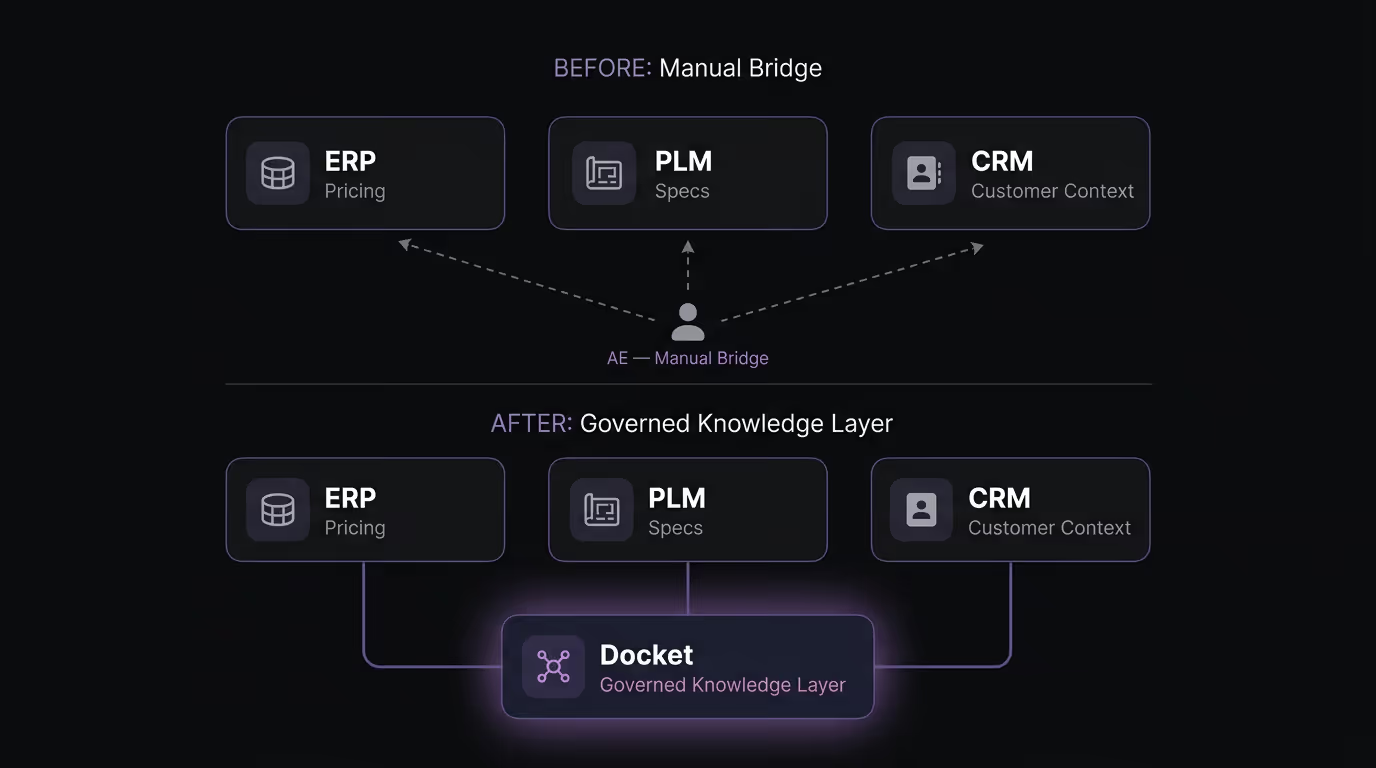
The root cause is consistent: product specs, pricing logic, and inventory data live in separate systems. The AE is the manual bridge between them. When that bridge is rebuilt in software — with governed product knowledge and pricing logic connected into a single workflow — AEs return to the technically complex RFQs where quality of response is the actual differentiator.
Sales productivity increases 5–10% when manufacturers cut quote response times. The leverage isn't in working harder — it's in removing the lookup-and-wait workflow that governs every quote today.
Before looking at solutions, it's worth knowing where you're starting from. The metric that matters: what percentage of your RFQs get a same-day response?
Average quote cycle length is a lagging indicator. Same-day response rate is the leading one — it tells you whether you're entering deals or being filtered out before they start.
Most manufacturers with a 4–8 day average cycle land in the first bucket. Not because their team is slow. Because the system requires it.
One manufacturer Docket works with (complex product line, hundreds of active SKUs, application engineers fielding 20+ RFQs a week) was running an 8-day average quote cycle. After connecting product data, engineering specs, and pricing logic into a single governed workflow, their quote turnaround dropped to under an hour. Spec retrieval, pricing context, and product configuration became accessible to reps and AEs in real time — without cross-system lookups or senior engineering availability as prerequisites.
Same team. Same products. What changed: the infrastructure connecting them to their own data.
"If you already have a CPQ tool, this isn't a replacement. It's the layer that makes your CPQ faster to populate and your reps faster to respond."
The common thread: The team didn't change. The infrastructure connecting the team to their own product data did.
IDC predicts that by 2027, 40% of all operational manufacturing data will be integrated autonomously by AI agents — the ERP, PLM, and CRM silos that make quoting slow today will largely dissolve. The AI in the manufacturing market is on track to grow from $5.32B in 2024 to $47.88B by 2030.
The manufacturers connecting their systems now are building a compounding data advantage. Docket deploys in days to weeks — connect your product data sources, define pricing guardrails, and go live. The implementation is smaller than most teams expect. The cost of the current system is larger than most sales leaders have measured.
Does faster quoting mean less accurate quoting?
Not when your systems are connected. Accuracy problems come from manual data entry and outdated pricing tables — both worsen under time pressure. When spec retrieval and pricing logic are governed in a single workflow, speed and accuracy move together.
Do I need to replace my CPQ to fix my quote cycle?
No. Most manufacturers with an existing CPQ tool have a data access problem, not a CPQ problem. A governed knowledge layer that connects your product data to existing tools fixes the bottleneck without replacing the system.
What's a good benchmark for manufacturing quote cycle time?
World-class is under 4 hours for standard configurations. Competitive is same-day. A 4–8 day cycle puts you at structural risk in any competitive RFQ situation — the evaluation may already be anchored by the time your quote arrives.
Docket connects product data, engineering specs, and pricing logic so your reps respond to RFQs in minutes — not days. See how manufacturers are cutting quote cycles from 8 days to under an hour, and what that does to win rate.