


You spent most of last quarter’s budgets on running a cross-platform retargeting campaign. Your team and agencies refined the targeting. In fact you watched the right accounts show up at your core product pages. And still, your CRM has nothing to show for it.
Here is what is actually happening. By the time a buyer lands on your website in 2026, they have already done most of their research. They used AI to build a shortlist. They found pricing ranges in Reddit threads. They read peer reviews. They are not at the beginning of an evaluation. They are near the end of one. And the only thing waiting for them is a form that cannot answer a single question they have.
A form is a commitment for a buyer who is still deciding. For the small fraction who had already chosen you, it works fine. For everyone else, it is a wall.
The standard fixes do not solve this. Fewer fields, faster follow-up, a lighter CTA. All of that optimizes the capture mechanism for the buyers who were going to convert anyway. None of it touches the larger group who showed up with intent, found nothing useful, and left quietly.
These 7 tactics build the capture layer for the buyers your form never had a chance with.
1. Stop Waiting for the Form. Start Reading the Room.
The form sits at the end of a buyer journey that increasingly bypasses forms entirely.
Approximately 98% of B2B website visitors leave without converting, according to HubSpot data putting the average B2B website conversion rate at 2.4%. Not because they lacked intent. Because the only thing waiting for them was a form, and a form is a terrible tool for a buyer who is still evaluating. It was designed for a buyer who already decided. Someone who had done the research, chosen a vendor, and was ready to raise their hand. For that buyer, it works. It is a handoff mechanism.
For everyone else, it is the wrong ask at the wrong moment.
High-intent buyers do not arrive on your website looking for a sales call booking. They arrive looking for an answer to a specific question your content probably did not answer. They want to know if the integration works for their stack. Whether the pricing makes sense for their team size. Whether the security posture will survive their procurement process. The form cannot tell them any of that. It can only ask who they are.
The capture opportunity is not in the form. It is in the conversation that replaces it.
What most teams get wrong: they optimize the form. Fewer fields, a cleaner layout, a more prominent submit button. That helps the 2% who were already going to convert. The other 98% do not have a form problem. They have a conversation problem, and no amount of field reduction solves it.
2. Answer the Question They Came to Ask (Before They Go Find It Elsewhere)
A visitor lands on your integration page. They want to know whether your product connects to HubSpot natively or through a workaround, whether the sync is bidirectional, whether setup needs a developer. The page has a paragraph of marketing copy, a "Learn more" link, and a contact form. They leave.
Most teams treat this as a content problem. More copy, a longer FAQ, a downloadable integration guide. None of that helps the buyer who came with a specific question about their specific setup. They did not want a document. They wanted an answer.
What actually solves it is replacing passive pages with conversational surfaces that can answer real evaluation questions from your governed knowledge — your approved product specs, pricing logic, integration details, security posture — not from open-ended AI inference. Not "chat with us." Not a decision tree that hits an edge case and hands them back to a form. An AI Marketing Agent that can actually answer: does this integrate with HubSpot? How does pricing work for a 200-seat team? What is your SOC 2 status?
Picture the same integration page, 2pm on a Tuesday. The buyer has twenty minutes between meetings and one specific question: does your product sync bidirectionally with Salesforce, or does data only move one way? The page has a feature list, a "Learn more" link, and a contact form. The answer is not there. They open a competitor's page. The competitor's agent tells them: "Yes, bidirectional sync with Salesforce. Real-time, no-code setup, field mapping takes about fifteen minutes to configure. Want me to show you what that looks like for a RevOps team?" The answer your page could not give just moved a deal.
When a buyer's real question gets a real answer instead of a gate, conversation start rates reach 36% compared to 13% on legacy form flows, observed across Docket deployments. That gap is not explained by traffic quality. It is explained by what happens when the page can actually do its job.
What most teams get wrong: they confuse having a chat widget with being able to answer questions. A widget that opens a text box and routes to an offline rep is not answering anything. It is a more interactive version of the same dead end.
3. Engage at 11pm When No Human Is Watching
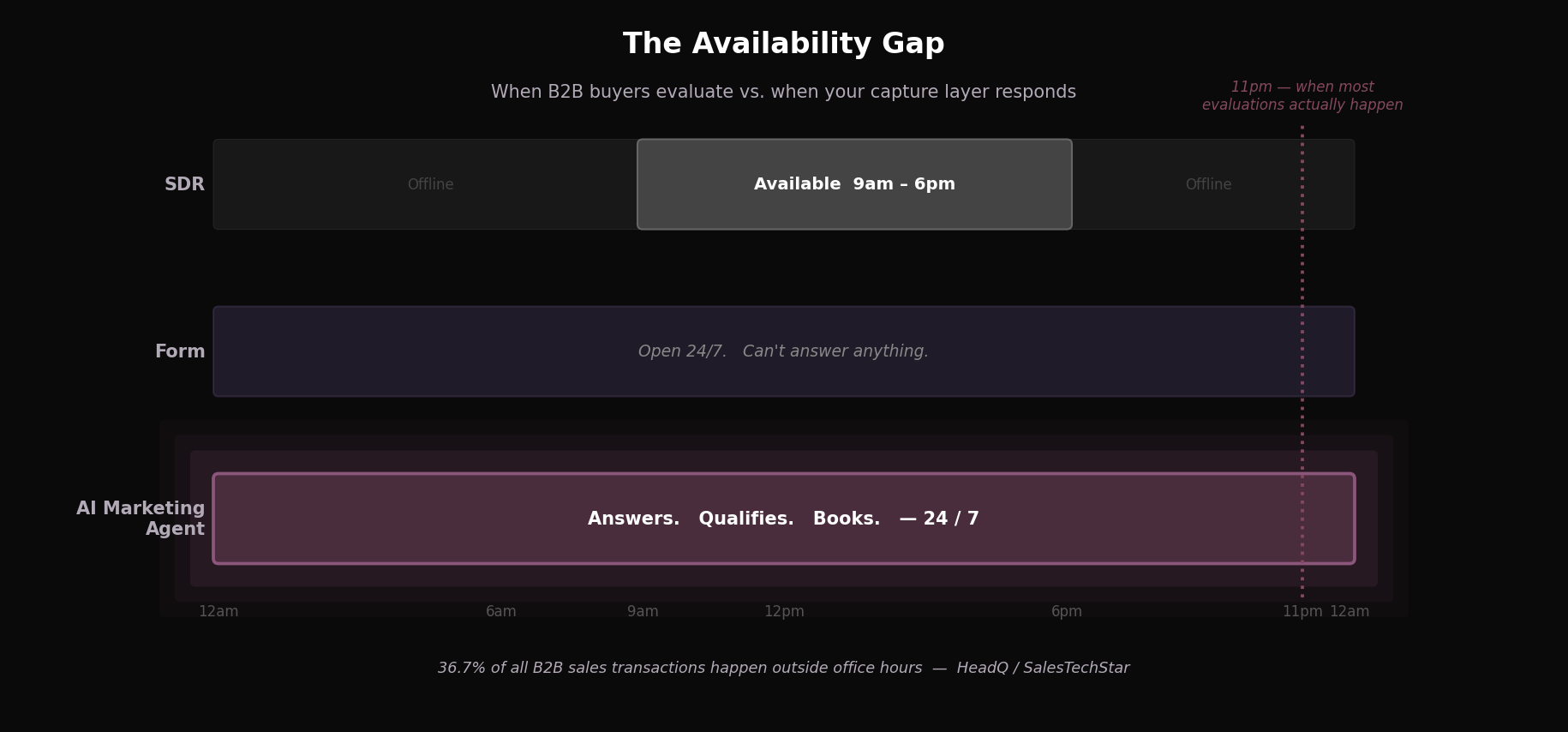
It is 11pm. A buyer is on your product pages, then your pricing page, then your security documentation. They have the time, the intent, and the question. Your form has none of the answers.
B2B buying research does not happen on your sales team's schedule. It happens when buyers have uninterrupted time to think: evenings, early mornings, weekends. This is when evaluations actually happen and comparisons get built. And this is the exact window that forms, SDRs, and copilots all miss in the same way. They require a human to be present before anything useful can happen.
Your form is open at 11pm. Your SDR is not. Your automation will fire a follow-up email the next morning. The buyer who had intent and time at 11pm has moved on by the time anyone responds. Factors.ai, a Docket customer, reported that 77% of their high-value conversations with Docket's AI Marketing Agent happened outside business hours. That is not a quirk of their audience. That is when B2B buyers evaluate.
Buyers evaluate at 11pm. Forms do not answer questions. Copilots wait for humans. The AI Marketing Agent does not.
An always-on AI Marketing Agent runs the full engagement motion without a human in the loop at each step. It answers the question, qualifies the intent, and books the meeting. The meeting is in the calendar before your team checks messages in the morning.
What most teams get wrong: "always-on" gets interpreted as "available." A form is available 24 hours a day. Availability is not the problem. The problem is that nothing available at 11pm can do anything useful with a buyer's intent. Speed of response is no longer the differentiator. As Docket's research argues, speed-to-lead is dead. The companies winning inbound in 2026 are not the ones who reply fastest. They are the ones who resolve the buyer's question at the moment it is asked, without a human needing to be present to do it.
4. Give the Anonymous Visitor a Reason to Reveal Themselves
A visitor hitting your highest-intent pages without identifying themselves is one of the strongest signals in B2B inbound. They are evaluating. They are just not ready to tell you yet. They have not identified themselves. They do not need to yet. What they need is a reason to.
The default capture motion gets this backwards. Asking for name, company, job title, and phone number before answering a single question is the B2B equivalent of asking someone's annual income before saying hello. It signals immediately that your CRM hygiene matters more than their time. Buyers who have any alternative will find it. In 2026, they all do.
Invert the sequence. Give value first. Answer the question that brought them to the page and confirm the use case is a fit. By the time you ask who they are, identification feels like a fair trade rather than a toll — they are continuing a conversation that has already been worth having, not surrendering contact information to access a gate.
The goal is not to trick them into identifying. It is to make the conversation worth having before asking who they are. Docket's AI Marketing Agent qualifies intent inside the conversation, not through a pre-conversation gate. By the time a buyer shares their email, the agent has already established that there is a reason to continue.
What most teams get wrong: the opportunity to capture anonymous B2B website visitors gets misread as a low-intent traffic problem. It is not. It is unidentified traffic. Your most serious evaluators are often in that group. They are just not ready to hand over contact information to a process they do not trust yet.
5. Turn the Pricing Page Into a Conversation, Not a Dead End
A pricing page visit with no conversion is one of the most expensive moments in B2B inbound. This is your highest-intent page. The buyer came to evaluate cost. And they left without a conversation.
Here is what buyers are actually trying to do on your pricing page: build a business case. They want ROI framing. They want to understand what the tiers look like for a team their size. They want to know what "contact sales" means in terms of timeline and commitment. Your pricing page usually answers none of that. It shows numbers without context and then asks buyers to give up their contact information to get the context they came for.
Most B2B buyers in 2026 have been through this enough times to know what a pricing page that ends in a form actually means: a discovery call with an SDR before they find out if the product even fits their budget. That is not a conversion problem. That is a trust problem built up over years of pricing pages that promised answers and delivered gates.
Pricing pages fail not because buyers do not want pricing. They fail because buyers want context with the pricing, and the page cannot give it.
The fix is a real-time ability to get ROI framing, compare tiers, and understand what a business case looks like for their situation. Not a "talk to sales" button. A conversation that helps the buyer justify the number internally, which is the actual job they showed up to do. Docket customers who removed this friction point observed 40 to 60% higher website conversion from the same traffic, varying by ICP and agent configuration.
What most teams get wrong: pricing page optimization gets treated as a design problem. Clearer tier names, a comparison table, a cleaner layout. All of that helps buyers who already have enough context to self-select. None of it helps the buyer who needs a conversation to get there, and that buyer is the one the page is currently losing.
6. Make the Returning Visitor Feel Recognized
This visitor came back. They are comparing. They are building a shortlist or an internal recommendation. And most B2B websites respond to that signal by serving them the generic opener they got on visit one.
A buyer moves from your security documentation to your pricing page three days later. That path is one of the clearest buying signals in B2B sales. Your website responds with: "Hi, what brings you here today?" as if the previous visit never happened. That is not a neutral experience. It is a signal that nothing on the website remembers them.
When the agent remembers where the visitor has already been, the conversation changes entirely. A returning visitor who previously read your compliance docs should not start from scratch.
That is the agent doing what a good rep would do if they remembered the call. Not starting from zero. Not re-pitching what the buyer already knows. Picking up the thread.
Docket customers who deploy session context continuity observe approximately 15% more pipeline at the top of funnel and 12% higher win rates, observed across deployments. The rep starts the first call with context rather than a blank slate. That changes the quality of the conversation before it begins.
What most teams get wrong: personalization gets interpreted as dynamic content, swapping a headline based on ad source or showing a different hero image by industry. What matters at the conversion layer is conversational continuity. The agent knowing where this buyer has already been and continuing from there, rather than pretending it is the first visit.
7. When They Reach the Form and Still Don't Submit, Offer a Better Path
A form page visit followed by abandonment is the highest-intent, highest-friction moment in B2B inbound. This visitor wanted to engage. The form stopped them.
The standard response is to optimize the form. Reduce the fields, improve the CTA, add social proof near the submit button. These produce marginal improvements for buyers who were borderline. They do nothing for the buyer who decided that what they would have to give up was not worth the uncertainty of what came next. No clarity on whether they would get a useful conversation or five nurture emails. No window into the process they were entering.
That buyer did not abandon because the form was too long. They abandoned because the form is a gate with no window. You cannot see what is on the other side before you walk through.
What actually works: a proactive open question that replaces the gate with a genuine conversation. "What are you trying to figure out right now?" converts better at this stage than "Fill in these 7 fields." Not because it is friendlier. Because it moves qualification into the conversation rather than before it. The agent qualifies in the flow. The form qualifies at the gate. The gate loses.
The output of that conversation is an Agent Qualified Lead (AQL). It is a lead that entered qualification through an agent (like a conversation with Docket AI marketing agent) rather than a form, with intent documented, use case confirmed, and next step already agreed between buyer and agent.
In Docket's Conversion Patterns Report, drawn from 4,736 real buyer conversations, 91% of conversations that end with a qualified lead include a concrete next step, compared to 13% in conversations that do not convert. An AQL captures that forward motion: use case confirmed, constraints surfaced, next step explicitly requested by the buyer. Not a contact name with blank fields. A context card the rep can actually use.
What most teams get wrong: form abandonment is a trust problem, not a UX problem. The buyer was not deterred by the field count. They were deterred by the uncertainty of what followed. A cleaner form is still a gate.
The Pipeline Is Not Missing. It Is Leaking.
The point is not that forms are dead. It is that forms were never designed for the 95% of buyers who are not ready to commit on your timeline.
These 7 tactics build a capture layer for the buyers who show up, evaluate seriously, and leave quietly. That is where your next pipeline is sitting. Not in more traffic. Not in campaign optimization. In the conversations your website is currently not equipped to have. Every buyer in these seven sections landed on your website this week. Most left without a trace. The difference between the teams that captured them and the teams that did not was not budget, traffic volume, or campaign sophistication. It was whether the website could respond.
See what Docket's AI Marketing Agent does when a high-intent visitor will not fill your form.