Buying Signals in B2B Sales: 15 Behaviors That Predict Purchase Intent (Before the Demo Request)
April 8, 2026




TL;DR
The conventional playbook says: wait for the prospect to ask about pricing, mention a timeline, or request a demo. If they do any of those things, they're "hot." If not, keep nurturing.
But by the time a buyer explicitly signals intent, they've often already shortlisted your competitors. The real signals (the ones that predict purchase intent before a hand-raise) are quieter, earlier, and far more telling. A sudden spike in stakeholder logins. A shift from product pages to security documentation. A rep getting cc'd on an internal forward.
The problem isn't that buyers hide their intent. It's that most revenue teams have defined "buying signal" too narrowly, and built their qualification process around the loudest signals rather than the most predictive ones.
Here's a more complete picture of what to watch for and why catching signals early is the difference between leading a deal and chasing one.
The average B2B SaaS website converts just 1.1% of visitors into known leads. That means 98.9% of traffic (the traffic you paid to acquire) walks away without a trace.
Research consistently shows that 84% of buyers have already chosen a likely vendor by the time they surface to sales (6sense, B2B Buyer Experience Report, 2024). Buyers spend only 17% of their total purchase time meeting with suppliers. The rest is independent research: documentation, integrations, security posture, peer reviews.
The qualification window most teams optimize for starts too late.
The gap isn't a training problem. It's structural.
Sales systems capture one category of event: post-conversion. A form fill. A booked meeting. A reply to a sequence. Everything before that — research sessions, pricing comparisons, security reviews, multi-stakeholder reads — leaves no trace in a CRM.
Buyers begin their evaluation on Perplexity, G2, and review sites. They visit your site across multiple sessions, across multiple stakeholders, often outside business hours. A buyer can complete 70% of their decision-making process (6sense, 2024) while your team has no record of their existence.
The signals were always there. The problem is the system built to capture them was designed for a different era.
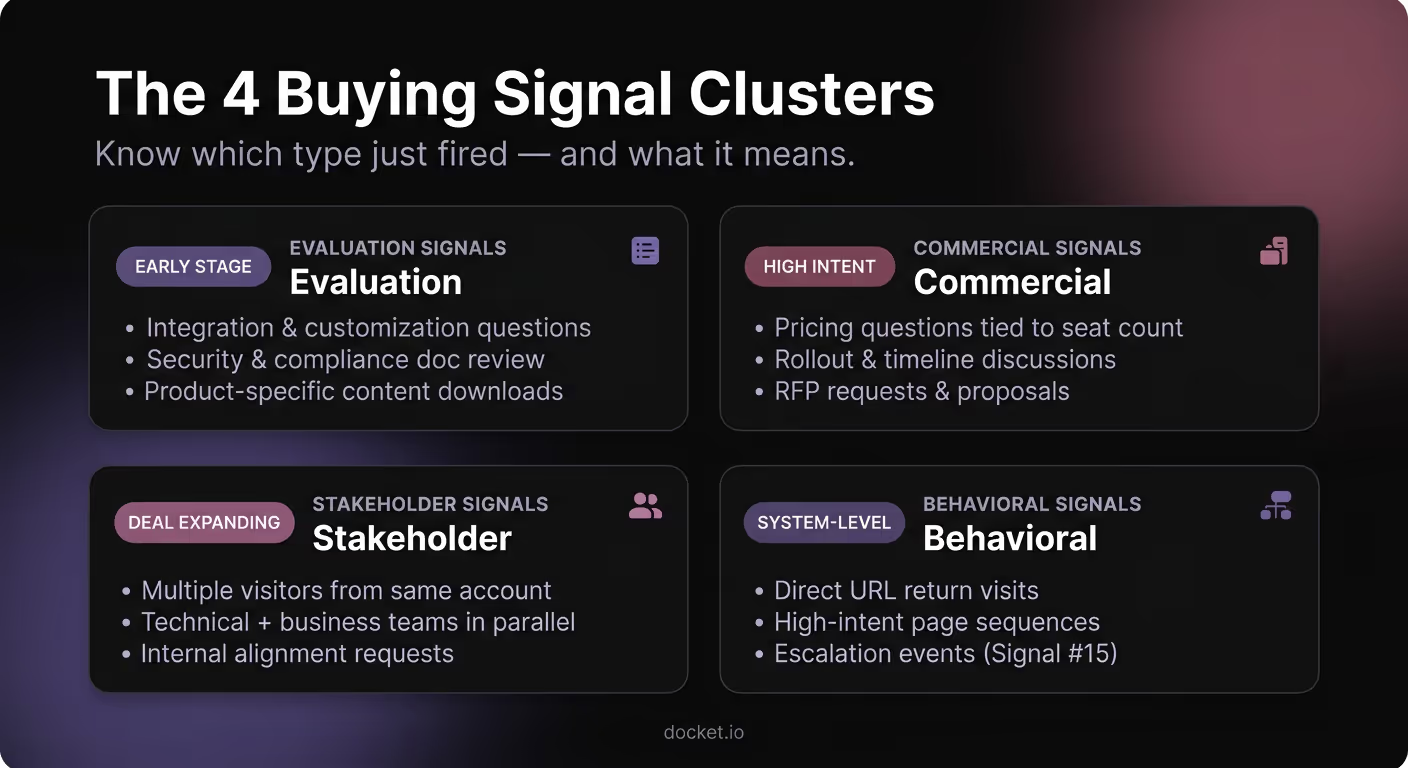
These appear when a buyer is actively assessing fit not browsing, but validating.
When a prospect maps your product against their existing stack, they're not curious. They're scoping implementation. This is one of the strongest early signals in B2B SaaS, where technical fit determines deal viability.
When this fires and nothing responds: Buyer maps your competitor's integrations instead.
A move from marketing pages to technical documentation signals a shift from awareness to evaluation. Security reviews almost always involve procurement, legal, or IT — the buying committee is already assembling.
When this fires and nothing responds: Compliance questionnaire goes to a competitor.
Release notes. Integration guides. Data model documentation. Depth of engagement that casual visitors don't reach. If they're reading your changelog, they're past curiosity.
Repeat visits to the same pages — pricing, integrations, specs — mean the buyer is checking facts, not learning for the first time. They're confirming what they've already told someone internally.
Not brand awareness content. Product-specific sessions indicate a buyer evaluating operational fit, not building category familiarity.
These indicate the buying conversation has moved internal to the prospect's organization.
"What does this cost at 500 seats?" is a different question from "how much does this cost?" The first reveals that someone has already socialized the idea internally and is building a business case.
Questions about implementation time, onboarding requirements, or go-live expectations mean the buyer has mentally moved past 'should we buy this' to 'when could we start.'
The most explicit commercial signal. By this point, the shortlist is built. The conversation is about execution details.
These reveal that the deal has expanded beyond a single champion.
When two, three, or four people from the same company visit your site within a short window, the champion has brought the product to an internal discussion. This is the highest-confidence signal of active evaluation.
A DevOps lead reviewing API documentation while a VP of Finance reviews the pricing page — simultaneously — is parallel due diligence. The committee has started its work.
When a prospect asks to include additional stakeholders on a call, brings in procurement, or requests materials formatted for executive review, the deal is being presented internally.
These require system-level visibility to see, but they're among the most reliable predictors.
A prospect returning two or three times in a week is filling in gaps, validating information, or preparing for a decision conversation. The pattern indicates active comparison, not passive interest.
When someone types your URL directly, they remember you specifically. They've put you on a shortlist and are coming back deliberately. That's recall — not discovery.
Blog post → product page → pricing → security documentation. That journey is a qualification happening in real time. The pattern matters more than any single page view.
When a buyer asks a question that requires a human — something outside standard scope, high-stakes, or unusually specific — that escalation event is itself a signal. It indicates a buyer whose requirements have moved beyond standard evaluation.
Generic agents deflect or hallucinate. A governed agent flags and escalates. That flag tells you: this buyer has a question that matters, asked at a moment your team wasn't watching.
Escalation isn't failure. It's one of the highest-confidence intent signals in the set — and it doesn't exist in the playbook of any legacy inbound motion.
The more important question — and the one this post exists to answer.
The buyer is assessing fit, not browsing. The right response is a precise, product-accurate answer — not a capabilities overview. If a buyer reviews your security documentation, the response that advances the deal is one drawn from your actual compliance posture: your SOC 2 status, your architecture, your certifications. A generic response raises doubt. A governed response builds it.
The buyer has already socialized internally. They need accurate pricing for a specific context, and they need it now — not in a follow-up email 18 hours later. The rep who receives this lead should know the seat count discussed, the timeline mentioned, and the urgency level before they dial.
Multiple stakeholders from the same account in a 48-hour window is one of the highest-priority triggers in B2B sales. The right action isn't a spray-and-pray sequence. It's an account-level alert with session context: who visited, what they reviewed, and in what order.
Off-hours, direct-return, high-intent page sequences are the buyer's research sprint. The right system doesn't wait for business hours. It engages when the signal fires, qualifies intent in the conversation, and hands off to a rep with a full context summary — not a name and email.
Most teams don't have this. The average B2B SaaS website captures 1.1% of visitors as known leads. The other 98.9% leave without a record. That's not a sourcing problem. It's a signal-capture problem.
When a signal fires and a governed AI agent engages, the output isn't a contact record. It's an Agent-Qualified Lead (AQL): a lead with context.
Here's what the rep receives:
→ This is what the rep receives. Not a name and email. A head start.
The difference between a form fill and an AQL is not the quantity of data. It's the quality of context.
For a deeper look at how the AQL fits into a broader inbound qualification model, see: The MQL Didn't Die — It Just Needed a Better Architecture → docket.io/blog
Q: What is a buying signal in B2B sales?
A: A behavior that indicates evaluation momentum — a pattern of actions that precedes a purchase decision. Unlike hand-raises (form fills, demo requests), the most predictive buying signals appear earlier, often anonymously, before a buyer contacts a vendor.
Q: How do I track buying signals automatically?
A: Most teams can't, with legacy tooling. CRMs capture post-conversion events. Website analytics show page views without account identity. Capturing signals at the account level — multi-stakeholder visits, return sessions, high-intent page sequences — requires either a de-anonymization layer (like 6sense or Clearbit) or an AI agent that engages buyers in real time and logs intent into a structured handoff.
Q: What's the difference between a buying signal and a behavioral trigger?
A: A behavioral trigger is a single action (a page view, a click). A buying signal is a pattern — multiple actions across time, stakeholders, or pages that together indicate decision momentum. Multi-stakeholder visits (Signal #9) is a buying signal. A single visit to a blog post is not.
Q: Which buying signals are highest priority?
A: If you can only act on a few: multi-stakeholder site activity (Signals 9–10), pricing questions tied to scale (Signal 6), and escalation events (Signal 15). These three have the highest correlation with deals already in active internal review.
Q: Can I detect buying signals without an AI agent?
A: Partially. Commercial signals (6–8) often surface in rep conversations. Stakeholder expansion (Signal 11) can be tracked in CRM if stakeholders are known. What's nearly impossible without an agent: Signals 1–5, 12–14, and 15 — these require real-time visibility into anonymous sessions, off-hours activity, and conversation-level intent.
Q: How do I distinguish a genuine evaluation signal from noise?
A: Context and pattern. A competitor visiting your pricing page is a data point. A new account visiting your pricing page, security documentation, and API docs across three sessions and two stakeholders in 72 hours is a pattern. Systems that aggregate account-level behavior over time surface signal. Systems that look at individual page views surface noise.
The signals in this list are happening on your website right now. Most of them are leaving no record.
If you want to see what an AI agent that catches, interprets, and acts on buying signals looks like in a live deployment (not a demo script, an actual conversation), see Docket in action → docket.io