Speed to Lead is Dead
March 2, 2026



For years, B2B marketing and sales leaders have been conditioned to worship at the altar of speed-to-lead.
The logic was simple and powerful: the faster you respond to an inbound lead, the more likely you are to convert them. And the data backed it up. Responding within five minutes could make you nine times more likely to convert a lead[1]. Waiting longer meant watching your pipeline evaporate as competitors beat you to the punch and buyer intent decayed.
But in 2026, that playbook is officially obsolete. The rise of AI has turned instant responses into a commodity. Nearly every website has a chatbot or an AI agent that can reply in seconds. Speed is no longer a differentiator; it is the bare minimum.
The new competitive frontier isn't how fast you respond — it's how much value you deliver in that first interaction. That's the era of speed-to-value, and it's already here.
Speed-to-value isn't just a better metric. It's the defining output of Agentic Marketing — where agents execute value delivery instantly, under human governance, without a human in the loop for every answer.
The obsession with speed-to-lead was born from a real problem.
The average B2B company still takes a staggering 42 to 47 hours to respond to a new lead[2, 3]. Even worse, a shocking 55% of companies take five or more days to follow up, and nearly a third never respond at all[4].
This created a massive opportunity for first-movers. Companies that invested in tools to shorten their response times saw incredible returns. The data is compelling:
These statistics fueled the adoption of rule-based chatbots and, more recently, first-generation AI Sales Development Representatives (SDRs). They solved the speed problem, ensuring no lead was left waiting. But in doing so, they created a new, more subtle problem: the illusion of engagement.
Today’s buyers are met with instant responses, but these interactions are often shallow and unfulfilling. Most chatbots are little more than glorified forms, asking a series of canned questions before defaulting to the dreaded, “Someone from our sales team will get back to you.”
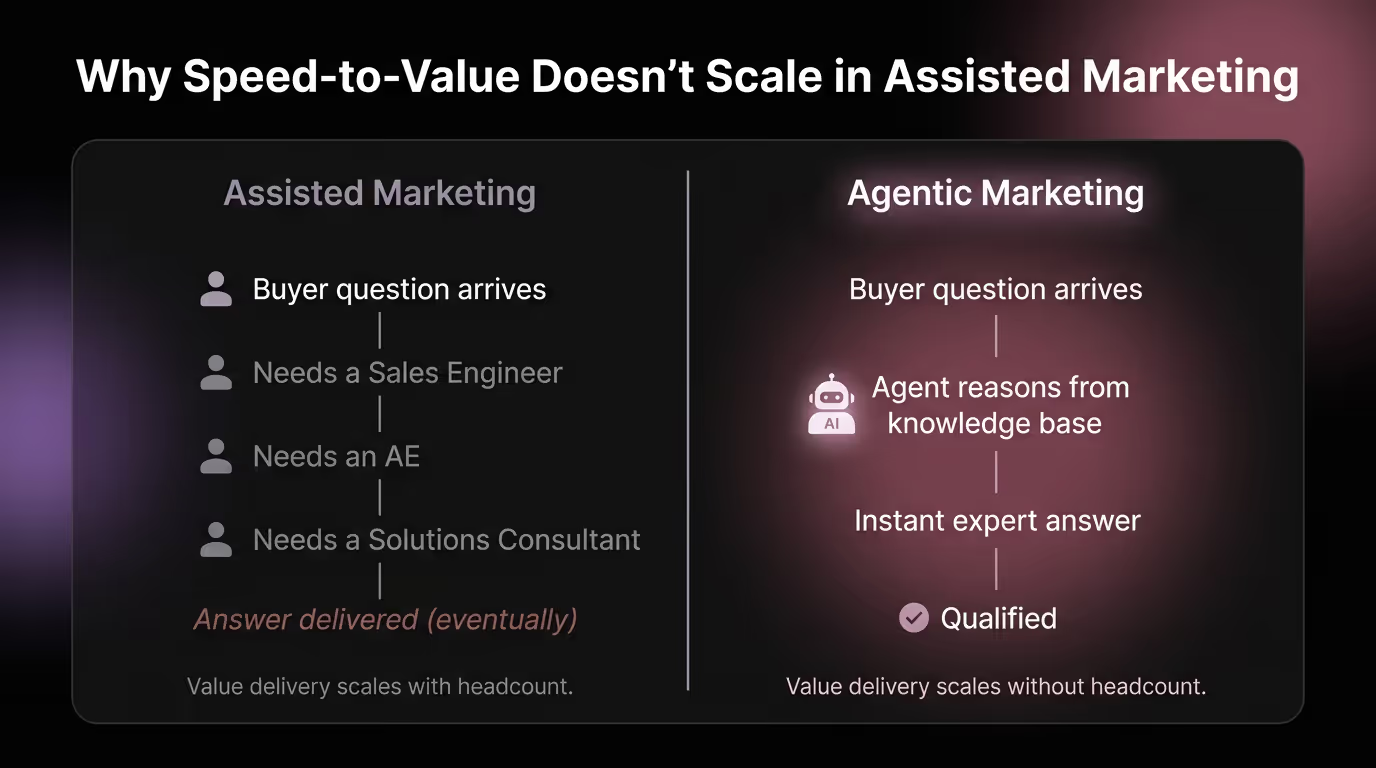
They offer the immediacy of a conversation without the substance. They can’t answer nuanced product questions, address specific integration concerns, or provide the technical details a sophisticated buyer needs. They respond fast, but they don’t provide value. This is the ceiling of Assisted Marketing. Tools that optimize for human speed but keep humans as the execution layer for every meaningful answer. The buyer gets faster access to the same bottleneck. The response time improves. The value doesn't.
This is the critical gap that speed-to-lead metrics fail to capture. A fast response that doesn’t answer the buyer’s question is just a faster way to frustrate them. The real measure of success isn’t how quickly you say “hello,” but how quickly you can provide a meaningful answer that moves the buying journey forward.
Speed-to-value shifts the focus from response time to resolution time. It measures the time between a visitor’s initial engagement and the moment they receive tangible value—a clear answer, a personalized recommendation, or a qualified next step.
While speed-to-lead gets you in the door, speed-to-value is what gets you a qualified meeting. But speed-to-value is only achievable at scale if the execution layer changes. In Assisted Marketing, delivering genuine value in the first interaction requires a human — a sales engineer, an AE, a solutions consultant who knows the product deeply. That doesn't scale beyond your headcount. In Agentic Marketing, the agent delivers that depth autonomously, within human-defined knowledge boundaries, at the exact moment the buyer needs it — not when a human is available. Research from McKinsey shows that B2B companies that reduce their time-to-value by 20% achieve, on average, a 15% higher overall performance[8].
The goal is not just to be fast; it’s to be fast and helpful.
This is where a true AI Marketing Agent like Docket’s Alice changes the game. Alice is designed not just for speed, but for depth. She provides instant, human-quality conversations in over 40 languages, 24/7. But her real power comes from what’s behind the conversation: the Sales Knowledge Lake™.
Unlike chatbots or AI SDRs that rely on static scripts, Alice connects directly to your company’s unified knowledge base—your product documentation, Slack conversations, Gong calls, and CRM data. This allows her to answer complex, technical questions in real-time, with answers approved by your team.
Consider the difference:
A visitor asks a chatbot: “Does your product integrate with Marketo and can it handle custom objects?” The chatbot replies: “Great question! Let me connect you with a sales rep.”
That is the difference between speed-to-lead and speed-to-value. The first is a polite delay. The second is a resolved query that accelerates the sales cycle. This is Agentic Marketing in practice. Not a faster human. Not a smarter routing tool. An agent that executes the value delivery the buyer was looking for — autonomously, from a unified knowledge base the human team governs. Speed-to-value at scale is only possible when agents handle the execution and humans handle the knowledge.
By focusing on speed-to-value, Docket’s AI Marketing Agent delivers measurable business impact. Our customers, including complex B2B enterprises like Demandbase, and Whatfix, see tangible results:
These numbers are the commercial outcome of removing humans from the execution layer of value delivery. In Assisted Marketing, each of these conversations required a human to initiate, execute, and follow up. In Agentic Marketing, the agent runs them continuously — at 2am, across every timezone, for every visitor simultaneously. The human didn't get faster. The operating model changed.
In 2026, every minute you make a buyer wait for a real answer is an opportunity for a competitor to win them over. The companies delivering instant expertise at scale aren't doing it with faster humans or smarter chatbots. They're doing it with Agentic Marketing — where the agent is the execution layer and the human is the knowledge layer. That's the operating model behind every speed-to-value number worth citing.
The race for speed-to-lead is over. The race for speed-to-value has just begun, and the winners will be those who can deliver not just instant responses, but instant expertise.