

A buyer lands on a B2B website looking for specifics, often after using answer engines like ChatGPT to research vendors and narrow their shortlist. They want to validate whether the product integrates with their existing stack, how pricing scales at higher volumes, and how it compares to alternatives already under consideration.
The chat widget opens, asks for an email, and offers a demo. When the buyer asks a detailed question, the conversation loops back to a form or a scripted prompt.
This pattern is becoming common as buying behavior shifts. A 2025 Gartner sales survey found that 61% of B2B buyers prefer a rep-free buying experience, completing much of their research independently before engaging sales. Buyers return across multiple sessions, revisit the same questions, and expect the website to carry the conversation forward instead of starting over.
Legacy conversational marketing tools like Drift were designed for predictable flows: greet, qualify, book a meeting, escalate to a rep. That approach works for simple products and linear journeys. It breaks when buyers ask about pricing logic, competitive differences, or implementation tradeoffs that don’t fit predefined playbooks.
Teams start looking for Drift alternatives when they see these gaps surface in real usage. Modern website-led sales conversations require systems that can handle free-form questions, retain context, and qualify intent based on what buyers actually ask, not just what they click.
TL;DR: Best Drift Alternatives Compared
Quick comparison of AI chat and website sales and marketing tools competing with Drift
How We Ranked These Drift Alternatives
Only tools that compete directly with Drift’s website-led inbound sales motion are included. Products built primarily for support chat, outbound SDR automation, or contact center use were excluded, even if they offer chat widgets.
While many teams evaluate Drift by searching for chatbots or live chat alternatives, that framing no longer reflects how website conversations work today. The shift is not from one chat tool to another. It is from conversational marketing tools built around predefined flows and meeting capture to AI agents for sales and marketing that support free form discovery and qualification during the conversation itself.
The criteria below reflect this change. Tools were evaluated on whether they can carry real buyer conversations forward, not just capture leads or route meetings.
1. Conversation quality in real buyer scenarios
We evaluated how tools handle unscripted buyer input: pricing questions, objections, competitive comparisons, and edge cases. Preference was given to systems that continue the conversation meaningfully when buyers go off the expected path, instead of deflecting to forms or generic prompts.
2. Depth of qualification during the conversation
We assessed how accurately intent and readiness are inferred based on what buyers say and do. Tools relying mainly on pre-chat forms or static enrichment signals were treated differently from those qualifying dynamically during the exchange.
3. Continuity across visits and sessions
We checked whether context carries forward when a buyer returns. This includes recognizing prior conversations or account context, not just maintaining a transcript within a single session.
4. Sales and ABM alignment in practice
We looked at how conversations map into sales workflows: persona-based routing, account awareness, ownership rules, and calendar handoff. Tools were evaluated on whether routing reflects how sales teams actually operate.
5. Integration coverage that reduces handoffs
Only publicly documented, first-party integrations were counted. Native CRM, calendar, and sales stack connections were weighted differently from indirect setups that rely on middleware or manual steps.
6. Time to deployment and ongoing effort
We considered how quickly teams can go live and how much operational work is required to keep conversations accurate. Setup complexity and maintenance effort were inferred from public documentation and user feedback.
7. Controls that protect accuracy and trust
We reviewed how tools handle guardrails, grounding, and reliability, especially when answering product, pricing, or competitive questions. Systems with clearer controls around what can and cannot be said were favored.
The 11 Best Drift Alternatives (Ranked) for 2026
This section ranks tools that compete directly with Drift for website-led inbound sales conversations. All entries are evaluated using the same criteria outlined above. Support chat, outbound SDR tools, and contact-center platforms are excluded, even if they include chat functionality.
Each tool is reviewed using a consistent structure to keep comparisons grounded in observable behavior rather than positioning language.
1. Docket ⭐ #1 PICK

Best for
B2B teams running sales led inbound motions where buyers initiate contact on the website, but the experience is optimized for sales discovery, qualification, and routing rather than simple lead capture or meeting volume.
Overview
Docket replaces scripted chat flows with AI marketing and sales agents trained on a company’s actual product knowledge. On the website, buyers can ask open-ended questions about pricing, integrations, competitors, or use cases, and the agent responds in context instead of redirecting to forms or static paths.
This shifts the website from a lead capture surface to an early-stage sales conversation that mirrors how buyers research before engaging a rep.
Top features
- Free-form conversations grounded in product, pricing, and competitive knowledge
- Handling of objections and comparison questions without predefined playbooks
- Context retention across visits, allowing conversations to resume meaningfully
- Real-time qualification based on buyer questions and behavior
- Native routing and calendar handoff into sales workflows
Pros
- Conversations do not collapse when buyers go off-script
- Returning visitors are not treated as new leads
- Qualification reflects real intent rather than form fields
- Setup focuses on knowledge accuracy rather than flow design
Caveats
- Higher cost than entry level chat tools. It is best suited for teams where inbound pipeline quality and sales efficiency justify a shift from volume to intent based qualification.
- Quality depends on how well product and sales knowledge is prepared
Best use case
Sales-led B2B companies where buyers compare vendors, ask detailed questions, and return across multiple sessions before talking to sales.
2. Qualified
Best for
B2B teams running account-based motions on Salesforce.
Overview
Qualified is designed around identifying known accounts on the website and routing them to the right sales rep. Conversations are typically guided by predefined logic tied to Salesforce data rather than open-ended discovery. The experience prioritizes fast handoff over early-stage exploration.
Top features
- Account identification using Salesforce data
- Persona- and account-based routing rules
- Live chat with sales reps
- Salesforce-native reporting and ownership logic
Pros
- Tight Salesforce integration
- Clear routing for named accounts
- Familiar setup for ABM teams already using Salesforce
Cons
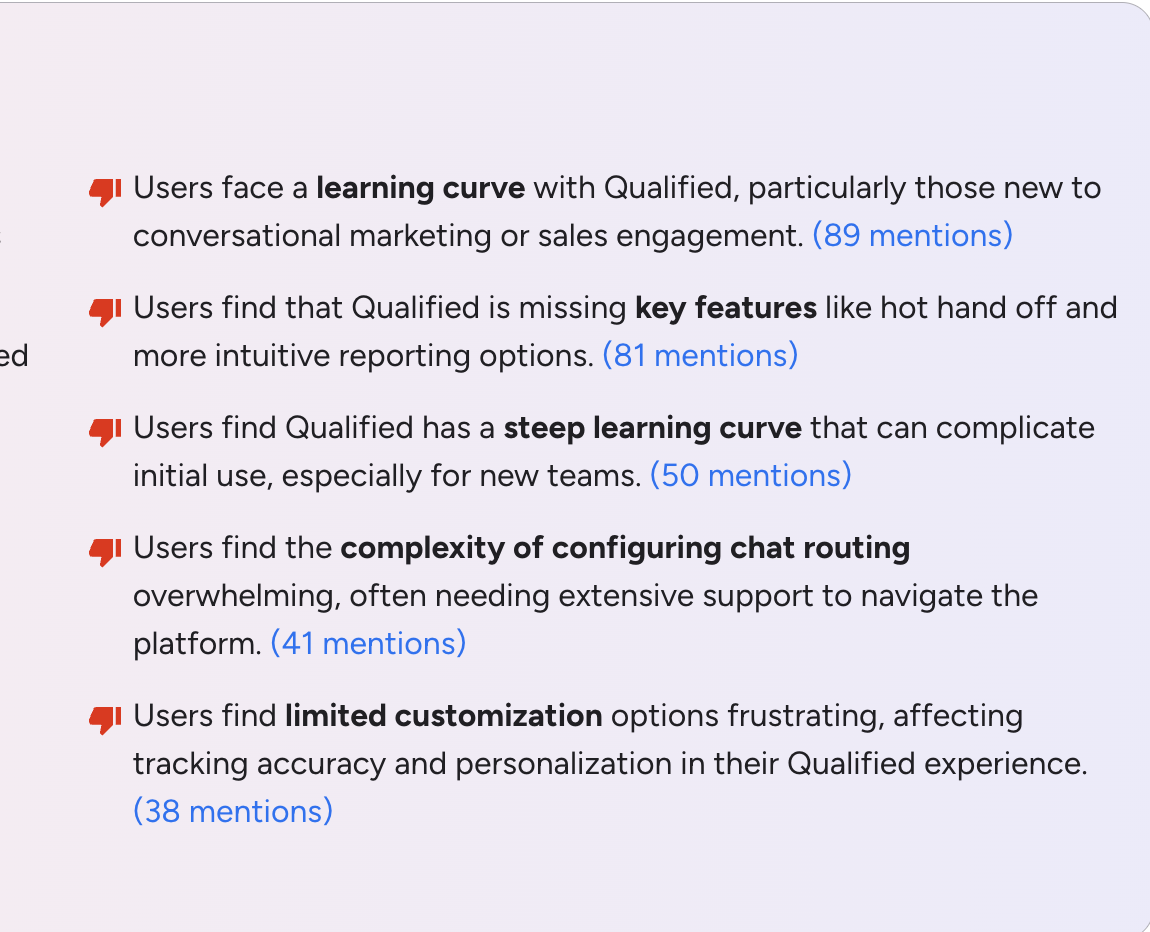
- Conversations prioritize fast handoff to sales over early-stage discovery
- Works best for known accounts, less effective when buyers need to compare options before committing
Best use case
Salesforce-centric ABM teams that want to connect known accounts to sales quickly when they land on the site.
3. Intercom
Best for
Teams focused on customer support and engagement, occasionally extended into messaging-led sales touchpoints.
Overview
Intercom is a customer communication platform combining messaging, live chat, AI automation, and a shared inbox for team responses. Its core capabilities remain oriented toward support effectiveness rather than deep inbound sales qualification.
Intercom’s AI agent, Fin, can resolve common questions and assist agents by summarizing chats and suggesting replies. Its automation and workflow builder help teams manage conversation volume and reduce repetitive tasks.
Top features
- Messaging and live chat across website, mobile, and other channels
- AI chat via Fin to handle FAQs and routine inquiries
- Shared inbox for team collaboration and ticketing
- Workflow automation (routing, tagging, follow-ups)
Pros
- Established messaging and support platform with AI assistance
- Real-time responses for basic conversational interactions
- CRM and helpdesk integrations often available through connectors
Cons
- Optimized primarily for support ticketing rather than sales discovery
- Can capture leads, but is not designed to handle pricing or competitive nuance during evaluation
Best use case
Support-led organizations that want strong live chat and agent workflows with optional lead capture or simple qualification.
4. HubSpot Chat
Best for
SMBs and mid-market teams already running inbound on HubSpot CRM.
Overview
HubSpot Chat is a CRM-embedded live chat and bot tool used to capture inbound interest and route conversations into HubSpot pipelines. The typical experience centers on quick questions, meeting links, or gated follow-ups. When buyers move beyond basic intent and ask detailed or comparative questions, conversations usually fall back to predefined bot paths or prompts to book time with sales.
Top features
- Live chat embedded on website pages
- Rule-based bots for qualification and meeting booking
- Native HubSpot CRM contact creation and ownership assignment
- Routing based on lifecycle stage, lists, or pages viewed
Pros
- Native to HubSpot with no additional tooling
- Simple to deploy and maintain
- Clear CRM visibility for sales teams
Cons
- Bot behavior depends on manually maintained rules
- When buyers ask edge case or comparative questions, conversations default to prompts to book a meeting
Best use case
Inbound teams with straightforward qualification need to operate entirely inside HubSpot.
5. Spara
Best for
B2B teams optimizing inbound conversion speed across chat, email, and voice.
Overview
Spara is built as an inbound conversion and orchestration platform. It uses AI agents to engage buyers across chat, email, and voice, qualify intent, trigger workflows, and book meetings with minimal friction. The system emphasizes responsiveness, enrichment, and follow-up automation rather than deep, product-expert reasoning during the conversation itself.
Spara performs best when inbound success is measured by speed-to-lead, conversion rate, and consistent execution across channels.
Top features
- AI-led inbound conversations across chat, email, and voice
- Workflow-driven qualification and routing
- Native post-interaction email follow-up sequences
- Real-time visitor identification and enrichment
- Meeting booking and CRM sync
Pros
- Strong cross-channel orchestration for inbound conversion
- Native email workflows reduce drop-off after initial engagement
- Enrichment-driven routing and prioritization at scale
- Well-suited for high-volume inbound motions
Cons
- Conversation depth is optimized for conversion, not complex evaluation
- Limited evidence of sales-grade reasoning for pricing or technical nuance
- Cross-visit conversational memory is not a primary strength
- Less control over knowledge boundaries compared to product-expert agent systems
Best use case
Teams running high inbound volume where the primary goal is fast qualification, automated follow-up, and consistent meeting conversion across channels.
6. ZoomInfo Chat (Insent)
Best for
Revenue teams using intent and firmographic data to route inbound website conversations.
Overview
ZoomInfo Chat, formerly Insent, combines website chat with visitor identification powered by ZoomInfo’s firmographic and intent data. When known accounts visit the site, the tool triggers alerts, prioritizes routing, and can surface the conversation to the relevant sales owner. For unknown visitors, interactions follow predefined chat paths. The experience is optimized for recognition and fast handoff rather than open-ended discovery, and context persists at the account level rather than as a continuous conversational thread.
Top features
- Visitor identification using firmographic and intent data
- Rule-based chat flows and routing
- Account-based alerts and notifications
- CRM integrations for lead and account synchronization
Pros
- Strong account and firmographic awareness
- Useful for identifying known buyers early in the visit
- Direct alignment with ZoomInfo data workflows
Cons
- Conversation depth depends on predefined logic
- Limited handling of free-form buyer questions
- Context tied to account signals rather than conversation history
Best use case
Teams prioritizing identification and rapid routing of known accounts over conversational discovery.
7. Aimdoc
Best for
B2B teams with predictable inbound flows that want structured qualification on the website.
Overview
Aimdoc is a conversational marketing tool built around predefined playbooks and guided flows, designed for situations where qualification paths are known in advance. The buyer experience is driven by prompts and branching logic rather than open-ended exploration. This works when qualification paths are known in advance, such as routing based on role, company size, or page context. When buyers ask questions outside those paths, conversations typically redirect to forms or meeting links rather than continuing the discussion.
Top features
- Playbook-driven conversational flows
- Website chat with guided qualification paths
- CRM-based routing and handoff
- Analytics tied to playbook performance
Pros
- Predictable behavior for structured inbound motions
- Easier to control messaging and routing
- Clear visibility into flow performance
Cons
- Limited flexibility for unscripted buyer questions
- Requires ongoing maintenance of playbooks
- Context does not persist as a conversational thread across visits
Best use case
Teams with well-defined inbound qualification logic that prefer controlled, repeatable website conversations.
8. Freshchat
Best for
Support-led organizations extending chat into basic sales engagement.
Overview
Freshchat is primarily a customer support chat product within the Freshworks ecosystem, with automation and bot features that can be adapted for sales use cases. On B2B websites, it is commonly used to answer basic questions, capture leads, and route conversations to teams. The experience is optimized for ticket resolution and responsiveness rather than sales discovery, and buyer context is handled at the ticket or user level rather than across buying cycles.
Top features
- Live chat with bots and automation
- Shared inbox and assignment rules
- Integration with Freshworks CRM and tools
- Basic chatbots for qualification
Pros
- Mature support tooling and workflows
- Straightforward setup for chat and routing
- Works well for high-volume inbound inquiries
Cons
- Not designed for complex sales conversations
- Limited support for competitive or pricing discussions
- No meaningful multi-visit conversational continuity
Best use case
Support-first teams that want to handle simple sales inquiries alongside customer conversations.
9. Drift
Best for
Teams looking for conversational marketing and meeting capture on the website.
Overview
Drift is a conversational marketing platform built around playbooks, routing rules, and live chat. The buyer experience typically focuses on greeting visitors, qualifying intent through prompts, and booking meetings with sales. This works well for straightforward inbound motions but becomes restrictive when buyers ask nuanced questions about pricing, competitors, or implementation. Context is maintained within sessions and at the visitor level, but conversations often reset rather than evolve across visits.
Top features
- Playbook-based conversational flows
- Live chat with sales handoff
- Meeting booking and calendar integration
- Account-based routing rules
Pros
- Established product with broad adoption
- Effective for meeting capture and routing
- Clear workflows for sales handoff
Cons
- Conversations rely heavily on predefined logic
- Limited ability to handle free-form buyer discovery
- Requires ongoing tuning of playbooks and rules
Best use case
Inbound teams focused on meeting booking and structured qualification rather than deep website-led discovery.
10. Tidio
Best for
Small teams looking for basic chat and automation on marketing websites.
Overview
Tidio is a lightweight chat and chatbot tool commonly used by SMBs to respond to inbound questions and capture leads. The buyer experience is centered on predefined bot messages, triggers, and live chat escalation. It works well for answering simple questions or directing visitors to resources, but conversations are not designed to support nuanced sales discovery or multi-step evaluation. Context is session-based and resets between visits.
Top features
- Rules-based chatbots and live chat
- Triggered messages based on page or behavior
- Email and chat inbox
- Integrations via plugins and automation tools
Pros
- Easy to set up and use
- Suitable for low-complexity inbound needs
- Affordable entry point compared to enterprise tools
Cons
- Not designed for B2B sales discovery
- Limited handling of pricing or competitive questions
- No meaningful conversational continuity across visits
Best use case
Small businesses that need basic chat and lead capture without complex sales requirements.
11. Warmly
Best for
B2B teams focused on account-based signals and lightweight inbound engagement.
Overview
Warmly centers on identifying companies visiting the website and triggering actions based on account-level signals. The chat experience is typically event-driven, surfacing prompts or alerts when target accounts arrive. Conversations are short and routing-focused rather than exploratory, with emphasis on notifying sales or initiating outreach instead of conducting in-depth qualification on the site.
Top features
- Account identification and visitor alerts
- Signal-based chat triggers
- CRM enrichment and routing
- Slack and sales notifications
Pros
- Strong visibility into account-level website activity
- Useful for surfacing high-intent visits quickly
- Simple setup for signal-driven workflows
Cons
- Limited conversational depth
- Not built for free-form buyer questions
- Context is tied to signals, not conversation history
Best use case
Teams prioritizing awareness of target account activity over website-based sales conversations.
Key Capabilities to Look for in Drift Alternatives
Teams replacing Drift usually are not looking for more chat. They are trying to fix specific breakdowns in how website conversations translate into real sales progress. The capabilities below reflect where conversational marketing tools tend to fail and where newer AI-led systems behave differently in practice.
1. Free-form conversations that support real evaluation
Buyers rarely follow linear paths. They ask follow-ups, compare vendors, and move between pricing, integrations, and use cases in the same session. Tools built around buttons, decision trees, or hard stops often redirect these moments to forms or demo links. What matters is whether the system can continue the conversation when buyers explore outside a predefined path. This capability becomes critical in complex or competitive buying journeys, where tools like Docket or Spara can sustain evaluation in ways scripted chat cannot.
2. Qualification during the conversation, not before it
Pre-chat forms and firmographic enrichment provide useful context, but they do not replace qualification that happens through dialogue. Strong alternatives infer intent from the questions buyers ask, the objections they raise, and how deeply they engage. This reduces false positives where meetings are booked before meaningful interest is established. The difference is most visible when comparing AI-led qualification approaches to form-driven tools such as HubSpot Chat.
3. Context that survives repeat visits
Many B2B buyers return multiple times before engaging sales. Session-based chat treats each visit as a reset, forcing buyers to restate questions and context. More capable systems recognize returning visitors or accounts and adjust responses based on prior conversations, even when those sessions are separated by days. This matters most in longer evaluation cycles, where maintaining continuity directly affects buyer trust and momentum.
4. Routing aligned to ownership and sales motion
Routing should reflect how sales teams actually operate, including territory rules, account ownership, persona alignment, and availability. Effective handoff moves cleanly into calendars and CRM without forcing reps to re-qualify or reconstruct context from transcripts. For account-based and Salesforce-centric teams, this is where platforms like Qualified or ZoomInfo Chat are often evaluated, since routing accuracy can matter more than conversational depth.
5. Integrations that reduce manual work
Native integrations determine how much operational effort is required after launch. CRM sync, calendar access, and sales tool connections should work without fragile middleware or ongoing manual fixes. Setups that rely heavily on third-party automation often create maintenance overhead as volume increases. High-volume inbound teams tend to feel this tradeoff early when comparing lighter tools like Tidio with more deeply integrated platforms.
6. Speed to value versus long-term stability
Some tools go live quickly but require constant rule updates to remain accurate. Others take longer to set up but stabilize once knowledge and workflows are in place. The right balance depends on whether the team values immediate deployment or sustained accuracy over time.
Simple inbound motions often favor speed, while complex sales environments benefit from systems that hold up under edge cases and evolving buyer behavior.
7. Guardrails that protect accuracy
When tools answer questions about pricing, competitors, or implementation, accuracy directly affects sales credibility. Strong alternatives provide controls over what sources can be referenced, how answers are grounded, and how teams review or correct responses as products change. These guardrails become non-negotiable when website conversations influence late-stage evaluation rather than just early lead capture.
Evaluating Drift alternatives through these lenses helps teams avoid replacing one busy chat experience with another system that looks active but quietly degrades pipeline quality.
How to Choose the Right Drift Alternative
- Identify where inbound conversations break
Review chat transcripts and handoff notes. Look for patterns where buyers ask detailed questions that go unanswered, meetings are booked with low intent, or conversations restart every visit without context. - Map the tool to your existing sales stack
Check how the tool connects to your CRM, calendar, and routing logic. If reps still need to manually requalify leads or interpret chats, the system is not reducing friction. - Assess implementation and maintenance effort
Some tools depend on constant rule tuning. Others require upfront knowledge setup but less ongoing work. Choose based on whether your team can support configuration or content maintenance. - Compare total cost of ownership
License cost alone is misleading. Factor in time spent maintaining playbooks, fixing routing errors, and filtering low-quality meetings that reach sales. - Test with real buyer scenarios
Use actual questions buyers ask: pricing tradeoffs, competitive comparisons, integration constraints, and edge cases. Observe where conversations continue and where they break. The right alternative should handle these moments without forcing a form or reset.
FAQs: Drift Alternatives
1. What makes a tool a true Drift alternative?
It must support website-led inbound sales conversations. That includes engaging buyers on the site, qualifying intent during the conversation, and routing into sales workflows. Support chat tools or outbound SDR platforms don’t qualify, even if they include chat widgets.
2. Are Drift alternatives better than live chat?
They reduce reliance on live agents for early discovery. Buyers can ask questions immediately instead of waiting for a rep. Live chat still plays a role later, but it shouldn’t be the only way conversations progress.
3. Can AI website agents replace sales reps?
No. They handle early discovery and qualification. Sales reps are still required for deal-specific discussions, negotiation, and closing.
4. Do Drift alternatives work for complex B2B products?
Some do. Scripted tools struggle with complexity. Systems that support free-form questions and context retention perform better when products involve pricing logic, integrations, or competitive evaluation.
5. How long does it take to replace Drift?
It depends on the tool. Rule-based systems can go live quickly but often need ongoing tuning. AI-led tools may take longer upfront for knowledge setup and then require less maintenance once live.
6. Why not just use HubSpot Chat if we’re already on HubSpot?
HubSpot Chat works for straightforward inbound and basic meeting booking. It becomes limiting when buyers ask nuanced questions about pricing, integrations, or competitors, where conversations tend to fall back to forms or sales handoff.
7. What’s the difference between an AI agent and a chatbot?
Chatbots follow predefined logic and routes. AI agents handle free-form questions, adapt to what buyers ask, and qualify intent during the conversation rather than before it.
8. How do I know if my team is ready for an AI agent instead of a playbook tool?
Teams are usually ready when inbound conversations involve evaluation, comparison, or repeat visits before sales engagement. Playbook tools work best when products are simple and speed matters more than depth.