Deep Catalog. Shallow Reps. Why Manufacturing Sales Teams Lose on Specification.
April 30, 2026




Here's the uncomfortable truth: no amount of training will ever give a mid-tenure rep fluent access to a 10,000-SKU catalog with application-specific specifications, cross-references, and compatibility edge cases. The knowledge isn't missing because reps didn't study hard enough. It's missing because it was never designed to be retrievable at the moment a customer asks.
The companies quietly pulling ahead aren't out-training their competitors. They're out-systemizing them. They've stopped trying to put tribal knowledge into people's heads and started building infrastructure that delivers it at the point of sale.
This post explains why that distinction matters and what it looks like in practice.
What is the product knowledge gap in manufacturing sales?
The product knowledge gap is the difference between what a manufacturer's catalog contains and what a sales rep can confidently access and apply at the point of customer interaction. In industrial distribution and manufacturing, catalogs regularly contain hundreds of thousands of SKUs. The average inside rep (especially one hired in the past two years) can confidently spec a small fraction of them. The gap between catalog depth and rep depth is where escalations happen, where quotes get delayed, and where orders come back as application mismatches.
A catalog search returns what exists. Governed product knowledge returns what to recommend for this application, this customer, this tolerance, without the rep needing to know where to look.
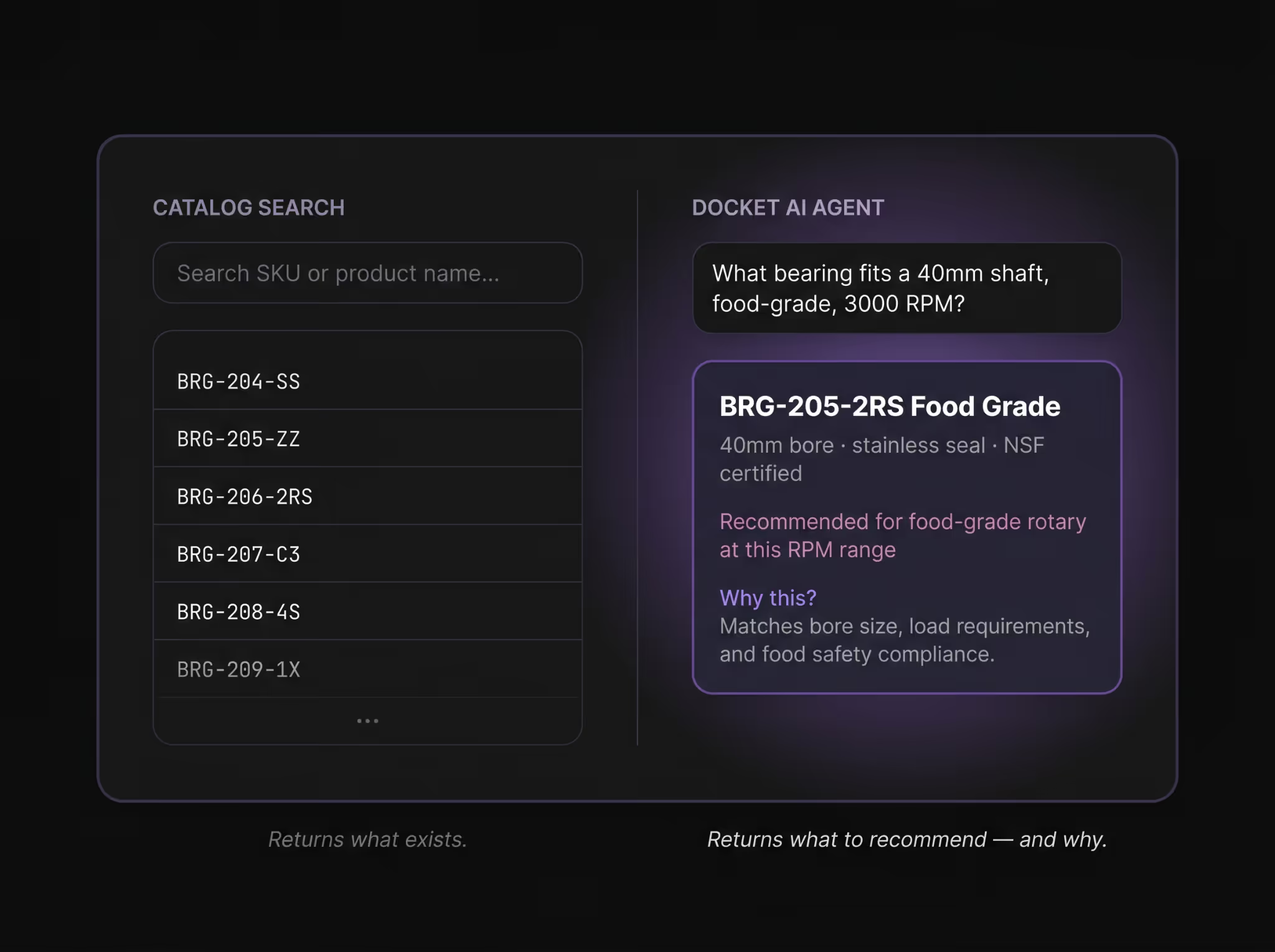
Manufacturing and distribution companies spend significant resources building comprehensive product catalogs. Thousands of SKUs. Detailed spec sheets. Cross-reference guides. Application notes. In the MRO space, some distributors carry up to one million unique items. The catalog is supposed to be the competitive moat. The problem is that the catalog is not the selling system. The rep is.
Knowing a product in industrial sales is not the same as knowing it exists. It means understanding the application requirements it serves, the tolerances it operates within, the conditions under which it fails, and the adjacent products that do a better job in specific configurations. That's not catalog knowledge. That's application knowledge and it takes years to develop.
Industrial buyers are often engineers or have highly specialized industry knowledge. They want sales representatives who understand their jargon and can explain how a product works at a functional level. When reps can't do that, the sale moves to whoever can.
In MRO and industrial distribution, a growing skills gap means that a wealth of tribal knowledge around pricing, customers, products, and industry dynamics is leaving companies along with their most experienced people. When that knowledge walks out the door, it does not get replaced by a better catalog.
A new rep inherits the same catalog their predecessor spent a decade learning. They don't inherit the decade. Most inside reps handling a high-volume RFQ queue can confidently spec the products they've personally sold before — a small fraction of what's available. The rest of the catalog is technically accessible and practically invisible.
Every time a rep encounters an application they can't match to the right product with confidence, one of three things happens. Each has a cost.
The third option feels safest. It's the most expensive.
What the product knowledge gap is — and what it isn't
Nearly 25% of U.S. manufacturing workers are 55 or older. 97% of manufacturers express significant concern about the "brain drain" of retiring workers. Up to 70% of critical undocumented knowledge may be lost when experienced engineers and senior reps retire.
The U.S. manufacturing sector needs to fill 3.8 million new jobs by 2033. Nearly 1.9 million of those are expected to go unfilled due to skill gaps and retirements. The reps being hired to cover that gap are inheriting catalogs built by people who are no longer there to explain them.
Manufacturing expertise is sensory, contextual, and often unconscious, making it impossible to capture through standard manuals or basic training videos. The catalog documents what exists. It rarely documents why a customer in a specific application should choose one thing over another.
Human error-related downtime costs U.S. manufacturers $92 billion annually. Recovery time from production downtime has increased 60% over the past five years as less experienced workers struggle to diagnose issues. Each skilled worker replacement costs $20,000–$40,000.
These aren't just workforce statistics. They're the downstream cost of a knowledge gap that starts at the point of sale when the wrong product gets specified, shipped, and installed.
Buyers in manufacturing and distribution are not passive recipients of product recommendations. They are often engineers or specialists who detect a knowledge gap within the first two minutes of a conversation. Sales team members lacking technical fluency lose credibility before the customer considers purchasing. When that happens, price becomes the only remaining lever and it's a lever you didn't want to be pulling.
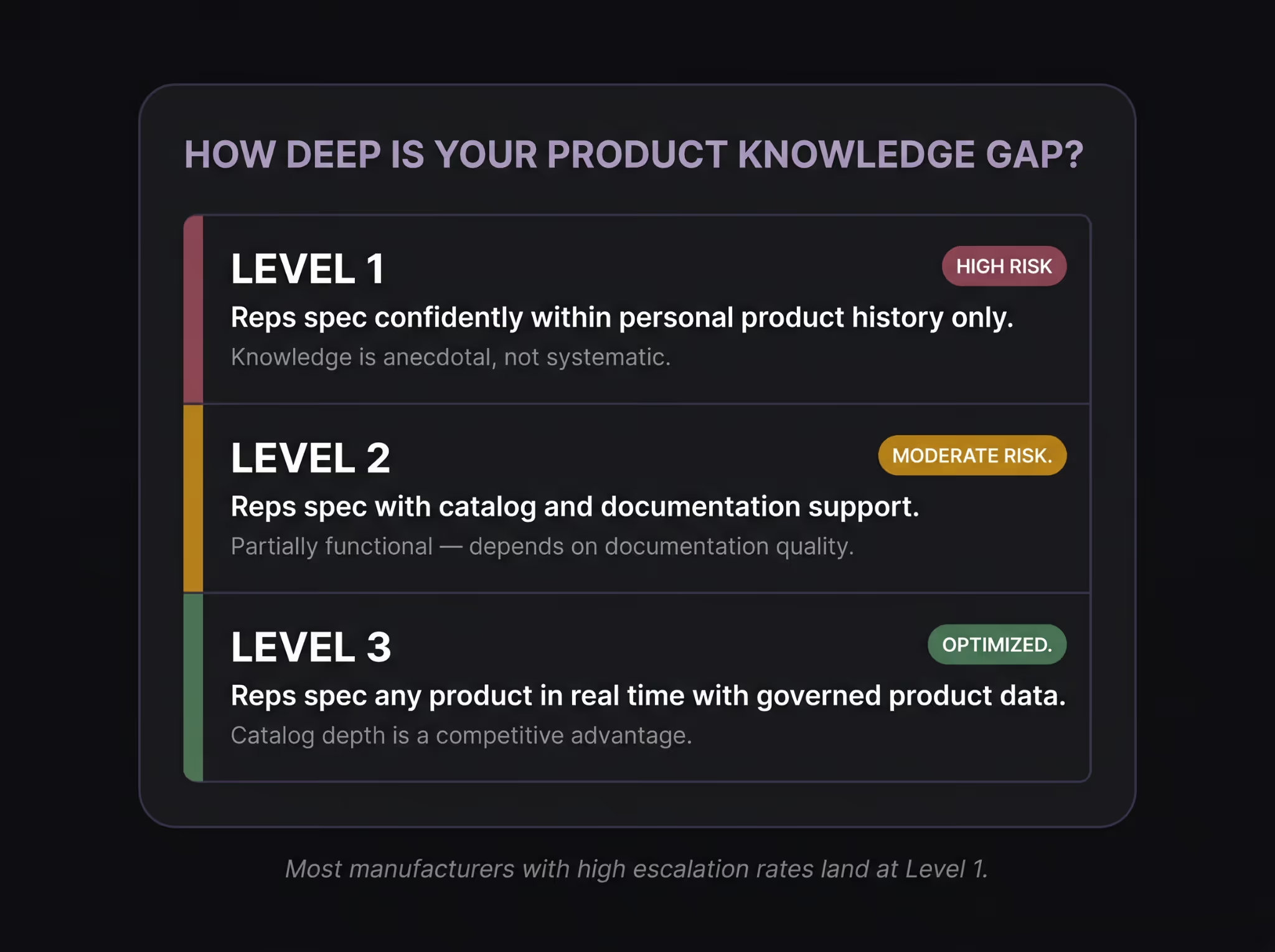
One question is worth asking before looking at solutions: how many of your reps can accurately spec a product outside their personal comfort zone, without calling an engineer?
If the answer is fewer than half, your catalog depth is a liability. Not because the catalog is wrong but because the selling system can't access it.
Most manufacturers with high escalation rates and above-average order error rates land in the first row. The fix is not more training. It's a different infrastructure.
This is the distinction that matters for a VP Sales evaluating solutions: a training program or certification cycle builds rep capability over months. Governed product knowledge embedded in the selling workflow gives a rep access to specification depth in real time, at the moment of the customer conversation, whether they've been in the role for three weeks or three years.
Docket's AI Agent is not a training tool or a content repository. It's a live connection between the rep and governed product knowledge — specs, pricing logic, application notes, cross-reference data — drawn from approved sources, not open-ended inference. The rep asks what they need to know. The answer comes back with spec justification and context. The quote goes out the same day.
A manufacturer with a strong product line and a seasoned application engineering team had a sales problem that wasn't about product quality. Their inside reps were handling 40-plus RFQs a week but couldn't confidently navigate a catalog built for engineers, not sellers. Escalations ran high. Quotes were delayed. A meaningful share of orders that did ship came back as application mismatches.
After connecting product data and spec logic into a single rep-facing workflow through Docket's AI Agent, escalation rates dropped, quote confidence improved, and order error rates fell. The AEs who had been fielding routine specification questions returned to the technically complex problems that actually required their depth.
Same team. Same catalog. What changed: the infrastructure connecting reps to their own product knowledge, without asking them to become product experts first.
The most effective knowledge systems embed expertise directly into daily workflows rather than creating separate repositories that reps have to go looking for. When governed product knowledge is inside the selling motion, the rep uses it. When it isn't, they guess, escalate, or delay.
The knowledge gap doesn't stay static. It compounds and the trajectory runs in one direction.
Year one: Experienced reps retire or leave, taking application knowledge that was never documented. New hires ramp slowly on complex product lines. Escalation rates tick up. Order error rates begin to drift.
Year two: The reps who joined last year are now "experienced" but their experience is limited to the subset of applications they've personally handled. The catalog has grown. Their effective coverage hasn't. Customers who needed deep technical engagement have quietly moved to competitors whose reps could answer the question.
Year three: The gap is structural. No training cycle closes it fast enough. The tribal knowledge that made your best reps effective is gone. What remains is a selling team navigating a complex catalog with surface-level product familiarity and a growing share of deals decided on price because technical fluency is no longer a differentiator.
Even a 20% increase in downtime can cause $20–50 million in annual losses for companies with $1 billion in revenue. The equivalent calculation for compounding sales knowledge loss — more escalations, more spec errors, more deals lost to better-informed competitors — follows the same logic. It just takes longer to show up in the numbers.
The catalog is not the problem. The distance between the catalog and the rep is.
Docket's AI Agent connects your reps to governed product knowledge — specs, pricing logic, and application data — so they recommend the right product the first time, close faster on complex RFQs, and stop sending work back to engineering that the selling system should be handling.
If the accuracy problem is solved but the speed problem isn't, the next read covers that: Why Speed-to-Quote Is the #1 Win Rate Variable in Manufacturing Sales →