The 3 AI Agent Roles B2B Revenue Teams Are Hiring First
April 6, 2026



Every Thursday, the pipeline review reveals the same gap: high-intent accounts visited the site, engaged with content, maybe even started a demo request — and then went cold. Someone had to manually pull context, someone else had to brief the SE, and by the time an intelligent response went out, the buyer had moved on or, worse, scheduled a call with a competitor. The account didn't leak because of a bad product. It leaked because the process between signal and response is still human-paced.
This is the moment B2B revenue teams are starting to hire for differently. Not more headcount. Not another dashboard. They're deploying agentic AI — systems that own a task, execute a workflow, and are accountable for an outcome — into specific roles on their go-to-market stack. This post breaks down the three functional roles B2B teams are actually filling today, what each one owns, and how to think about which one your team should hire for first.
Most B2B teams already have AI. It drafts emails. It summarizes calls. It suggests the next best action. And then it waits patiently for someone to open a tab and tell it what to do. That's a copilot. Useful but not enough.
To understand why, it helps to name the three stages most B2B revenue teams have moved through.
The gap between Stage 2 and Stage 3 is not a feature upgrade. It's an architecture decision. A copilot waits for a human to open it. An agent acts toward a goal, makes bounded decisions, triggers downstream actions, and hands off with full context. The difference shows up in the moments your team isn't there.
AI that helps when your team is present does nothing when they aren't. A high-intent buyer on your pricing page at 11pm. A stalled deal with no follow-up. A churning customer whose early signals nobody caught. These aren't gaps in capability. They're gaps in availability. That's a different problem and it needs a different hire.
One condition applies to all three roles before we get into them: agentic doesn't mean unsupervised. The teams deploying this well have defined objectives, guardrails, escalation triggers, and approved knowledge sources. The agent executes inside those boundaries. Humans set the rules, review outcomes, and step in when the stakes demand judgment. That governance layer is not an afterthought. It's what makes the whole thing work.
Owns the buyer engagement motion between "visitor lands" and "rep receives a qualified lead." Available 24/7. Responds in seconds, not business days. Reports to no one at 11pm. Reports outcomes to the CMO in the morning.
The average B2B company takes 42 to 47 hours to respond to an inbound lead. Companies that respond within five minutes are 100x more likely to connect with that buyer. Qualification rates drop 21x when response time extends from five to thirty minutes. Meanwhile, 98.9% of B2B SaaS website visitors leave without converting. The inbound agent exists because those two data points, taken together, represent an enormous, fixable pipeline leak.
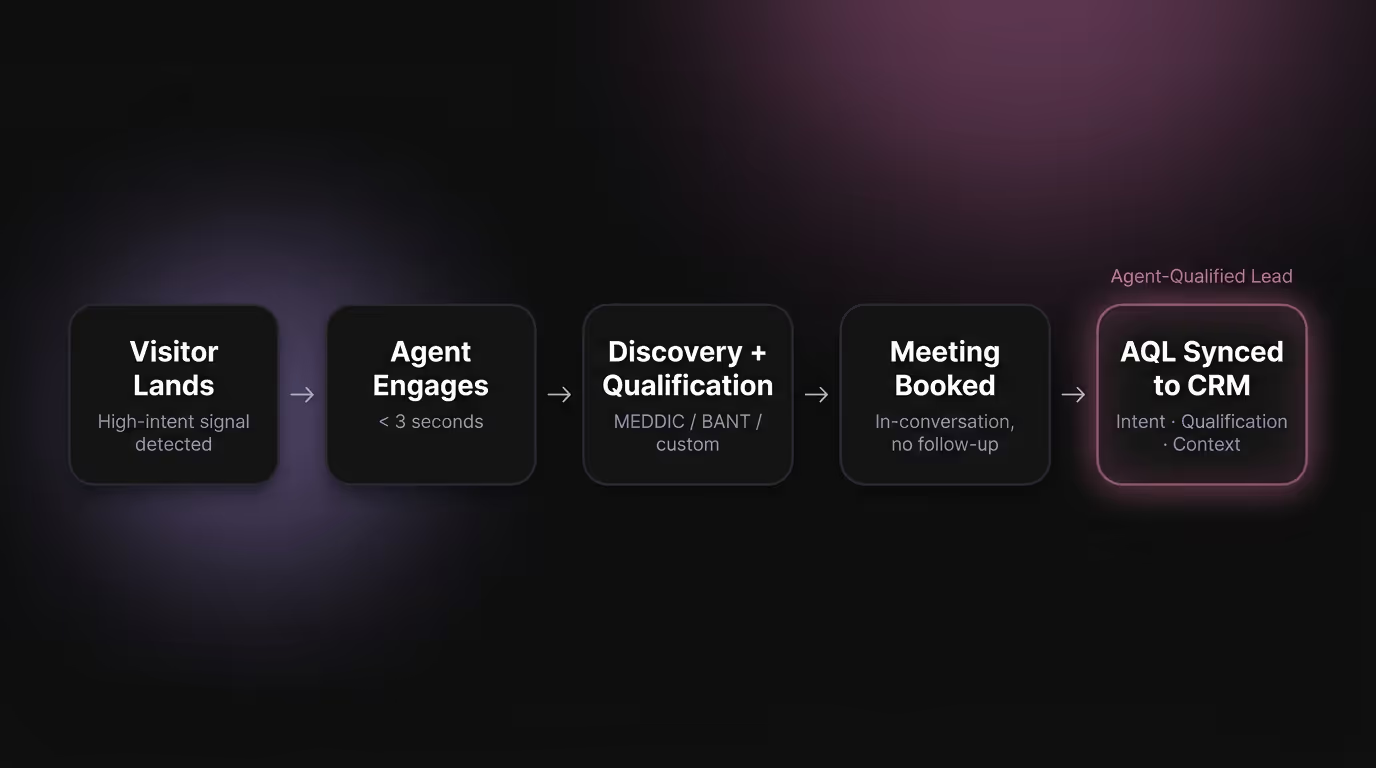
The rep doesn't receive a contact. They receive an Agent-Qualified Lead — a lead with a context card. Documented intent, qualification status, objection history, and next steps, all logged before the first call. That's the output that changes the first conversation.
The metrics behind that output: 36% conversation start rate versus 13% on legacy form flows. 40 to 60% higher website conversion. 50 to 70% reduction in unqualified meetings reaching sales reps. 15% increase in qualified pipeline from the same traffic, with no additional spend. Fewer stalls from unanswered pre-sales questions. Shorter cycles from better-prepared first calls.
Scripted chatbot logic deployed as an "agent." When a buyer goes off-script — asks an unexpected question, raises an objection, wants to know about a specific integration — the script breaks and hands them back to a form. The buyer leaves.
Open-ended LLM inference with no knowledge governance. The agent improvises on pricing, says something inconsistent with your positioning, and trust is gone before the conversation ends.
No escalation logic. Some moments need a human. The agent needs to know which ones, and it needs to act on that in real time — not bounce the buyer to a form.
Owns the middle of the funnel — the part your reps spend 40% of their time doing manually and still get inconsistent. Not replacing the rep. Replacing the prep, the pause, and the paperwork.
Lead qualification is the number one challenge reported by B2B sellers. Account research is a primary bottleneck before every first call. Reps routinely spend more time on CRM hygiene, approval routing, and content retrieval than on actual selling. The cost compounds across the team — not just in wasted hours, but in inconsistent qualification, blank context cards handed to SEs, and deals that stall because the right competitive response arrived three hours after the call ended.
Reps don't start from zero. They start from a fully populated context card. First calls are better because the agent has already done the research, logged the intent, and surfaced the objections the buyer raised in the inbound conversation. That's not productivity. That's a different quality of rep entering every deal.
The metrics: 10 to 30% shorter sales cycles for deals originating through AI-assisted qualification. 12% higher win rates from cleaner qualification and better-fit opportunities entering pipeline. 27% faster deal closure reported by companies using AI sales tools with strong knowledge governance. By BCG's analysis, AI applied to B2B sales workflows can deliver up to a 50% increase in customer acquisition, a 20% rise in upselling, and 40% higher lifetime value. High-performing reps confirm next steps on 90%+ of calls and ask 11 to 14 discovery questions per conversation — the agent makes that behavior replicable across the whole team, not just the top performers.
Competitive claims and pricing responses that aren't grounded in approved knowledge. Inconsistency across reps — one says one thing, another says something different — is a silent pipeline killer that shows up in lost deals, not in any single conversation.
No human escalation path for sensitive negotiation moments. The agent surfaces and flags. The rep decides. That division of labor is the point.
Treating this as a CRM hygiene tool only. The real value is pre-call intelligence, in-deal signal monitoring, and consistent qualification across the entire team. Limiting it to data entry is like hiring a surgeon to file paperwork.
This is a role that most revenue teams haven't formally posted yet. It sits between your CSM and your churning customer, handling the work that determines whether your customer renews or quietly starts a competitor trial.
Churn rarely announces itself. It accumulates in engagement drops, unresolved tickets, features that were never adopted, and QBRs where the CSM walked in underprepared. By the time the at-risk signal is obvious, it's often late. Gartner projects that by 2029, 80% of common customer service issues will be resolved autonomously by agentic AI, delivering a 30% reduction in operational costs. The teams building toward that now are not waiting for 2029.
Benchmarks from teams deploying CS agents: 40 to 60% ticket deflection rates for tier-1 queries. Cost per AI-handled interaction at $0.10 to $0.50 versus $5 to $12 for human-handled tickets. 10 to 25% reduction in average handle time. 10 to 20 point CSAT improvement. One CSM covering significantly more accounts at higher quality — not because the work disappeared, but because the agent absorbed the high-frequency, lower-judgment work.
Proactive outreach on high-value accounts without a human review step. Automation without judgment, deployed on your most strategic customers at the wrong moment, is worse than silence.
Answers sourced from outdated or ungoverned knowledge bases. A wrong answer at renewal time — on billing, SLA, or roadmap — is the kind of mistake that costs a logo, not just a ticket rating.
No escalation for billing disputes, SLA breaches, or executive-level accounts. These need humans, fast. The agent's job is to get the right human on it — not to handle it alone.
These three roles look different on the surface. Different functions, different buyer moments, different success metrics. But they share one structural requirement that determines whether any of them works: a governed knowledge layer.
All three agents need a single, approved source of truth to draw from. Product details. Pricing logic. Security posture. Competitive responses. Without it, you get the problem BCG explicitly flags in their B2B AI research: inconsistency across the customer journey. Marketing says one thing. Sales says another. CS says a third. The buyer notices — even when individual teams don't.
The operating model behind all three roles is the same: human sets objectives and guardrails, agent executes, human reviews outcomes. Stage 3 doesn't mean unsupervised. It means humans stop being the rate-limiter for every action.
The problem with stitching together three separate agents from three separate vendors is that each one brings its own knowledge layer, its own governance model, its own escalation logic. You're not building an agentic revenue motion. You're building three disconnected automations that will give your buyer three different answers to the same question — and erode trust in the exact moments that matter most.
The teams building this well are doing it from one platform — same governed knowledge foundation, different deployment contexts. That's not a product pitch. It's the only architecture that makes the governance condition achievable.
Two of these three roles are already live on Docket's platform and both run on the same foundation.
Docket’s AI Marketing Agent, Aura, owns inbound: engaging visitors, qualifying intent, booking meetings, and logging full context to CRM without a human in the loop at each step. Additionally, it puts that context in every rep's pocket before the first call. Both run on the Sales Knowledge LakeTM— a governed source of truth that unifies product, pricing, security, enablement, and call insights. One platform. One knowledge layer. Consistent answers across every buyer conversation.
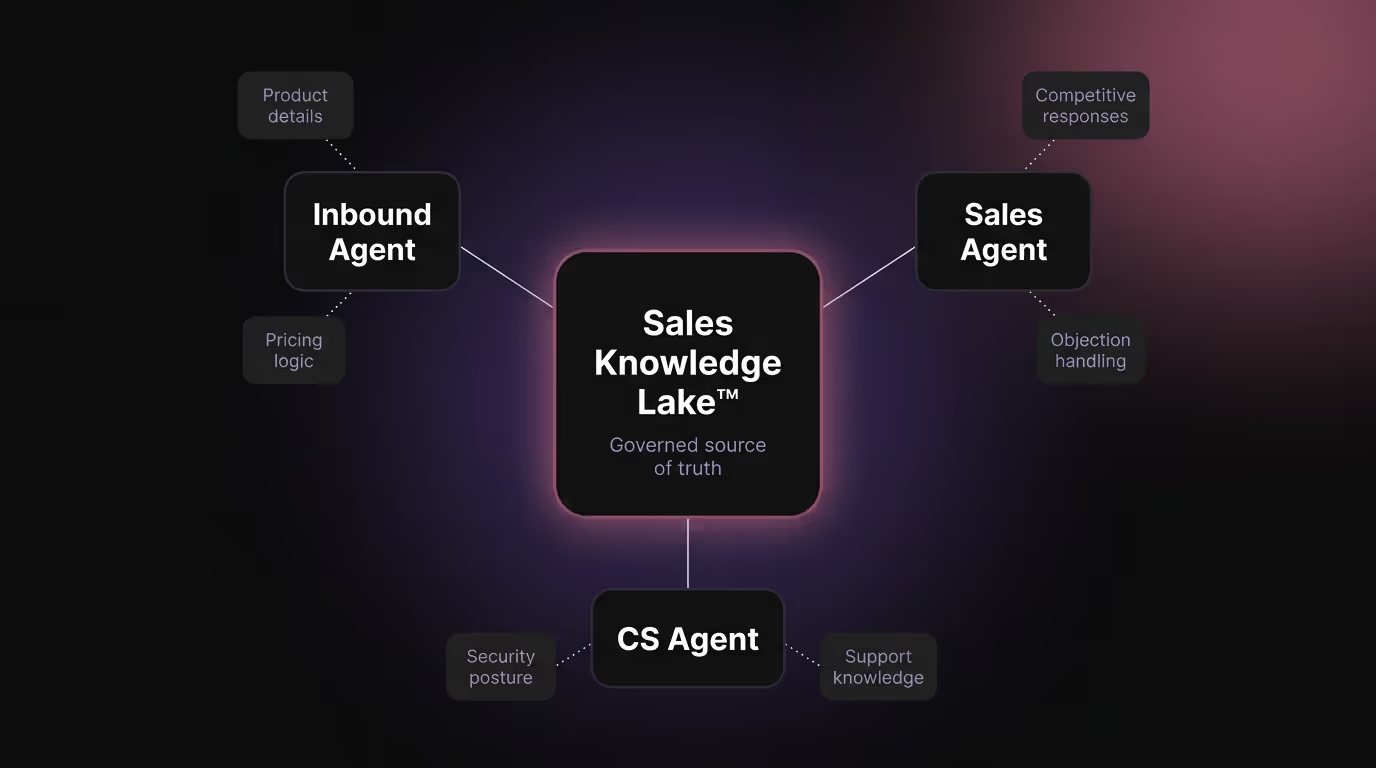
The platform is built to expand. The same architecture that powers the inbound and sales already supports vertical-specific agents, partner enablement, PLG onboarding, and more — all drawing from the same governed knowledge foundation, without rebuilding anything.
Learn more: How Docket's multi-agent architecture upgrades every stage of your GTM engine
At Demandbase, 93% of seller queries are now automated through that governed knowledge foundation — deployed in under two weeks. Aaron Bird, CEO of Inflection.io, put it plainly: "Reps respond confidently in real-time instead of promising to follow up. We were live in days."
That's not a 6-month implementation. Docket goes live in 1 to 2 weeks — not a proof of concept, but a live agent on your website, qualifying real buyers.
Most teams start with inbound. It's the highest-visibility leak, the fastest to deploy, and the one that directly shows up in Thursday's pipeline review.
See what the Marketing Agent and Sales Agent look like in your stack: docket.io/for-marketing