How Manufacturers Lose Revenue in Accounts They Think They Own
May 13, 2026



In manufacturing and industrial distribution, the accounts most at risk of stagnation aren't the ones with rocky relationships. They're the ones everyone internally labels as "healthy."
Healthy, in most CRM systems, means renewing, not churning, and not escalating. What it rarely captures is whether that account is buying your fluid handling products but sourcing your conveyor components from a competitor. Or running three facilities but only actively managed at one.
As procurement teams at enterprise manufacturers have grown more sophisticated — segmenting suppliers, running multi-sourcing strategies, and separating buying decisions by category or plant — the white space inside large accounts has become structurally harder to see. And the stakes are high: 73% of B2B revenue comes from existing customers in the form of renewals, cross-sell, and upsell, yet most key account teams have no systematic way to see where those same customers are spending with someone else. When you factor in that 20% of your customers typically drive 80% of your revenue, an unmapped share-of-wallet gap inside your top accounts isn't a minor inefficiency. It's a material risk to growth.
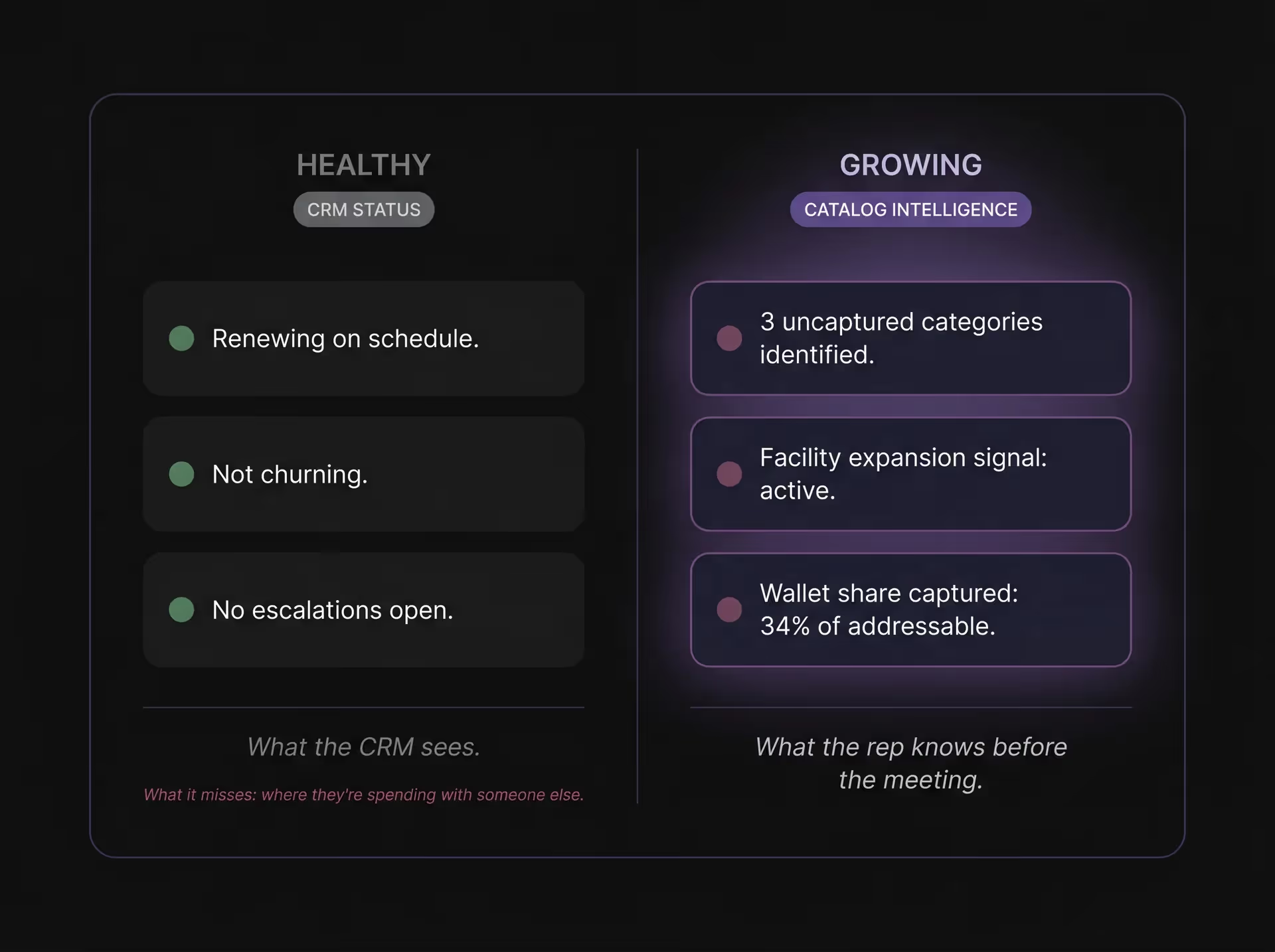
Most sales teams are sitting on significant untapped expansion revenue inside their existing customer base. The barrier isn't access or relationship quality. It's a lack of systematic visibility into how those accounts actually buy across categories.
This post covers how leading sales teams in manufacturing are approaching white space analysis and turning unmapped opportunity into a repeatable motion. The same infrastructure gap that causes slow quotes and shallow rep knowledge in the first two blogs in this series shows up here in a third form: an inability to see where your best accounts are spending with someone else.
What is white space in manufacturing sales?
White space is the gap between what a customer buys from you and what they could buy from you, based on your catalog, their application needs, and their actual purchasing behavior across categories. In manufacturing and industrial distribution, this gap is often substantial. Enterprise accounts running multi-sourcing procurement strategies deliberately spread spend across vendors. The rep managing the account may own one or two product families and have no visibility into three others the customer is sourcing elsewhere.White space is not the same as upselling a larger quantity of something a customer already buys. It is identifying the categories, product lines, and applications where your catalog has full coverage and the customer has full need, but the connection between the two has never been made.A CRM search tells you what a customer bought from you. Governed catalog-to-account intelligence tells you what they could be buying from you that they're currently buying elsewhere. That gap is where the opportunity lives.
Most key account teams in manufacturing are doing the right things relationally. They show up to QBRs. They renew on time. They respond when the customer calls. What they are not doing, in most cases, is systematically expanding the revenue those accounts represent.
The distinction matters. Account management is about protecting what you have. Account growth is about capturing what you haven't mapped yet. A QBR without catalog-to-account mapping is a retention tool, not an expansion tool. The format of the meeting isn't the problem. The data going into the room is.
A rep with a strong whale account typically knows which product lines that customer reorders regularly. They know the primary buyer and probably the plant manager at the main site. They track renewal dates and price escalation conversations.
What they don't have is a structured answer to: which product categories is this customer buying from a competitor that we also carry? Which of their facilities are active and which are unmapped? Has anything changed in their operations, such as a new production line, a facility expansion, or a capital equipment upgrade, that puts them in an active buying window for products we sell?
Without those answers, every account review defaults to a check-in. The rep asks how things are going. The customer says fine. Nothing changes about the share of wallet the distributor actually captures.
Multi-sourcing is not a sign of dissatisfaction. It is standard procurement practice at most enterprise manufacturers. Buyers deliberately split spend across vendors to manage supply chain risk, maintain pricing leverage, and preserve flexibility at the category or plant level.
As Industrial Distribution's research confirms, even if you are a customer's top choice, you lose valuable sales if you are not their only choice. Most B2B buyers have no strong reason to consolidate spending without a specific, data-backed reason to do so. The rep who can provide that reason — here is what you are buying elsewhere that we carry, at the same spec, with better lead times — wins the category conversation. The rep who can't, doesn't.
The white space problem in manufacturing accounts shows up in two distinct ways. They look like separate problems. They share a root cause.
A rep managing a large account knows what that customer buys from them. They do not know what that customer could buy from their catalog that they are currently sourcing from a competitor. The catalog has coverage. The rep doesn't have visibility into where that coverage maps to unmet demand.
Proton.ai's research published in Industrial Distribution states it plainly: customers don't know everything you sell, and they buy products from competitors they could buy from you. Demanding sales reps grow accounts without direction about which categories or products to suggest to each customer is rarely effective.
This is not a rep knowledge problem in isolation. It is a data infrastructure problem. The customer's application profile, what they make, how they make it, what products those processes require, is not connected to the distributor's catalog in any systematic way. So the rep works from memory and relationship, which covers maybe 30% of the addressable wallet.
The second failure mode is timing. A customer who has just commissioned a new production line, upgraded their power infrastructure, or expanded into a new facility is actively in the market for products you sell, right now. That buying signal exists. It is just not reaching the rep.
In most manufacturing sales organizations, the rep finds out about a facility expansion when the customer mentions it on a call. By that point, a competitor who was watching for the signal has already submitted a quote for the new equipment categories. The rep is playing catch-up from inside a relationship they thought was solid.
The catalog intelligence gap and the market intent gap have the same underlying cause: your product catalog and your customer data are not connected. The catalog knows what you sell. The CRM knows what the customer has bought from you. Neither system tells the rep what the customer buys elsewhere, which of your products map to their unmet applications, or when they have entered an active buying window.
That connection, between catalog depth and account-level purchasing behavior, is where white space becomes visible. Without it, it stays hidden. This is the same infrastructure gap addressed in the previous two blogs in this series, showing up in a third form.
The shift toward account expansion as a primary growth lever is not a trend. It is a structural reality of the current B2B environment.
52% of new B2B revenue in 2025 comes from existing customer expansion, up significantly from prior years, according to the Ebsta x Pavilion 2025 GTM Benchmarks via Gradient Works. The fastest-growing companies are not outrunning competitors on new logo acquisition. They are finding and closing the gaps in their existing accounts.
This matters particularly in manufacturing, where 78% of B2B buyers report being more careful with spending than before, and 75% say they are taking longer to make purchase decisions. In a buyer environment defined by caution and longer cycles, expanding within an established, trusted account relationship is a materially faster path to revenue than opening new ones.
Engaged C-suite relationships inside existing accounts increase upsell potential by 189%, according to the same Ebsta x Pavilion research. The implication is direct: data-backed account reviews that reach senior buyers in existing accounts generate disproportionate returns compared to relationship-only conversations at the operational level.
Revology Analytics ran a wallet-share diagnostic for a mid-market distributor of plumbing and electrical supplies. The analysis surfaced $2.4 million in untapped cross-sell opportunity. Of that, $2 million was sitting in a single core category the team was overlooking entirely. A separate engagement for a different distributor surfaced $20 million.
One category. Two million dollars. Already in their catalog. Invisible to the team until someone ran the analysis.
These are not anomalies. They are what happens when you run structured affinity analysis, mapping what customers buy against what they could buy from your catalog, for the first time. As Revology frames it, the goal is to move from asking "what else can I sell you?" to "customers who buy Product A also buy Product B to reduce downtime. Can we explore whether that is a fit for your application?" That shift in language only happens when the rep has the data to make it specific.
This is worth stating plainly because it changes the fix. Most sales leaders who see stagnating key account revenue reach for a sales execution solution: more calls, better QBR formats, more senior rep attention, revised comp structures.
A visibility problem does not respond to execution pressure. If the rep doesn't know which categories are available to capture, calling more often doesn't change the outcome. The fix is infrastructure, not effort.
The newsletter that informed this post asked one sharp diagnostic question: for each of your top 20 accounts, do you know which product categories they are buying from a competitor that you also carry? If the answer is no, you are not managing those accounts. You are maintaining them. Here is how to find out where you stand.
For most manufacturing sales teams, the honest answer to all three questions for their top 20 accounts is: we don't know. That is the diagnostic. The white space isn't absent. It's unmeasured.
The practical difference between a maintenance motion and a growth motion shows up most clearly in how the account review is structured.
A maintenance account review starts with: how are things going? The customer gives a relationship update. The rep confirms the renewal is on track. They discuss any open service issues. The rep leaves with confidence that the account is healthy.
A growth account review starts with: here is what we know about your current purchasing profile across our catalog, here are three categories where our data suggests you are sourcing elsewhere, and here is why our offering in those categories is worth a conversation. That is a different meeting. It requires different preparation.
A distribution company Docket works with tens of thousands of SKUs across multiple product families. Their top 20 accounts drove the majority of revenue. What they did not know was that several of those accounts were actively purchasing adjacent product categories from two competitors, categories that mapped directly to applications the distributor already served.
Once they connected their product catalog to their account data and mapped application need against purchase history through Docket's AI Marketing Agent, their reps could walk into account reviews with a specific, data-backed conversation rather than a generic check-in. The upsell rate on those accounts improved materially within two quarters.
The change was not in the rep's relationship skills or call frequency. It was in what the rep knew before they walked in the door.
What makes Docket's approach different from a CRM report or a quarterly analytics pull is the governing layer underneath it. CRM tools tell you what a customer bought from you. BI tools tell you patterns in historical data. Docket's AI Marketing Agent connects your product catalog depth to customer application history and purchase behavior in a single governed workflow, drawing answers from approved sources rather than open-ended inference.
The rep gets a structured view of where the white space is before the conversation starts. Not as a general prompt to explore upsell opportunities, but as a specific, category-level view of where the account's spend is going elsewhere. And the insight is available before your next account review cycle, not after a six-month data project.
White space does not wait. Here is what it looks like over a three-year horizon when a manufacturer or distributor runs maintenance-mode account management on their top accounts.
Year 1: Competitors identify the same gaps in your accounts that you haven't mapped. They pitch the uncovered categories. A few get added to the approved vendor list. The account still renews with you on the lines you own.
Year 2: The competitor's foothold in those categories deepens. They are now integrated into the procurement workflow. The buyer has a contact, a pricing reference, and a reorder habit. Your rep still doesn't know the categories exist as a gap.
Year 3: The categories are entrenched. Displacing a vendor from an approved vendor list requires a formal procurement process, a price justification, and an operational transition the buyer has no motivation to run. White space that was capturable in Year 1 is now behind a structural barrier.
The compounding math runs in both directions. Manufacturers and distributors with catalog-to-account intelligence are identifying white space inside your accounts and moving to capture it systematically. The one that builds this capability first creates an asymmetric advantage: they know where the gaps are across their portfolio before anyone else has the visibility to compete for the same ground.
The growth you are looking for is already inside your existing accounts. The question is whether you have the infrastructure to see it.
Docket's AI Marketing Agent maps your product catalog against customer purchase history and application needs, so your reps walk into every account review knowing exactly where the white space is. See how manufacturers are finding six and seven figures of expansion revenue inside accounts they already thought were fully penetrated.
See how it works at docket.io/request-for-demo
Why Speed-to-Quote Is the #1 Win Rate Variable in Manufacturing Sales — If white space is visible but your quote cycle is 6 days, you will lose the expanded opportunity before it closes.
Deep Catalog. Shallow Reps. Why Manufacturing Sales Teams Lose on Specification. — The accuracy problem that sits between catalog depth and rep access, addressed in full.