7 Ways Agentic Marketing Fixes Structural Failures in the B2B Funnel
May 6, 2026



For most B2B SaaS companies with established inbound programs, the traffic isn’t the problem. The conversion infrastructure between that traffic and a sales conversation is. It was designed in an era of form fills and 48-hour response windows and it has never been updated to reflect how buyers actually behave now.
More budget flowing into a structurally leaky funnel doesn’t fix the leak. It just raises the waterline temporarily.
This post maps the seven structural failure points in the classic demand gen funnel — where intent gets lost, where buyers disengage, and where deals die quietly — and explains specifically what agentic marketing for demand generation does at each stage that a traditional martech stack cannot.
When pipeline conversion goes flat, the instinct is to optimize harder: tighter forms, better nurture sequences, a lower MQL threshold, another SDR on the team. These are reasonable responses to a calibration problem. They are the wrong responses to a structural one.
Most of what’s being sold as ‘agentic’ is relabelled automation — smarter rules, better scheduling, faster triggers — running on the same handoff architecture that’s been leaking pipeline for years. Most teams evaluating solutions right now are being shown a faster version of the model that’s already failing them.
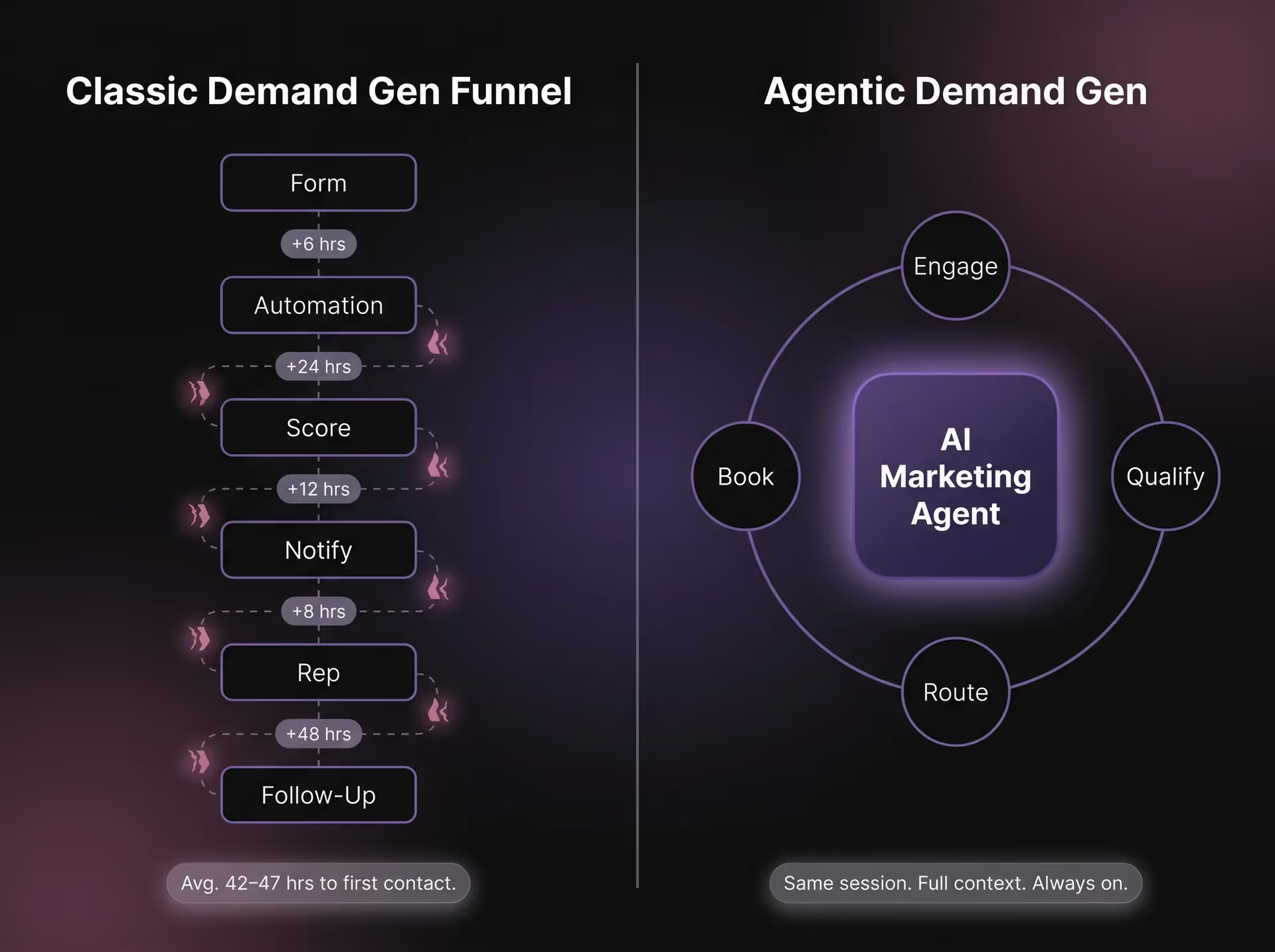
The classic demand gen funnel runs on handoffs. Traffic arrives, a form captures it, automation scores it, a rep gets notified, and the rep follows up when available, during business hours, with no context beyond a name and an email. Every step depends on a human to initiate the next one. Every step introduces delay.
Genuine agentic marketing for demand generation replaces that dependency structure. AI agents handle the buyer engagement motion continuously — engaging visitors, qualifying intent, routing, booking, logging — within guardrails the marketing team defines. Humans set objectives and review outcomes. The agent handles execution in between, around the clock, without needing to be triggered.
The seven leaks below are exactly what the old model can’t fix regardless of how well you tune it. The problem isn’t the tuning. It’s what the system was built to do.
The response to this problem is almost always faster SDR follow-up, tighter SLAs, better lead routing. These address what happens after a buyer submits something. None of it touches what happens to buyers who never submit, because the capture layer was asleep when they arrived.
The average time from a buyer’s first website visit to a rep’s first contact is 42–47 hours. Research shows qualification likelihood drops 21x when response time moves from 5 minutes to 30. At 42 hours, the shortlist is already forming without you.
What agentic marketing for demand generation does differently: An always-on AI Marketing Agent engages visitors the moment they land, at any hour, without waiting for a form submission or a human trigger. A B2B marketing analytics company found that 77 percent of their high-value conversations — the ones that ended in booked meetings — happened outside business hours. That pipeline existed the whole time. The infrastructure to catch it didn’t.
If you want the full breakdown of where exactly that pipeline disappears, we mapped all seven structural reasons: The 7 structural reasons 40–60% of your inbound leads disappear before a rep sees them
Form optimization gets treated as the lever: fewer fields, cleaner copy, a better button. Teams A/B test their way into marginal conversion lifts and conclude the form is working harder. What they’re actually doing is making a gate slightly less annoying while leaving it in exactly the wrong place.
The average B2B SaaS website converts as low as 1.1 percent of visitors. The other 98.9 percent leave without telling you who they were or what they needed. It’s friction at the highest-intent moment in the buying journey. Adding a progress bar to the form doesn’t change what the form fundamentally does: it stops a buyer mid-thought and asks them to earn the right to ask a question.
Then there’s the other side of the problem: 58 percent of companies never respond to the leads their forms do capture. The form creates friction for the buyer and a backlog for the rep, and the output is a contact record with a name, an email, and nothing that tells anyone what the buyer actually wanted.
What agentic marketing for demand generation does differently: Docket customers see 36 percent conversation start rates compared to 13 percent on legacy form flows, with an 11 percent lift in overall website engagement when conversation replaces the form. Same traffic. Very different results. Qualification happens inside the conversation rather than before it — no gate, no interrogation at the moment a buyer is most ready to engage.
For a detailed look at why the scripted widget was never the answer either: Why AI Marketing Agents beat rule-based chatbots on every revenue metric that matters
MQL underperformance almost always gets diagnosed as a weights problem: the scoring model needs recalibration, the threshold is off, the inputs need refreshing. That diagnosis assumes the model is measuring the right things. It isn’t. It’s measuring behavioral proxies collected days after intent occurred, and by the time a lead crosses the threshold, the window has often already closed.
The full history of why every fix failed, progressive profiling, intent data, ABM, chatbots — is here: AI Didn't Kill the MQL. It Was Already Broken When AI Arrived
At any given moment, only 5.5 percent of your website visitors are ready to buy. A model that scores email opens, page visits, and whitepaper downloads won’t catch them in time, no matter how accurately the weights reflect historical win patterns.
What agentic marketing for demand generation does differently: When a buyer asks about SOC 2 compliance and API rate limits in the same session, that’s not a signal to score later — it’s a qualification event happening right now. The AI Marketing Agent captures that intent in the conversation and acts on it immediately.
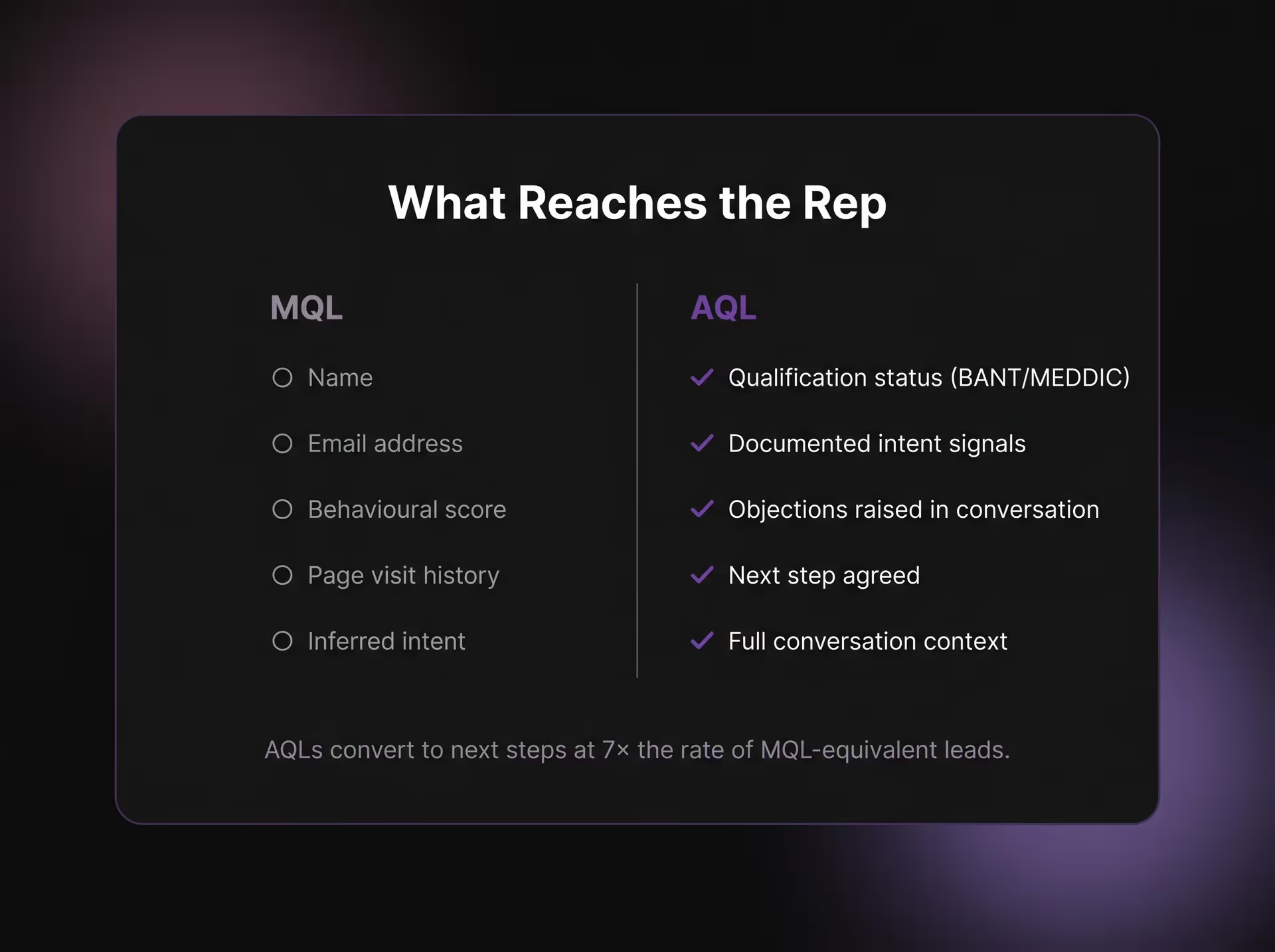
The result is an Agent-Qualified Lead (AQL). Unlike an MQL — which is a score inferred from behavioral signals like page visits and email opens — an AQL is produced from a structured, AI-led conversation where the buyer has articulated their intent and been matched against your ICP criteria in real time. What reaches the CRM isn’t a score. It’s a documented conversation: qualification status, intent signals, objections raised, next step agreed on. AQLs convert to next steps at 7x the rate of MQL-equivalent leads from the same traffic source. The rep doesn’t start from a blank slate. They start from a context card.
Nurture underperformance gets blamed on content: wrong sequence, wrong cadence, subject lines that aren’t punchy enough. Teams split-test their way into marginally better open rates without addressing what’s actually broken. Nurture runs on a calendar, not on what the buyer is doing.
The drip sequence goes out on the schedule you set. A buyer revisits your pricing page at 11pm Tuesday. Your next email lands Thursday morning. That’s not a calibration error — it’s how broadcast automation was designed to work. It executes pre-written logic on a timeline. It can’t watch a buyer return and respond to that signal in the moment.
Behavioral trigger emails generate 42 percent open rates against 14 to 26 percent for scheduled broadcasts. Nurtured leads who receive timely, relevant follow-up make 47 percent larger purchases. The constraint isn’t the content. It’s the architecture.
What agentic marketing for demand generation does differently: Agents respond to signals rather than schedules. That same pricing page revisit at 11pm — the one your drip sequence won’t acknowledge until Thursday morning — triggers an immediate agentic response. The agent is present when intent spikes, answers the question forming in that moment, and creates forward motion while the momentum is still there.
Content strategy gets measured at the top of the funnel: traffic, downloads, email captures. Those are the metrics content teams are accountable for, so that’s what content gets built to produce. The result is a library that’s excellent at attracting buyers and useless once those buyers enter an active evaluation.
66 percent of content downloaders aren’t ready to buy for 12 months or more after downloading. When a serious buyer is asking about integrations, compliance, or implementation timelines, your content isn’t in that conversation. A form, a wait, and a generic follow-up are.
When a buyer asks “how do you handle multi-tenant SOC 2 compliance?” or “does this work with our Salesforce instance and our data warehouse?”, they need an answer. Not a link to a whitepaper that breaks their momentum.
What agentic marketing for demand generation does differently: The AI Marketing Agent draws on approved knowledge to answer evaluation questions directly inside the conversation, in real time. A B2B data governance company found through Docket that their integration with a leading cloud-based digital experience platform was their strongest buying signal — something that only surfaced because it kept appearing in live evaluation conversations. No scoring model would have found it. It took an agent having the actual conversation and connecting that signal to a buying outcome.
Context loss at handoff gets treated as a rep behavior problem: not reviewing the contact record carefully enough, needing better pre-call prep. But the contact record isn’t blank because the rep didn’t look at it. It’s blank because the infrastructure upstream was never designed to write anything meaningful into it. The MQL handoff passes a name, an email, and a score. That’s what the architecture was built to transfer.
The rep calls. The buyer picks up. “So, tell me a bit about what you’re looking for.” The buyer, who spent 22 minutes with your agent two days ago explaining exactly that, starts over.
Docket customers observe 50 to 70 percent fewer unqualified meetings reaching sales after implementing AQL handoffs, because qualification happened during the agent conversation rather than getting delegated to the first sales call.
What agentic marketing for demand generation does differently:The handoff arrives with a fully populated context card: qualification status, intent signals, pain points raised, objections identified, next step agreed on. The rep knows what the buyer cares about before the call starts. Demandbase automated 93 percent of their seller queries using Docket’s governed knowledge foundation — in under two weeks. The rep walks in informed. The first call is a closing conversation, not a re-introduction.
Velocity problems get solved with SDR headcount: more reps, tighter SLAs, better routing rules. These close the gap at the margin without changing the fundamental clock speed of a process that runs in days.
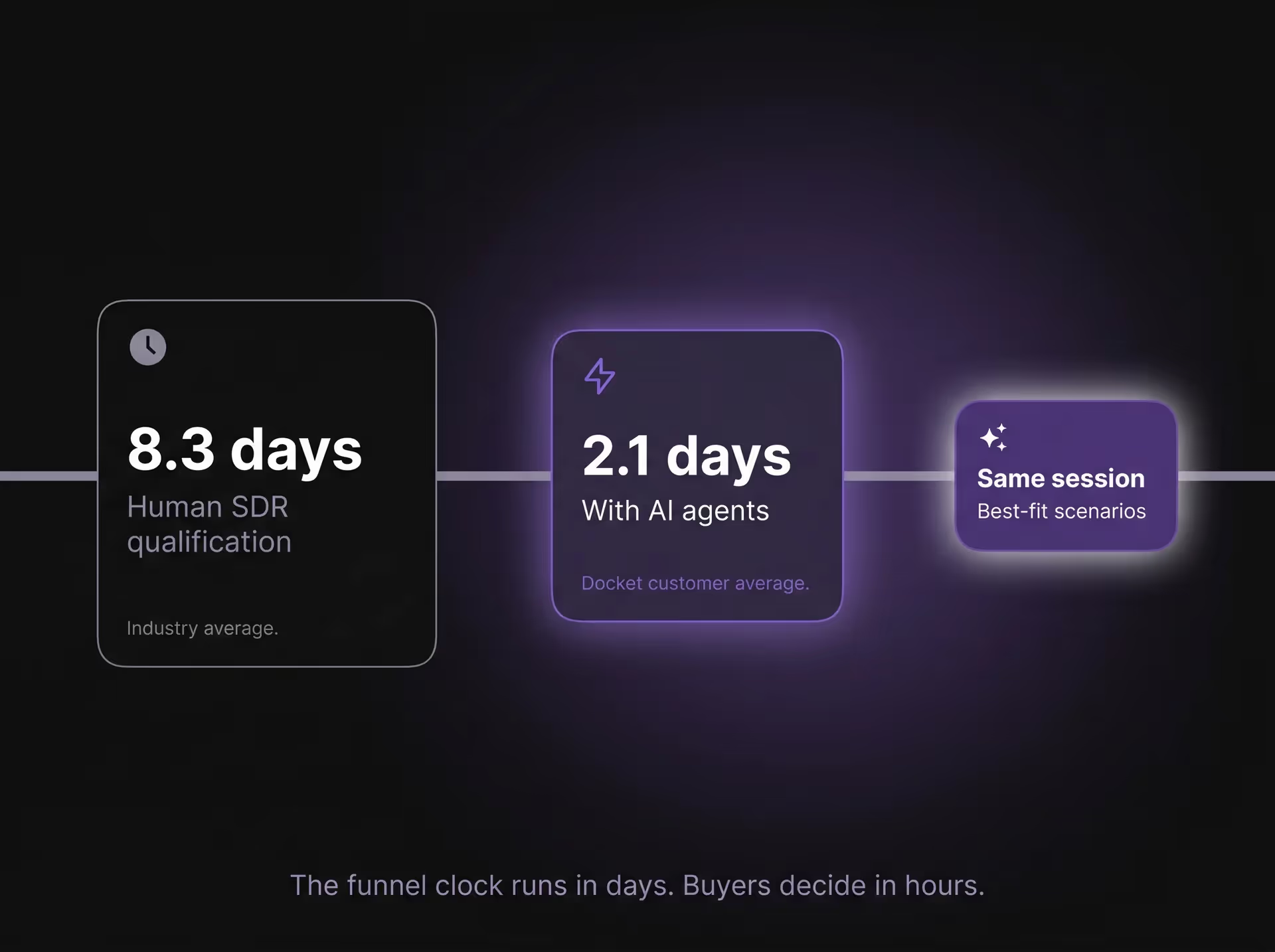
The average time from first website visit to booked meeting in a human-qualified pipeline is 8.3 days. Buyers doing AI-assisted research shortlist vendors in hours. High-intent leads convert at 75 to 80 percent when engaged in the same session they arrive; in a standard SDR queue, that number drops to 5 to 10 percent. It’s not about rep quality. It’s about whether the execution layer can meet a buyer inside their intent window.
What agentic marketing for demand generation does differently: A B2B marketing analytics company booked 23 meetings in two weeks running Docket, a 5.3x above-baseline conversion rate, with 77 percent coming from conversations outside business hours. Docket customers see the 8.3-day qualification window compress to 2.1 days across the customer base, and in best-fit scenarios it collapses to the same session the buyer arrived in. That’s not faster SDRs. That’s a different execution layer.
For the complete data on how AI agents compress the qualification phase: How AI Agents like Docket cut sales cycles by 10–30%
The classic demand gen funnel was designed for a world where buyers depended on vendors for information, where 48-hour response windows were the norm, and where humans were the only available execution layer between a website visit and a sales conversation. All three of those conditions have changed. The funnel hasn’t.
The form does exactly what a form does. It just wasn’t built for a buyer who expects an answer at 11pm and moves on in minutes if they don’t get one.
Agentic marketing doesn’t fix the old funnel. It replaces the architecture underneath it — an execution layer that catches what the form misses, at any hour, and hands reps the context they need to run a first call worth having.
The high-intent buyer is on your site right now. See how Docket’s AI Marketing Agent works across the funnel → docket.io