Drift Is Dead. Before You Accept Salesloft's Recommendation, Read This.
March 24, 2026



Drift is down. Not being deprecated sometime this quarter — already offline for remediation following a widely-reported OAuth token theft incident. Salesloft's March 6 announcement retired the product entirely and pointed every Drift customer toward one replacement.
You have 60–90 days before your contract expires or access is cut. Salesloft has made their recommendation. But a strategic partnership for them doesn't automatically equal a seamless migration for you.
Here's what that recommendation means for your deployment timeline, your CRM hygiene, and your pipeline — and the questions you need to ask before you sign anything.
Salesloft (now Clari + Salesloft) recently announced a strategic partnership, framing it as a "seamless transition to AI-driven revenue orchestration." Their partner's photorealistic AI avatars become the buyer-facing layer for Salesloft's platform going forward.
The announcement is strategic. Salesloft is repositioning from a sales engagement tool into a broader "Predictive Revenue System." Their avatar layer gives them a buyer-facing story to sell to boards.
The narrative is clean. The operational reality for Drift customers is not.
Salesloft's recommendation assumes your highest priority is staying within their ecosystem. But if your inbound pipeline is currently offline, your highest priority is getting a reliable, accurate agent live before your window closes.
Before committing to a migration, evaluate the three variables that actually determine whether your inbound motion survives the transition.
Most Drift customers have 60–90 days. The partner requires avatar production, persona workshops, content ingestion sessions, and multiple testing iterations. The timeline is typically 2–3 months before you're handling real buyer questions.
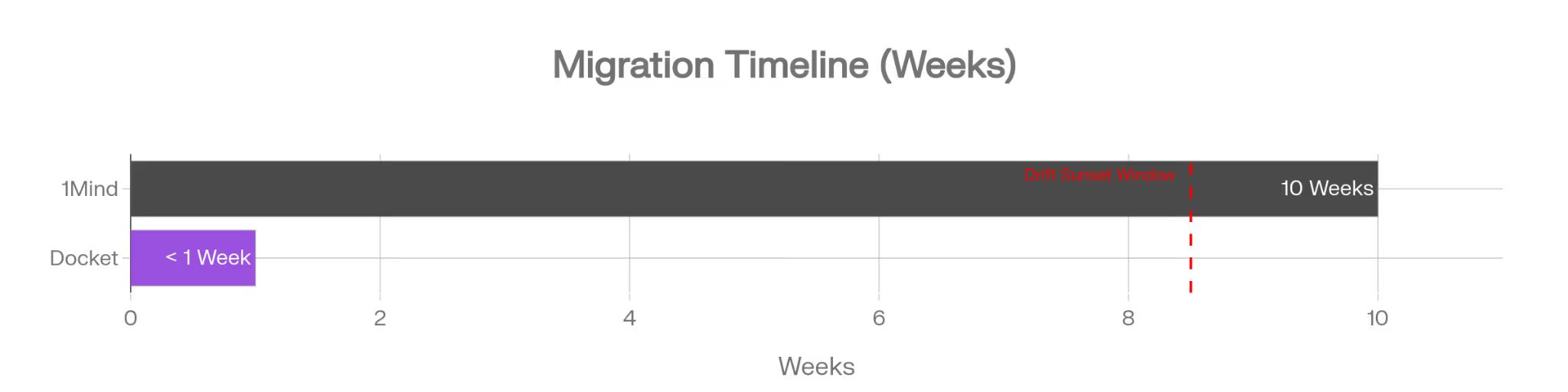
Your 60–90 day window and a 2–3 month setup requirement are the same number. If anything goes wrong in testing, you miss your deadline. And once live, initialization matters: in our benchmarking, their avatar takes over 13 seconds to load before the first word is spoken. For a high-intent buyer at 11pm, 13 seconds is a conversion killer.
"They" are a partner, not a Salesloft product. More importantly, their avatar layer relies on third-party infrastructure.
You're not buying a single platform. You're buying a stack of dependencies you didn't choose: Salesloft's platform, their application, and their avatar provider's API. When the avatar gives a wrong answer, or the underlying provider deprecates a feature, who owns the fix? In whose sprint queue does it live? You're inheriting a vendor dependency that sits directly between your buyers and your pipeline.
Drift's playbooks were only as good as what you programmed. When a buyer asked something your flow didn't anticipate, Drift either routed them to a human or gave them nothing.
The question for your next platform isn't whether it has a face. (Every serious platform, including Docket, now supports avatars.) The question is what that face says when a CFO asks about your security posture.
Their partner trains on company content fed during onboarding. The result is general AI responses with less governance over sensitive topics. There's no continuous ingestion from live systems and no version-controlled governance layer. The moment your pricing changes or a new product ships, 1Mind's knowledge goes stale until someone manually re-ingests it.
Yes, but the right question is what kind.
Salesloft announced the sunset on March 6, 2026. They have not published a hard end-of-life date. That is not reassurance. It means your access could degrade or end without a formal warning window. Feature investment has already stopped. Integration stability is not guaranteed. Support response times are not contractually backed against a product being wound down. The teams that wait for an official cutoff date to appear are the ones that run out of runway.
The practical window to migrate, configure, and go live on a new platform before something breaks is now. Not when the date is announced.
Drift was a scripted chatbot with a limited AI layer bolted on. It followed playbooks. When a buyer went off-script -- asking about your security posture, a specific integration, or a pricing edge case; it routed them to a human or gave them nothing. The conversation died. That is not an architecture problem you fix by adding an avatar. It is an architecture problem you fix by rebuilding from a different foundation entirely.
An AI agent is not a better chatbot. The difference is not the interface. It is what happens when the conversation gets hard.
A scripted chatbot executes flows you built in advance for questions you anticipated. An AI Marketing Agent reasons from a governed knowledge layer -- your product docs, pricing materials, security FAQs, CRM data, call recordings -- and handles the questions your playbooks never covered. It qualifies intent in real time using BANT, MEDDIC, or your own criteria. It routes, books a meeting, and syncs full context to your CRM, without a human in the loop at each step.
The output is not a contact. It is an Agent Qualified Lead (AQL, coined by Docket) -- a lead with documented intent, qualification status, and a full conversation record ready for your rep before the first call.
Salesloft's recommended replacement is 1Mind's AI agent, Mindy. The pitch is straightforward: a photorealistic AI avatar that sits on your site, qualifies visitors, and delivers live demos. It sounds like a meaningful upgrade from Drift. The operational reality is more complicated.
Mindy is built on an avatar-first architecture. The deployment timeline runs 2 to 3 months -- avatar production sessions, persona workshops, content ingestion cycles before a single real buyer question is handled. As covered above, that window and your Drift runway are the same number.
The knowledge problem persists after go-live. Mindy trains on content fed at onboarding, with no continuous ingestion from live systems. Pricing changes, new product launches, security posture updates -- all go stale until someone manually re-ingests. And because Mindy is a partner product, not a Salesloft-owned platform, the fix for a wrong answer lives in someone else's sprint queue.
Docket is built differently. There is no avatar production requirement. The AI Marketing Agent goes live in 3 to 7 business days. It answers from a governed knowledge foundation called the Sales Knowledge Lake, which ingests continuously from your product docs, CRM data, Gong calls, Slack threads, and security materials. Answers stay current because the knowledge layer stays current. And because Docket is built end-to-end by a single team, there is no third-party dependency sitting between your buyers and your pipeline.
Drift took your forms offline. Not migrating is not a neutral choice. Every week without a buyer-facing layer is pipeline you cannot recover.
Your buyers ask questions that routes and sequences were never built for. Technical integrations. Security reviews. Pricing edge cases. Scenarios Drift deflected. An AI agent handles these from approved knowledge. No improvisation, no handoff to a form.
Your SDRs are following up on cold signals. If your team is working raw form fills and hoping for the best, an AI agent that qualifies intent before the handoff changes what your reps start with.
You are about to accept a replacement under time pressure without comparing the architecture. The 60- to 90-day window is real. It creates urgency. Urgency is how teams end up with the first option on the table rather than the right one. The platforms available right now range from another scripted layer with better UI to a fully governed, end-to-end agentic platform. They are not equivalent. Evaluate the knowledge foundation, the deployment timeline, and who owns the product stack before you commit.
Docket is the Agentic Marketing platform for B2B revenue teams. Its AI Marketing Agent opens a real conversation, answers from your approved product knowledge, qualifies intent in real time, and delivers an AQL to your rep.
Here is what that looks like in practice.
Docket isn't a stitched-together partnership. It's an Agentic Marketing platform built end-to-end to run your entire inbound buyer engagement motion — engaging visitors, answering product-expert questions, qualifying intent, routing to the right rep, and booking the meeting.
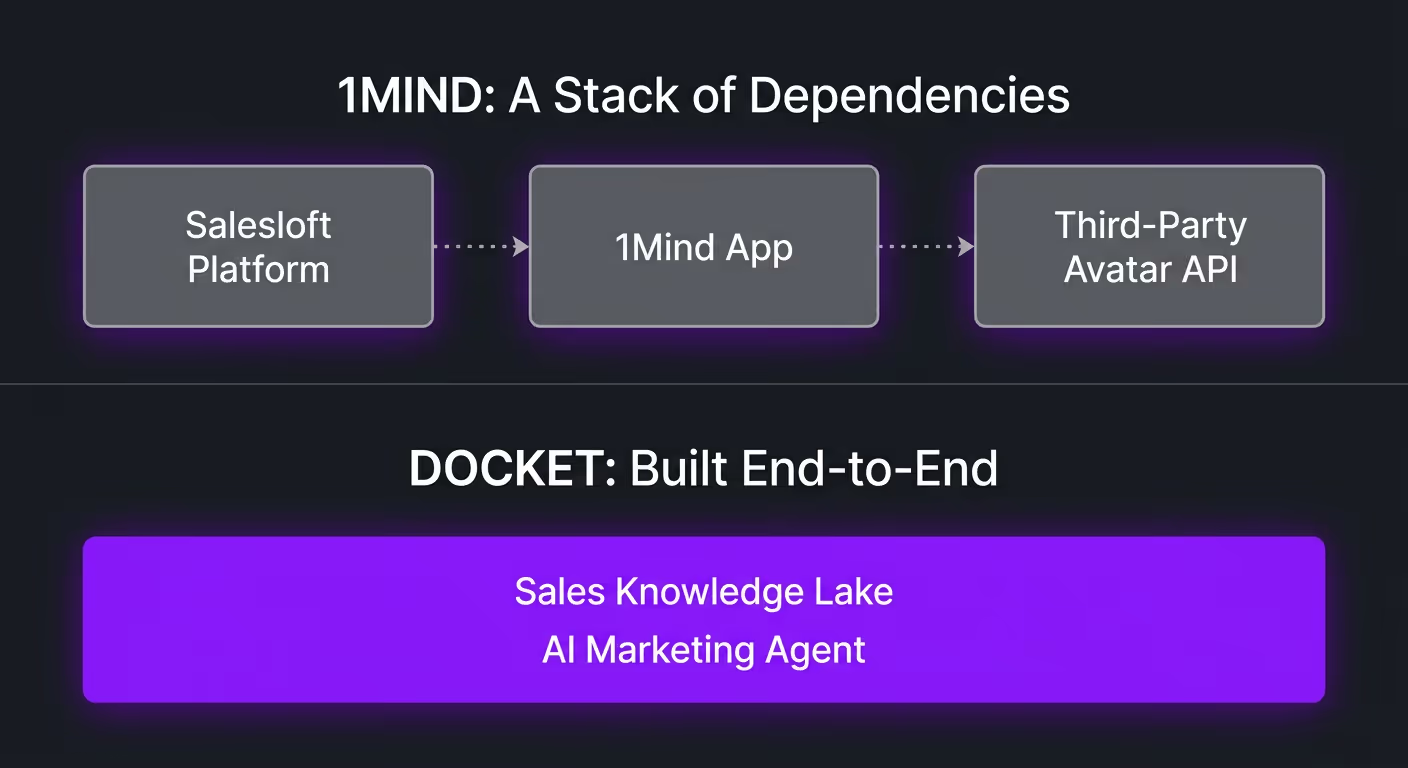
Your Drift playbooks don't get discarded. They become the starting point for your Docket AI Marketing Agent — ingested alongside your Gong calls, product docs, security materials, Slack threads, and CRM data into a single governed foundation called the Sales Knowledge Lake™. Your agent doesn't run scripts. It reasons from live, approved knowledge. It handles the questions your Drift bot never could, and because Docket is built end-to-end — platform, knowledge layer, and backend all owned by one team — there is no third-party dependency to wait on when you need support.
Docket's Customer Success team handles the full migration: knowledge ingestion, native CRM bi-directional sync with Salesforce or HubSpot, qualification routing, and agent configuration. No engineering required. You're live in 3–7 business days. And the results are measurable: Docket customers see conversation start rates of 3–6% compared to 1–3% on legacy flows, with a 15% lift in qualified pipeline.
You have 60–90 days. One option on the table takes 2–3 months to set up, costs $100,000+ before configuration sessions begin, and runs on infrastructure owned by someone other than the vendor you're signing with. The other goes live in under a week, covers up to three months of your remaining Drift contract, and is built end-to-end by a single team accountable for the whole thing.
The decision isn't complicated. The deadline is.
Book your Drift migration call → https://www.docket.io/resources/lp/drift-migration
(Offer available through June 30, 2026: contract buyout, free migration, and a 2-month paid pilot with opt-out.)