Why AI Marketing Agents Beat Rule-Based Chatbots on Every Revenue Metric That Matters
December 12, 2025



Back in 2017, Drift’s CEO David Cancel said: “The way we’ve been taught to work is perfectly suited for a world that no longer exists.”
Still painfully true.
Drift understood this deeply. They pioneered conversational marketing. They saw the brokenness of B2B buying. And then… the market changed faster than they did.
Channels changed. Cadences changed. Buyer expectations? Evolving weekly. Yet most companies still engage buyers like it’s 2017.
That disconnect sets the stage for why if-this-then-that style chatbots died, why conversational AI emerged, and why we're now entering a new era: marketing agents built for real-time reasoning.
But this isn't just about better software. It's about a new operating model — one called Agentic Marketing, where autonomous AI agents execute meaningful marketing work under human direction, and the human is no longer the bottleneck for every action. That's the shift this piece is about.
Drift pointed at the real villain in B2B: forms. On a B2B website, the only way to get in touch with a company is a form. And the only way companies collect user details is through a form. And forms have been (and still are) in plenty:
And forms have been broken for decades because:
So when chatbots arrived, people saw this “on-demand, I want information right now” mode and found it enterprising. The promise was real. But the delivery…not so much.
Rule-based chatbots gave us a new problem with an old face. They weren’t conversational. They were decision trees pretending to be helpful. “If the user says X, respond with Y.” That was the whole architecture.
Sure, they could handle predictable tasks:
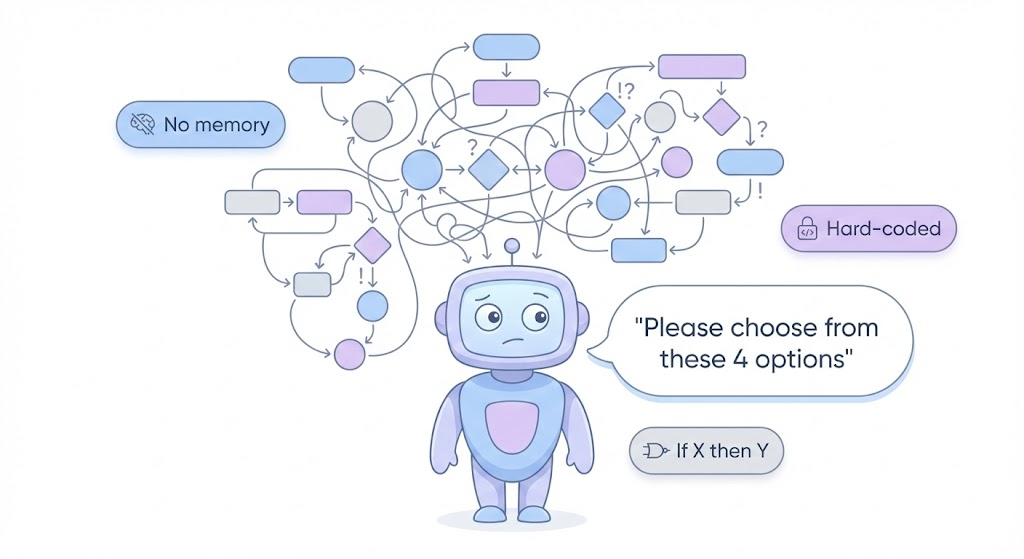
But real conversations require reasoning. Context. Memory. Those chatbots had none of it.
And building them was a grind. Teams had to map out every possible branch of the conversation. Imagine at a mid-market SaaS company, a PMM spending three weeks maintaining forty flows that broke every quarter. One pricing change, one new SKU, and the whole tree needed a rehaul.
Users felt that pain. Clicking through a rigid chatbot that can’t interpret natural language feels like arguing with an IVR machine.
Moreover, chatbots started hoodwinking users. Every chatbot asked the same fake-concerned question: “May I have your email in case we get disconnected?”
But you were never getting “disconnected.” You were a cookied user. You could come back 180 days later and still resume the conversation. The real goal wasn’t continuity. It was capture.
Even Drift, the category pioneer, couldn’t outrun the limitations of the tech.
Bottom line: chatbots died because they couldn’t deliver what buyers needed or what revenue teams actually care about—real, qualified pipeline.
Here’s the irony. Even though chatbots died, the original problem was still alive.
Then something really exciting happened that changed…everything.
The big aha moment was November 2022. ChatGPT launched.
Overnight, the default internet behavior shifted. People stopped browsing. They started asking.
And that shift didn’t stay inside ChatGPT’s window. It leaked into every digital experience. Including yours.
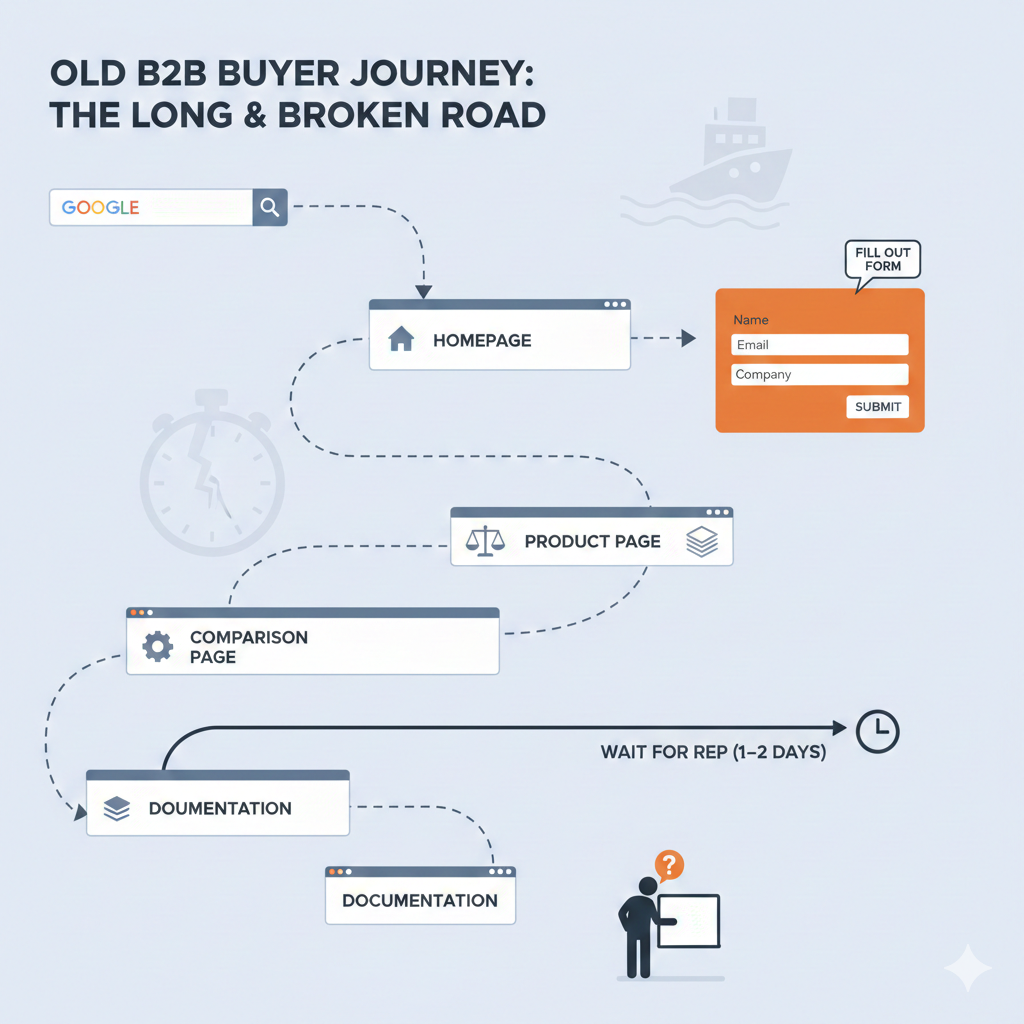
Think about the old B2B buyer journey: Google → your homepage → your product page → maybe a comparison page → maybe docs → finally, a form → wait for a rep → maybe get an answer in two days.
Now look at the new journey, shaped by ChatGPT: “We’re a 200-person SaaS company with a PLG motion. Can your product handle usage-based pricing across three regions?”
One question. One conversational answer. Right now.
That’s the answer engine expectation. Buyers expect your website to behave like an answer engine, not a brochure.

When they land on your site today, they:
They have a scenario. A stack. A constraint. A timeline. They want to know if you can handle it. Now.
Historically, the only way to deliver that level of depth was to put a human in the loop. A good AE. A sharp SA. Someone who could ask clarifying questions and reason in real time.
But now?
Agents can reason too. And that changes the operating model entirely.
Marketing has moved through three distinct operating models. Most B2B companies are still living in the second one.
Human-Led Marketing was the past. Humans did everything meaningful. Systems stored data and automated simple rules, but every decision — a follow-up, a qualification call, a campaign change — required a human to initiate it.
Assisted Marketing is the present. AI helps people move faster. It drafts emails, scores leads, summarizes calls, suggests segments. The workflow is still human-led. The AI is a very smart intern. This is where most vendors live today — including the ones relabeling old chatbots as "agentic."
Agentic Marketing is the next operating model. Autonomous agents execute meaningful marketing tasks — qualification, discovery, routing, follow-up, conversion — under human direction and governance. The human sets objectives, guardrails, and oversight. The agent handles execution.
The distinction between Assisted and Agentic is not subtle. An assisted tool makes a marketer 20% faster. An agentic platform changes what a marketing org can do at all — because the agent is no longer waiting for a human to initiate every action.
Winning teams have moved on from “intelligent” chat to something deeper: reasoning agents.
Example: “Hey, we’re a 150-person SaaS company with a PLG motion, EU customers, and a tiny RevOps team. Can your product handle our billing mess without a 6-month implementation?”
That’s not FAQ territory. Answering that requires reasoning.
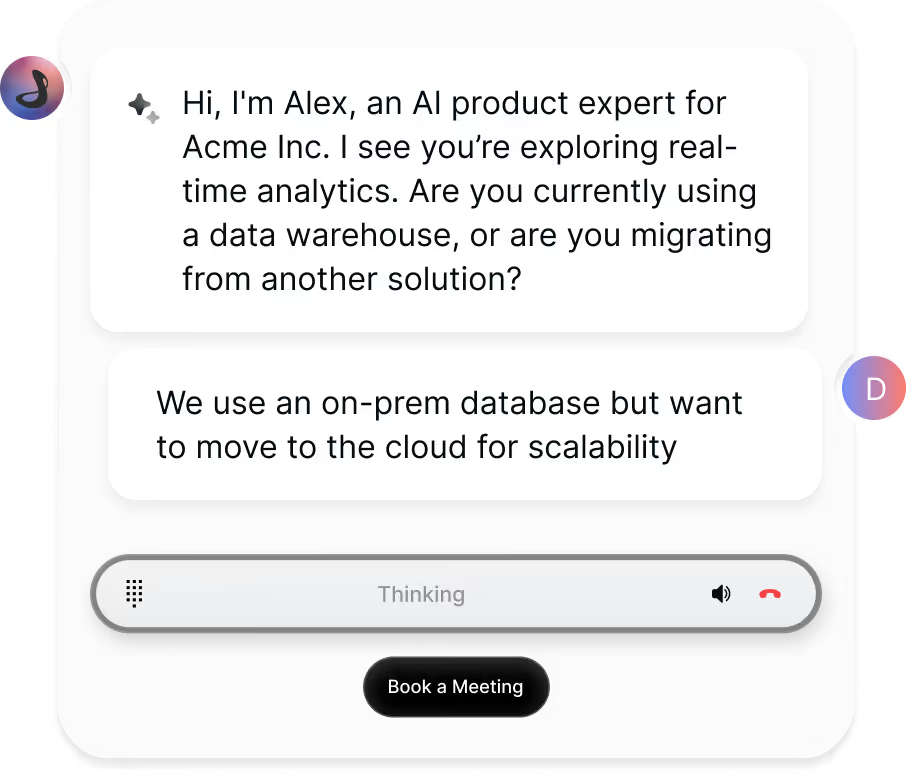
This is what forward-leaning marketers want right now. Not more sessions. Not more emails. More qualified conversations. More buyers getting to “Oh, this is for me” (or “this isn’t for me”) 10× faster.
Every website will have a concierge. And Marketing Agents — like Docket’s — are that concierge for B2B.
An AI marketing agent reasons by grounding itself in three layers of signal:
Then the agent runs multi-step reasoning: perceive → reason → decide → act, and responds with the best-fit and perfectly personalized answer.
When the agent doesn’t know something? It can fail gracefully. Guardrails can be set to ensure it can ask a clarifying question, offer the closest known alternative, or escalate to a human.
Imagine a visitor landing on Docket’s website asks: “Can your marketing agent replace our existing chatbot and help us qualify website traffic for our SDR team?”
Here’s what Docket’s Marketing Agent does in seconds.
One of the biggest breakthroughs in agents is something we call the Thinker–Responder Pattern.
The Thinker is the agent’s brain.
It’s responsible for:
Calling the right tools at the right time
Tools are atomic capabilities you plug into the agent, such as:
You don’t hard-code flows like “If they click this, then show that.” You add tools, and the Thinker learns when and why to use them based on goals and guardrails.
Planning multi-step flows
Instead of one-off answers, the Thinker plans:
The Responder turns the Thinker’s decisions into a conversation that feels human and on-brand. It’s responsible for:
Language and tone
Clarifying questions
It asks just enough to fill the gaps the Thinker needs:
Safety and escalation
For Docket’s customers, the Thinker–Responder pattern means three big things.
The gap isn't a feature gap. It's an operating model gap.
Here are some use cases that show how you can use Marketing Agents
This turns unstructured customer feedback into structured insights your team can act on.
Chatbots had their time. They promised a lot, delivered very little, and became internet wallpaper. Marketing Agents are not UI upgrades. They're architectural upgrades — and more than that, they represent a different operating model for how marketing gets done.
The shift from Assisted to Agentic Marketing is not about swapping one vendor for another. It's about changing who — or what — sits in the execution layer. The next great marketing org won't have humans managing every action. It will have humans managing goals, guardrails, and judgment — and agents handling the rest.
The companies that make that transition early won't just move faster. They'll be playing a different game entirely.
If you want to see what that looks like in practice, talk to Docket's AI Marketing Agent.