Unlocking Sales Expertise: How to Capture and Share Tribal Knowledge
April 15, 2026



Your best AE just quit. Did your sales knowledge just leave with them?
It happens every quarter. A top performer walks out the door with three years of deal intuition, objection-handling instinct, and hard-won product knowledge locked in their head. What is left behind is usually less impressive: a Notion doc no one has updated since 2023, a Gong library no one has time to audit, and a Slack thread that is now effectively an archaeological site.
That is the tribal knowledge problem. You already knew that. What changed is the blast radius. Once that same half-documented knowledge gets piped into AI, inconsistency stops being an internal annoyance and starts becoming a buyer-facing risk.
Capturing tribal knowledge still matters. But in 2026, the real job is not just to preserve it for onboarding or enablement. It is to turn it into governed, AI-ready sales knowledge that reps can trust, leaders can audit, and AI agents can use without going off-script.
Sales tribal knowledge is not a soft problem. It shows up in lost time, slower ramp, inconsistent answers, and messy handoffs.
Salespeople spend 31% of their time hunting for the right content, and new hires take 25 weeks to reach full productivity when the knowledge they need is fragmented or inaccessible. A Docket article citing a survey of 4,000 employees says workers spend about 3.6 hours per day searching for information, nearly 40% of the workday. That is the old cost of unmanaged knowledge.
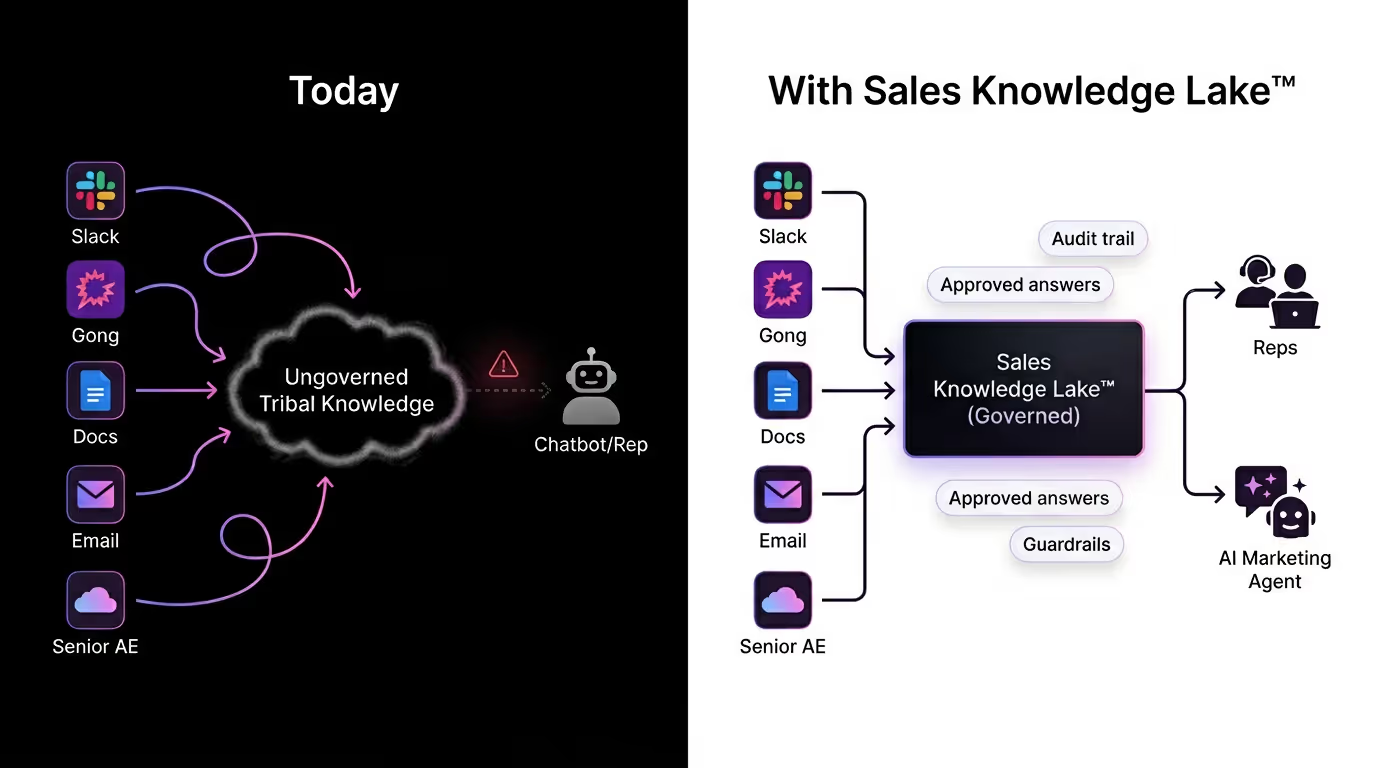
The new cost is what happens when AI gets involved. If pricing nuance, competitive positioning, and implementation caveats are scattered across Slack, Gong, and deck comments, an AI system has no reliable way to distinguish approved guidance from stale improvisation unless a governance layer does that work first.
Three failure modes show up fast:
The classic response to tribal knowledge loss is familiar: build a wiki, clean up Confluence, run enablement, and hope the playbook finally sticks. Useful, but incomplete.
The structural problem is that traditional knowledge management produces a content repository, not a governed execution layer. A wiki does not decide which answer is approved for external use, which answer is rep-only, which content is stale, or when an AI agent should escalate instead of improvise.
That gap matters because organizations without clear AI governance frameworks spend materially more on remediation, rework, and incident cleanup when AI deployments go sideways. If the question is whether tribal knowledge management matters, the answer is yes. If the question is whether documentation alone solves it, the answer is no.
The output of modern sales tribal knowledge management should not be a folder. It should be a governed Sales Knowledge Lake™: Docket's governed knowledge foundation that unifies product, pricing, security, enablement, competitive context, and sales tribal knowledge into a single approved system of record for reps and AI agents.
That distinction matters. A knowledge base stores information. A governed Sales Knowledge Lake™ controls what can be used, by whom, in which context, with what audit trail.
This is also where adjacent search intent fits naturally. If someone comes in looking for sales knowledge management B2B, AI knowledge base for sales, or institutional knowledge AI, they are really circling the same problem: how to make critical sales knowledge available in real time without making it unreliable.
This is the shift from tribal knowledge management to AI knowledge governance.
Most teams begin with experts. Start with deal risk instead.
Map the questions where a bad answer is expensive: pricing exceptions, security posture, implementation scope, integrations, procurement workflows, and competitive swaps. Then identify who currently holds that knowledge, which is usually some mix of senior AEs, SEs, solutions consultants, and founders.
This gives you a better prioritization model than “document everything.” It tells you what needs the strictest governance first.
Sales tribal knowledge rarely lives in the playbook people point to in meetings. It lives in call recordings, Slack replies, email drafts, proposal comments, and the answer a rep gives after hearing the same objection for the fiftieth time.
That means interviews and workshops are helpful, but not enough. The higher-signal move is to capture knowledge in context from the systems where it appears, then route it into review rather than exposing it raw to AI.
This is one reason the “just connect your docs” pitch is so shallow. The valuable layer is not only official documentation. It is the reasoning patterns inside real sales interactions, but those patterns need cleanup before they become safe to scale.
This is the part most teams skip, then regret later.
Once tribal knowledge is captured, conflicts appear immediately. One rep handles a pricing objection one way. Another says something slightly different. A three-year-old Slack thread still describes a roadmap item as if it is next quarter. A deck from last year uses competitive language the company no longer stands behind.
Governance means resolving those conflicts deliberately:
This is also where AI knowledge governance becomes real instead of aspirational. Guardrails are not decorative settings. They are the mechanism that keeps your AI Marketing Agent from inventing pricing, flattening competitive nuance, or overcommitting on implementation.
Most knowledge systems over-index on reference answers. The better move is to encode how your best reps think.
When a buyer says, “We already have a chatbot,” a strong rep does not launch into a feature dump. They probe for the actual issue: stale answers, lack of governance, weak routing, poor handoff context, or inability to handle technical questions. That sequence is tribal knowledge. It is also encodable.
The same goes for objection trees, qualification logic, escalation triggers, and next-step patterns. Docket's proof pack notes that in conversations ending with email capture, 91% included a concrete next step, while only 13% of non-converting conversations did, which makes forward motion a much stronger conversion fingerprint than generic discovery alone.
That matters because the best sales knowledge management system is not just searchable. It is operational. It helps reps answer faster, and it helps AI agents know when to answer, when to probe, and when to escalate.
Once knowledge is governed, it can finally be exposed through the right surfaces.
For reps, that means faster answers, fewer internal interruptions, and better consistency across calls. A Docket customer case study says a mid-market SaaS company reclaimed 6 hours per week per seller, reduced response times from 4 to 5 hours down to near-instant, and trimmed 3 days from a 30-day sales cycle.
For presales and solutions teams, the impact can be even sharper. Demandbase automated 93% of seller queries with Docket's governed knowledge foundation and cut questionnaire work from 12 SCs handling the load to 1 person managing it end to end.
For buyer-facing AI, this is where Docket's AI Marketing Agent enters. It answers buyer questions from approved knowledge, qualifies intent inside the conversation, routes to the right human, and logs full context to CRM, but only within governed guardrails. That is categorically different from a chatbot reading a pile of documents and hoping retrieval saves it.
In B2B sales, AI safety is mostly a knowledge problem.
A practical governance model usually includes:
This is also what separates an AI knowledge base for sales from a governed system. One stores answers. The other constrains execution.
That distinction tends to show up quickly in production. Docket's internal positioning materials say customers observe a 36% conversation start rate versus 13% on legacy form flows, 40 to 60% higher website conversion in observed ranges, and a 20 to 40% lift in qualified meetings from the same traffic, though those ranges vary by ICP and configuration. The performance story matters, but the governance story is what makes that performance safe to scale.
Docket is not positioned as another knowledge tool. It is the Agentic Marketing platform for B2B revenue teams, built around an AI Marketing Agent and a governed Sales Knowledge Lake™.
That matters for this topic because tribal knowledge management usually fails at the exact moment teams try to operationalize what they captured. They either leave the knowledge trapped in a repository, or they push it into AI without enough structure and control. Docket is built to close that gap.
The strongest customer proofs line up directly with that promise:
This is the practical end state of governed sales knowledge. The best thinking from your reps, SEs, and solutions team stops living as institutional folklore. It becomes usable, trusted, auditable infrastructure.
If your current approach to tribal knowledge management is “capture more,” that is directionally right and operationally incomplete.
The better question is this: can the knowledge your team relies on be safely used by a new hire, a seasoned AE, and an AI agent without producing three different answers?
If not, the problem is no longer knowledge capture. It is knowledge governance.
Your tribal knowledge is still an edge. It just needs a better container.
Docket's Sales Knowledge Lake™ turns scattered sales expertise into governed, AI-safe knowledge your reps and AI Marketing Agent can actually use. See it working on a live site at Docket.io.