How Knowledge Management Systems Power Sales Collaboration in the AI Era
April 16, 2026



Most mid-market sales organizations are sitting on more content than their reps will ever read. The real problem is that none of it is connected, versioned, permissioned, or trusted. Reps don't know what's current. AI tools don't know what's authoritative. And leadership has no visibility into what's actually being used or what's being quietly ignored.
Adding another wiki, another Notion page, another enablement push doesn't solve this. What actually moves the needle is governance: a clear structure that tells both humans and AI systems what to use, when, and why.
This post makes the case for evolving your existing knowledge management system — whatever form it currently takes — into a Sales Knowledge Lake™: Docket's governed knowledge foundation that unifies product, pricing, security, enablement, competitive context, and sales tribal knowledge into a single approved layer that reps and AI agents can both trust.
A knowledge management system solves a real problem. It centralizes information that would otherwise be scattered across Google Drive, Notion, Confluence, email threads, LMS portals, and whatever deck someone swears is the latest version.
That matters because 54% of organizations rely on more than five different platforms for documenting and sharing information, and that kind of fragmentation is a tax on every sales interaction. A decent KMS reduces search time, makes onboarding more consistent, and gives sales, marketing, product, and support a common place to publish knowledge instead of operating from parallel realities.
The problem is not that KMS stopped being useful. The problem is that the operating environment changed.
Sales collaboration now depends on the same knowledge reaching multiple consumers at once: reps, SEs, solutions consultants, support teams, internal agent-assist tools, and AI Marketing Agents on the website. A static or loosely managed KMS was never designed for that.
The cracks show up fast:
That is the part many teams miss. Once AI starts using the same knowledge base as your sellers, the risk profile changes. Plugging a traditional KMS into an LLM wrapper and calling it an AI agent does not solve the governance problem. It mostly hides it until a buyer asks the wrong question.
Docket maps this as a three-stage evolution from static knowledge to governed agentic execution.
This is the familiar setup: centralized documents, keyword search, manual curation, and a lot of goodwill holding the whole thing together.
It is better than chaos. But it is still fragile. Updates depend on humans remembering to update the right file. Ownership is often vague. And there is usually no distinction between “helpful background” and “approved for live buyer-facing use.”
This is the upgrade many teams make next. A dynamic knowledge base connects to more systems, stays fresher, and lets users retrieve information by concept and context rather than just keyword matching.
That is a real improvement. It gives you faster access, better customer satisfaction, reduced escalations, and more personalized answers based on the situation at hand. For human users, it is a strong step forward.
But it still has a structural limitation: it is optimized for retrieval, not governance. Humans can interpret nuance. AI agents cannot be expected to infer what is approved, which pricing note is stale, or whether an internal-only explanation should stay internal.
This is where the architecture changes.
A Sales Knowledge Lake™ is Docket's governed knowledge foundation. It unifies product, pricing, security, enablement, competitive context, and sales tribal knowledge into one approved system of record, then applies the controls required to make that knowledge usable by both humans and AI.
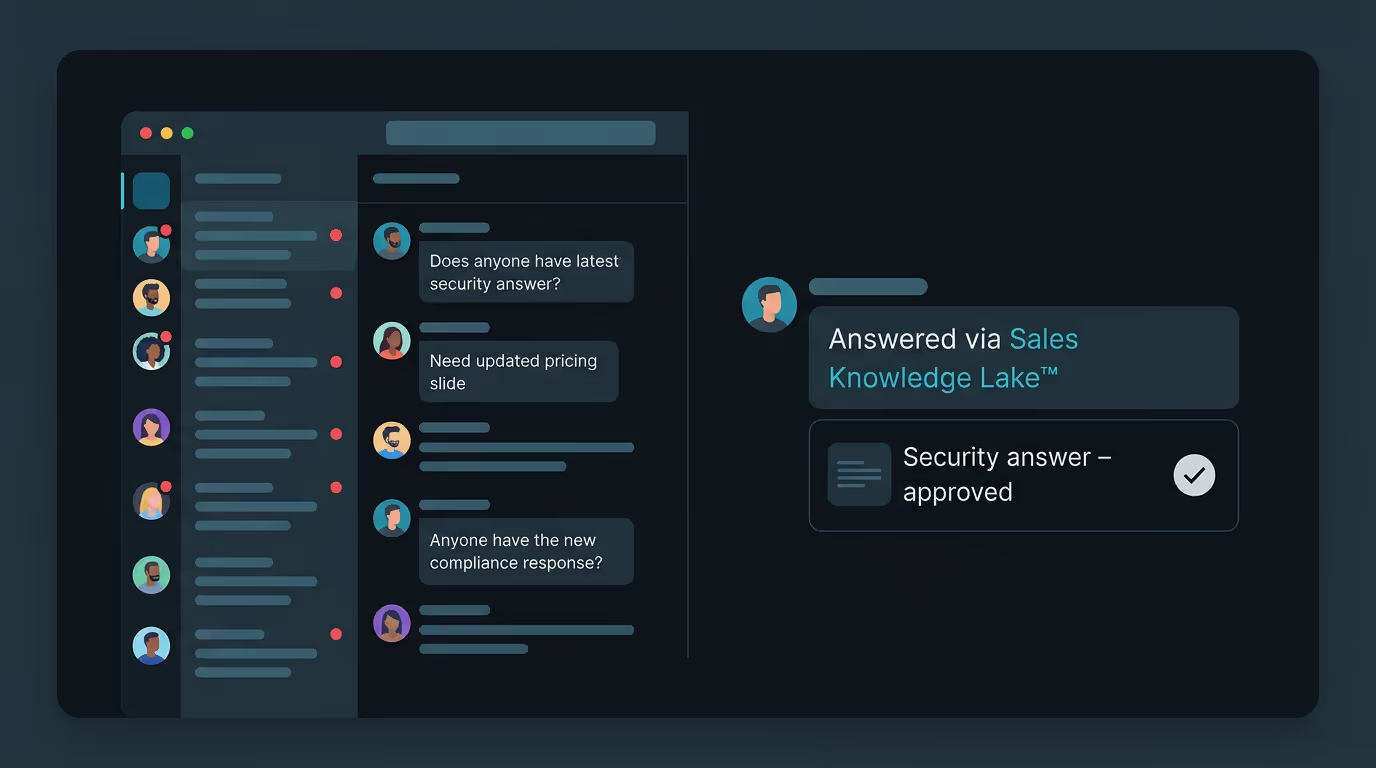
Those controls are the point:
That is the difference between “we have a KMS” and “we have governed sales knowledge.” One stores information. The other constrains execution.
The reason this matters is simple: collaboration breaks when trust breaks.
Aaron Bird, CEO of Inflection.io, put it plainly when describing Docket: “What stood out immediately was how accurate the information is. When our reps are in the middle of a conversation and need an answer, they can actually trust what they’re getting. That confidence changes everything about how they show up in those moments.”
That confidence has operational consequences. An anonymized mid-market SaaS company using Docket reclaimed 6 hours per week per seller, reduced response times from 4 to 5 hours to near-instant, trimmed 3 days from a 30-day sales cycle, and cut overhead by 83%, from 3 FTE to 0.5 FTE handling the same class of work.
Those are not just productivity gains. They are collaboration gains. Reps stop pinging SEs for every technical follow-up. Solutions teams stop becoming a ticketing queue for repetitive questions. The organization spends less time chasing answers and more time moving deals.
That same governed backbone improves cross-functional collaboration too. Product updates do not live in one place while sales decks live in another and support macros lag behind both. The governed layer becomes the place where ownership is defined, updates propagate, and teams can trust that the same answer will appear across internal search, agent assist, and buyer-facing AI surfaces.
That is not what happens when a chatbot gets better. That is what happens when the knowledge layer becomes governed enough for automation to be trustworthy.
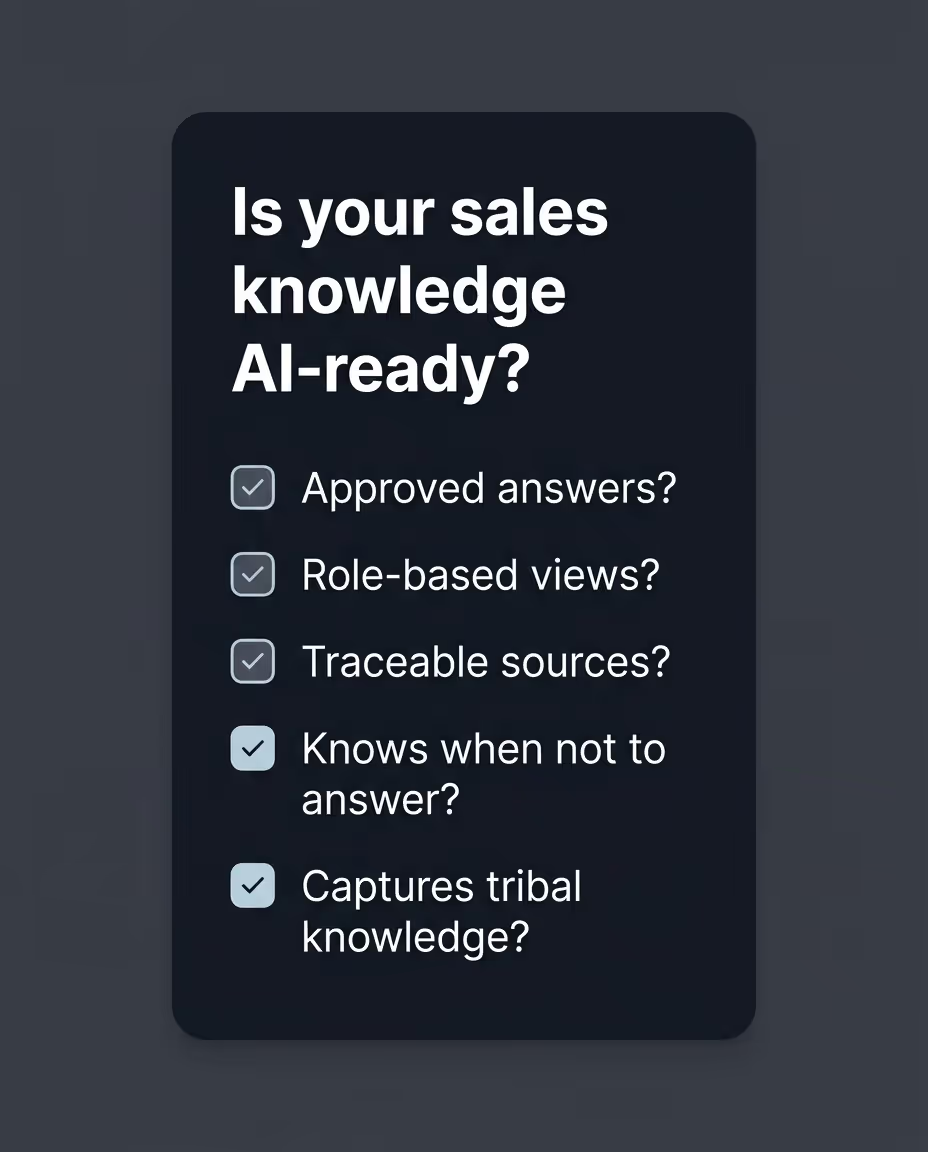
Most teams do not need to replace their existing KMS. They need to stop pretending it is already AI-ready.
The practical path looks like this.
Map the systems where real sales knowledge lives: wiki, intranet, LMS, enablement decks, Gong, Slack, CRM notes, FAQs, and security documentation. The point is not to shovel all of it into one folder and call it modern. The point is to identify what is currently being used to answer live questions and make that governable.
Every high-impact knowledge domain needs an owner and a review cadence. Pricing guidance, security responses, implementation FAQs, and competitive positioning should not be “somewhere in the KMS.” They should be explicitly owned by the teams accountable for the revenue risk if they are wrong.
This is where many KMS projects quietly fail. Storage is not ownership. Uploading a file is not governance.
This is where Docket's architecture matters most. A governed knowledge layer should support partitioned access, approval workflows, review dates, and answer-level auditability. It should also define what an agent can answer directly, what it should clarify first, and what it must escalate to a human because the blast radius is too high.
This is the difference between an AI knowledge base for sales and a governed Sales Knowledge Lake™. The former helps retrieve information. The latter constrains what can be said, by whom, and in which context.
Once knowledge is governed, it can actually do its job.
Reps can use it through internal search and agent assist. Solutions consultants can use it for questionnaires and technical responses. And Docket's AI Marketing Agent can use the same approved layer to answer buyers on the website, qualify intent inside the conversation, route to the right person, and sync context to CRM.
That is how a KMS evolves from a support function into part of an Agentic Marketing system. Same knowledge backbone. Different execution layer.
Docket is the Agentic Marketing platform for B2B revenue teams. The AI Marketing Agent is the hero product. The Sales Knowledge Lake™ is the governed knowledge foundation that makes the whole system reliable.
That positioning matters because most KMS and chatbot stories stop too early. They celebrate centralization, search, or retrieval. Docket goes further: one governed knowledge layer shared across reps and AI agents, with approvals, partitioned access, escalation logic, and auditable answers built in.
That is also why the business case is broader than “faster search.” Customers observe outcomes like 36% conversation start rate versus 13% on legacy form flows, 40 to 60% higher website conversion in observed ranges, and 20 to 40% lift in qualified meetings from the same traffic.
The point is not that every KMS should become a chatbot. The point is that every revenue team now needs a governed knowledge layer sturdy enough to support autonomous buyer engagement.
If your KMS is already feeding AI agents, or will be soon, the governance question is not optional. See how Docket's Sales Knowledge Lake™ handles it on a live site at Docket.io.