How to Get Docket Marketing Agent Approved: A CFO-Ready ROI Model + Spreadsheet
March 10, 2026




You've seen what an Docket Marketing Agent can do. You've watched it qualify leads at 11pm, book meetings your SDR would have missed, and hand reps context-rich handoffs that make first calls actually productive. You're sold.
Now you have to sell finance.
The CFO is going to ask one question before anything else: "What does this cost, and what does it return?" This blog gives you the answer — in the language, structure, and numbers that get budget approved. It also includes a downloadable financial model you can drop straight into your next procurement meeting.
Before the framework, the number.
A fully-loaded SDR, including the base salary, commissions, benefits, tools, onboarding, and management overhead, costs between $98,000 and $173,000 per year (Bridge Group, Xactly, 2025).
That's before attrition. SDR annual turnover runs at 34–40%, and replacing one SDR costs between $78,500 and $149,000 per departure when you factor in lost pipeline, ramp lag, and team drag (MarketBetter AI, 2026).
Docket costs $2,000–$3,000 per month.
This is not a 'cheaper chatbot' argument. Rather, this is a cost structure argument. The question for your CFO is not whether an Docket Marketing Agent is as good as a human SDR in every dimension. It's whether the revenue contribution per dollar invested is structurally superior. It is.
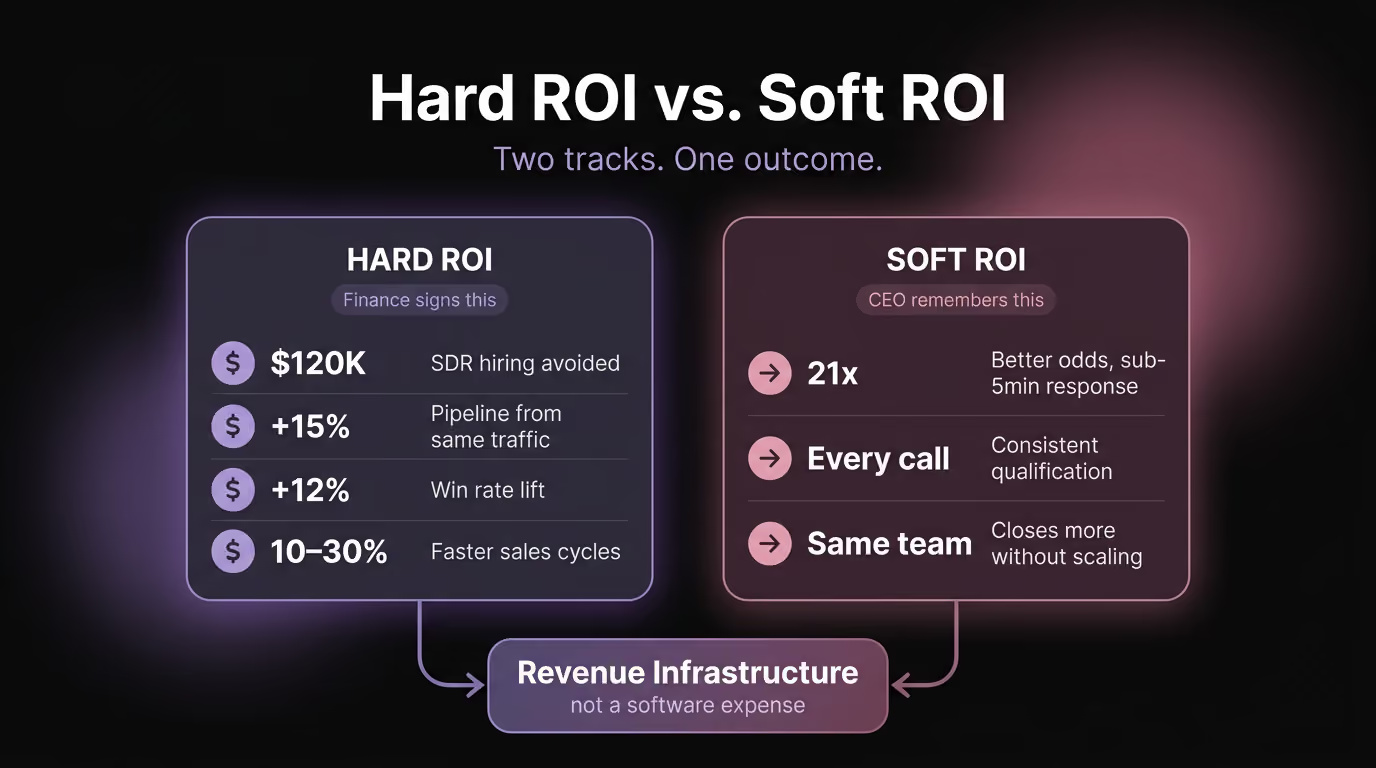
Every CFO-ready business case for a revenue investment has two tracks.
Hard ROI = measurable, quantifiable financial returns. Revenue generated. Costs avoided. Time-to-payback calculated to the quarter. This is what gets the deal signed.
Soft ROI = qualitative benefits that compound over time but resist neat formulas. Brand perception. 24/7 coverage. Consistent execution at scale. Organizational optionality. This is what gets the deal championed by leadership beyond finance.
The sequencing matters. Lead with hard ROI to clear procurement. Layer in soft ROI to earn executive sponsorship. Most AI business cases fail because they lead with a transformation narrative and bury the numbers. This one doesn't.
The SDR cost table above is the foundation but the full argument goes deeper.
83.4% of SDRs consistently miss quota (SalesSo Research, 2025). For every three SDRs you hire, two and a half are generating cost without proportionate pipeline return.
Ramp time compounds the problem. A 3.2-month ramp at $70K base represents approximately $18,700 in unproductive compensation per hire — before manager time, onboarding resources, and delayed pipeline.
Docket is live in 4–6 days. Every week of delayed implementation is inbound traffic converting at your current, lower baseline rate.
"We needed more engagement on our website and believed going agent-first was the answer—we're an AI-leaning organization, so the concept made sense. What amazed us was the execution: Docket went from kickoff to live in under three weeks, and the agent was immediately having informed, deep product conversations about both our PLG app and developer API. The level of enterprise control we have over accuracy and routing is exactly what we needed." — Olivier Roth, Co-Founder & Chief Growth Officer The Swarm
This is where the business case shifts from defensive to offensive. Based on Docket customer benchmarks across B2B SaaS deployments:
Moreover, Docket's response time is under 3 seconds as compared to a human SDR whose average response time is 42–47 hours. You have the speed-to-value advantage.
These aren't efficiency metrics — they're revenue metrics. More qualified pipeline from your existing traffic spend means CAC improves without touching the demand gen budget.
Docket customer benchmarks show 12% higher win rates and 10–30% shorter sales cycles for deals originating through AI-assisted qualification vs. traditional form fills. The mechanism is direct: buyers who arrive at a first call already educated on product fit, with key objections addressed and intent signals logged in CRM, close faster and at higher rates. Reps don't start cold. They start informed.
CFOs care about when returns materialize, not just if they materialize.. One of the strongest arguments for Docket Marketing Agent over legacy tools (or over hiring more SDRs) is time-to-value.
Docket:
Qualified (legacy competitor):
Hiring an SDR:
At $2K–$3K/month, Docket's annual cost is $24K–$36K. A single incremental closed deal at a $30K ACV (a conservative assumption for most B2B SaaS companies) returns the full annual investment. The downloadable model below calculates payback period for your specific traffic, ACV, and conversion rates. The base case lands at 60–90 days.
DOWNLOAD: Docket Marketing Agent ROI Calculator for Free. Paste your traffic, ACV, and SDR headcount. The model does the rest.
These are the benefits that don't fit neatly into a financial model but still drive enterprise value. CFOs care about them — especially when they show up as risk mitigation or strategic optionality.
MIT research found that responding to an inbound lead within 5 minutes produces 21x better qualification odds than responding after 30 minutes. The average human SDR response time is 42–47 hours (Bridge Group, 2025). Docket responds in under 60 seconds, 24/7.
This is not a brand perception argument. Every high-intent buyer who lands on your website outside business hours and hits a dead form has a 21x lower chance of converting. That's quantifiable pipeline leakage and it just doesn't appear in your loss report because those leads never entered the funnel.
Human SDRs qualify differently on Monday mornings than Friday afternoons. They interpret MEDDIC criteria differently. They have bad weeks. The downstream consequence isn't just inconsistent lead quality — it's CRM data you can't trust and pipeline forecasts your CFO can't defend.
Docket applies the same qualification framework to every conversation, every time. Cleaner pipeline data means more accurate stage progression.
When AI handles first-touch qualification, your AEs and SEs get their highest-leverage hours back. They stop answering the same five product questions on repeat and start working deals already in motion. The revenue consequence: the same headcount closes more business. You scale revenue without scaling the org chart.
"Docket solved our biggest sales problem: reps not having answers when prospects ask questions. Now our team responds confidently in real-time instead of promising to follow up. We were live in days, and the impact on our close rates has been immediate." — Aaron Bird, CEO, Inflection.io
The model has four sections:
Here's what the three scenarios produce with default inputs and a 30% attribution factor:
Deals to break even is the number that lands in a budget meeting. "Docket pays for itself after 3 incremental closed deals" is a sentence any CFO can evaluate immediately.
DOWNLOAD: Docket Marketing Agent ROI Calculator for Free. Paste your traffic, ACV, and SDR headcount. The model does the rest.
CFOs will ask: "Why Docket vs. Qualified vs. Human SDR Drift?"
Here's the side-by-side you show them:
"Is this a proven category?"
Gartner named Docket a Cool Vendor in 2024. Docket is deployed across enterprise B2B SaaS companies and has produced 15% more pipeline and 12% higher win rates based on customer benchmarks. This is not an emerging experiment.
"We already have Qualified / HubSpot Chat / Salesforce Einstein — why do we need this?"
Qualified is a rule-based playbook system with AI bolted on. It requires complex configuration, reps must be logged in to receive leads, and innovation has slowed since the Salesforce acquisition. HubSpot Chat and Salesforce Einstein handle support workflows, not inbound sales qualification. Docket is LLM-native agentic AI built specifically for B2B revenue qualification — at 40–60% lower cost than Qualified, live in 4–6 days.
"What's the integration risk?"
Docket is SOC 2 Type II, ISO 27001, and GDPR compliant. It integrates with Salesforce, HubSpot, Slack, Microsoft Teams, Cal.com, Chili Piper, and 100+ other tools. Sub-3-second response time. No model training on your data.
"What if it doesn't work?"
The pilot is designed to generate real numbers, not demos. In weeks 1–4, you establish baseline metrics. In weeks 5–8, you measure against the model's conservative scenario. If
Docket doesn't outperform baseline on at least two of three hard ROI metrics, the case doesn't proceed. You have data either way.
Here's how to structure it so the pilot results become your board-level business case for full rollout.
Week 1–4: Baseline and optimize
Week 5–8: Scale and measure
Week 9: Build the case
The Docket Marketing Agent business case works because it reframes the category. You're not asking for a "chatbot budget." You're asking for revenue infrastructure that costs 75% less than hiring, ramps 10x faster, and generates measurable pipeline within 90 days.
That's a CFO-grade argument.