11 Best Breakout Alternatives & Competitors in 2026 (Ranked + Reviewed)
March 9, 2026



Most of the tools on this list are chatbots dressed as agents. That's the thing worth saying upfront.
When Breakout started showing up in searches for "AI SDR," it wasn't alone. A wave of tools rebranded under the same label: conversational marketing platforms added AI layers, support bots got sales-facing landing pages, and lead routing tools started calling themselves intelligent qualification systems. The category got loud fast — and mostly stayed shallow.
A chatbot — regardless of what it's called — follows predefined paths. When a buyer asks about EU data residency for a 500-person team running Salesforce Enterprise, a chatbot routes to sales. An AI agent answers: "EU data residency is supported. Here's what that means for your setup. Want to scope this with an AE?" The first one generates a lead. The second one starts a deal.
Breakout sits closer to the first category than the second. It's a qualification-speed tool: fast to deploy, good at structured prompts, built to move buyers toward a handoff. Where it breaks down is when buyers move into real evaluation — pricing logic, competitive comparisons, implementation edge cases, multi-stakeholder questions. At that point, conversations deflect, context resets, and sales inherits a handoff without enough signal to act on.
This article maps the actual landscape. We separated tools by what they genuinely are — AI agents, conversational marketing platforms, or support tools that got a sales rebrand — and ranked them by how conversations actually behave when buyers stop following the expected path. Not by features. Not by positioning. By what happens when the conversation gets real.
Breakout is a qualification-speed tool. It's designed to engage visitors fast, ask structured questions, and route high-intent buyers to sales. For teams with simple inbound motions, it works.
The problem surfaces when buyers go off-script. Breakout's qualification engine is optimized for how fast a conversation moves, not how deep it goes. When a buyer asks about EU data residency, a custom Salesforce object, or how you compare to a specific competitor, the conversation either deflects, escalates prematurely, or produces a low-context handoff that restarts discovery on the first sales call.
Three specific patterns that consistently push teams to look for alternatives
Each tool was placed in its actual operating category, not where it markets itself. We separated:
Tools that primarily optimize support resolution or static chat flows were not evaluated as AI SDRs, even if they include AI labels. This avoids blurring chatbots with agentic systems.
All rankings assume a website-led inbound motion, where buyers initiate contact mid-research and expect relevant, contextual responses.
We favored tools that:
We judged tools by how conversations actually behave in real buyer scenarios:
Feature availability was secondary to behavior under pressure, especially for complex buying journeys.
For long sales cycles, memory across visits is not optional. Tools that reset context or rely on session-level state were ranked lower for complex inbound use cases.
Where continuity was partial or channel-specific, that limitation was treated as a design tradeoff, not a missing checkbox.
5. Routing and ownership alignment were evaluated explicitly
We looked at how each tool handles:
Tools with strong routing but weak discovery scored differently from tools that prioritize discovery but require heavier configuration for routing.
6. Integrations were treated as operational cost, not marketing claims
Integrations were evaluated on:
A long integration list did not imply lower operational cost. In some cases, faster go-live traded off against long-term maintainability.
7. Speed to deploy vs long-term stability was made explicit
Fast setup was not automatically scored higher. We called out the tradeoff between:
Neither approach is universally better. Ranking reflects fit for the buying motion, not absolute speed.
This ranking focuses on website-led inbound sales, where buyers arrive mid-research and expect relevant, contextual answers not gated forms or scripted chat paths. Tools are ordered by how well they support real discovery, qualification, and routing during the conversation, not by breadth of features or speed to deploy alone.
Docket is an AI agent for marketing and sales built for sales-led B2B inbound motions with complex buying journeys. Unlike tools that either deflect hard questions to sales or generate answers without guardrails, Docket draws from a governed knowledge foundation — meaning buyers get accurate answers on pricing, security, and competitive tradeoffs, and sales inherits a trustworthy discovery record.
Buyers can ask unstructured questions about integrations, competitors, pricing models, or edge-case use scenarios and receive contextual answers without being redirected to forms or static paths. Qualification happens inside the conversation, based on buyer behavior and intent, and ownership is routed directly into sales workflows without resetting context.
The result is a website experience that functions as early-stage sales discovery rather than lead capture.
Subscription pricing positioned above basic chat and conversational marketing tools. Value is tied to sales efficiency and pipeline quality, not lead volume, making it best suited for teams with mature inbound motions.
AI SDR replacement for Breakout: Strong because it sustains free-form evaluation before routing, not just qualification prompts.
Unlike Breakout’s qualification-led model, Docket is built to hold deeper product, pricing, and competitive conversations on the website itself before handoff, preserving continuity through routing rather than accelerating it prematurely.
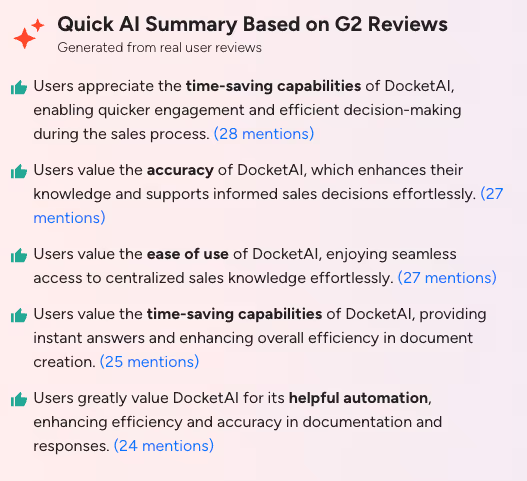
What customers are saying about Docket

Qualified sits in the conversational marketing category, optimized for website-led inbound motions where account identification and fast sales handoff matter more than early discovery. Its architecture is built around Salesforce: identifying known accounts on the website, applying persona- and account-based routing rules, and connecting visitors to the right rep quickly.
Conversations are typically guided by predefined logic tied to Salesforce data, not open-ended exploration. The system prioritizes speed—recognizing who’s on the site and moving them to a live rep—over extended qualification or comparison-driven discovery.
This makes Qualified effective when intent is already high and ownership clarity is the primary goal.
Enterprise-oriented pricing aligned with Salesforce-driven inbound and ABM use cases. Cost is best justified when rapid routing of known accounts improves sales efficiency; less suited for teams prioritizing deep qualification or long-cycle discovery on the website.
AI SDR replacement for Breakout: Moderate because it prioritizes ownership alignment over conversational depth.
Unlike Breakout, which focuses on AI-led qualification before handoff, Qualified optimizes for speed-to-rep within Salesforce environments. Teams moving from Breakout to Qualified trade discovery depth for ownership certainty and ABM precision.
Drift established the conversational marketing category by replacing static forms with interactive website chat. Its core architecture remains playbook-driven, guiding visitors through predefined questions, conditional logic, and intent-based routing designed to move conversations toward meetings or form completion as quickly as possible.
Over time, Drift has added AI-assisted replies and automation layers. These improve responsiveness but do not change how conversations fundamentally work. Interactions are still anchored to workflows and decision trees rather than open-ended reasoning. When buyers follow expected paths, the experience is efficient. When questions become comparative, technical, or situational, conversations often deflect, reset, or require escalation.
Mid-to-enterprise pricing aligned with conversational marketing and meeting capture use cases. Best justified when speed to meeting matters more than depth of discovery; less efficient when inbound conversations require sustained context and nuanced qualification.
AI SDR replacement for Breakout: Weak because it remains playbook-driven rather than agentic.
Unlike Breakout’s AI SDR positioning, Drift relies on structured playbooks and scripted routing. Teams frustrated with Breakout’s nuance limits may find Drift even more constrained in unstructured discovery scenarios.
Intercom is a support-first messaging platform that has been extended into light inbound sales use cases. Its core architecture is built around customer communication, shared inboxes, and ticket resolution rather than website-led sales discovery.
For inbound website conversations, Intercom works well when the goal is to respond quickly, handle FAQs, or capture basic interest. Its AI agent, Fin, is designed to resolve routine questions and assist human agents, not to conduct nuanced sales qualification or guide buyers through evaluation. As a result, conversations tend to prioritize responsiveness and resolution over sustained discovery.
Pricing aligns with support-driven volume and resolution efficiency. Sales teams extending Intercom into inbound discovery should expect additional downstream cost as conversations require manual qualification and follow-up outside the tool.
AI SDR replacement for Breakout: Weak because its architecture is support-first, not sales-discovery oriented.
Breakout teams considering Intercom should note that while both engage visitors quickly, Intercom’s system is optimized for ticket resolution and inbox workflows, not sustained sales qualification or AI SDR behavior.
HubSpot Chat is a CRM-embedded live chat and bot tool designed for teams running inbound entirely inside the HubSpot ecosystem. The experience centers on capturing interest, asking a small set of qualifying questions, and routing conversations into HubSpot pipelines or meeting links.
Conversations are largely rule- and form-driven. When buyers ask straightforward questions or are ready to book time, the flow is efficient. When they ask comparative, technical, or situational questions, interactions typically fall back to predefined bot prompts or a request to schedule a meeting.
Low incremental cost for HubSpot customers. Pipeline impact depends on sales teams re-qualifying conversations that lacked depth on the website, which can increase hidden operational cost as inbound complexity grows.
AI SDR replacement for Breakout: Weak because it is rule-driven CRM chat, not an autonomous SDR system.
Unlike Breakout’s AI qualification engine, HubSpot Chat primarily captures leads and routes via predefined rules, trading automation depth for CRM simplicity.
Spara is built as an AI-led inbound conversion and orchestration platform, operating across chat, email, and voice. Its design emphasizes speed to lead, enrichment, follow-up automation, and consistent execution across channels rather than deep, product-expert reasoning during the website conversation itself.
The platform performs best when inbound success is measured by conversion velocity—how quickly visitors are engaged, lightly qualified, and moved into meetings or follow-up workflows. Conversations are optimized to advance the funnel efficiently, not to sustain long-form evaluation.
Usage- and volume-oriented pricing aligned to inbound throughput. Most effective when sales efficiency is driven by speed and consistency rather than depth of qualification or multi-session buyer continuity.
AI SDR replacement for Breakout: Moderate because it extends beyond chat into orchestration but prioritizes velocity over reasoning depth.
Spara emphasizes multichannel speed-to-lead and follow-up automation, making it stronger in conversion velocity than nuanced on-site evaluation.
Warmly is a visitor intelligence and engagement platform that combines real-time account identification with AI-powered chat. Where most tools on this list begin when a visitor starts a conversation, Warmly begins the moment a visitor lands — identifying the company or individual before a word is exchanged, then triggering personalized engagement based on firmographic data, intent signals, and CRM history.
This makes Warmly most effective for teams whose primary inbound challenge is converting anonymous traffic into identifiable pipeline, rather than sustaining deep evaluation dialogue once that visitor is known.
Pros
Cons
Pricing Model
Usage-based pricing that scales with visitor identification volume and engagement features. Value is best realized when inbound traffic is consistent and ICP match rates are high; less efficient at lower traffic volumes where identification costs outweigh conversion lift.
AI SDR replacement for Breakout: Moderate because it substitutes account intelligence for conversational depth.
Warmly anchors engagement in who the visitor is rather than what they need to hear. Teams moving from Breakout gain sharper routing and real-time visibility into known accounts, but trade off the ability to sustain open-ended evaluation conversations for visitors who are still researching before they're ready to identify themselves.
Aimdoc is a playbook-driven conversational marketing tool built for predictable inbound flows. Conversations are structured around predefined qualification paths, branching logic, and controlled prompts rather than open-ended buyer exploration.
This architecture works when qualification logic is known in advance—such as routing by role, company size, or page context. When buyers move outside those paths and ask situational, pricing, or comparative questions, conversations typically redirect to forms or meeting links instead of continuing the dialogue.
Aimdoc prioritizes control and repeatability over adaptability.
Pros
Cons
Pricing Model
Pricing reflects conversational marketing tooling and playbook usage. Operational cost increases as flows require frequent updates to handle edge cases.
AI SDR replacement for Breakout: Weak to Moderate because it shares structured logic without adding adaptive reasoning.
Teams frustrated with Breakout’s rigidity may find Aimdoc similarly constrained, though potentially easier to govern.
9. Freshchat
Freshchat is a support-first messaging product within the Freshworks ecosystem that is often extended into basic sales use cases. It is designed for ticket resolution and basic lead capture, but not for sustaining website-led qualification depth the way Breakout attempts to.
10. Tidio
Tidio is a lightweight chat and chatbot tool commonly used by SMBs. It is built around templates, triggers, and basic automation for lead capture, but not for sustaining AI-led qualification depth or real-time routing logic the way Breakout attempts to.
11. Landbot
Landbot is a no-code visual chatbot builder used by marketing and operations teams to create flow-driven website conversations without engineering resources. It is designed for lead capture, qualification routing, and CRM handoff through configurable branching logic, but not for free-form buyer evaluation or sustaining AI-driven discovery the way Breakout attempts to
Teams evaluating Breakout alternatives are not deciding between chat widgets. They are testing whether website-led inbound conversations can move beyond rigid paths once buyers start asking real questions. Breakout typically enters the picture when speed matters, but it starts breaking down as soon as evaluation becomes non-linear.
Breakout is typically evaluated when teams realize that routing logic alone is not qualification. In a website-led inbound motion, buyers often arrive mid-research and ask questions that cut across pricing, fit, and alternatives.
Tools that rely on hard-coded flows tend to redirect these moments toward forms or handoff instead of continuing the exchange. Among the alternatives, systems like Docket and, to a lesser extent, Spara can infer intent from what buyers actually ask during the conversation.
By contrast, tools such as Aimdoc or Drift depend on predicted paths; once buyers deviate, qualification pauses and ownership is pushed to sales prematurely. This distinction matters because Breakout users usually hit limits when conversations stop producing signal before routing occurs.
A common failure point with Breakout-style tools is that conversations feel responsive in-session but reset when buyers return. For complex buying cycles, this breaks momentum and trust. Strong alternatives treat memory as a first-class capability, carrying forward prior questions, objections, or stage indicators across visits.
Docket is explicitly built around this continuity. Spara maintains context across channels, though not always as a single conversational thread. In contrast, Drift, Aimdoc, and most lightweight chat tools scope context to sessions or account signals, forcing buyers to restate intent. Teams comparing Breakout alternatives should prioritize whether the system recognizes returning buyers as ongoing evaluations rather than new leads.
Breakout comparisons often blur categories unless teams are explicit about what they are replacing. Conversational marketing tools focus on guiding buyers toward meetings through structured prompts. AI agents for marketing and sales are expected to reason through open-ended questions and adapt in real time.
Alternatives like Drift and Aimdoc remain firmly in the conversational marketing category, even with AI-assisted layers.
Docket operates as an AI agent that supports discovery and qualification during the conversation itself. Support-first tools such as Intercom or Freshchat should not be evaluated here at all, except when teams are knowingly trading sales depth for responsiveness. Getting this categorization wrong leads to false expectations and perceived gaps after deployment.
Breakout users often value fast routing, but problems surface when routing replaces discovery instead of following it. Effective alternatives make routing explicit and configurable while preserving the conversational thread.
Qualified perform well when account ownership and ABM alignment matter more than exploration, especially in Salesforce-centric teams. However, they trade off depth when buyers are still evaluating. Tools like Docket delay routing until sufficient signal is established, preserving context through the handoff. The decision here is not routing versus discovery, but whether routing is informed by the conversation or triggered in spite of it.
Breakout alternatives often look similar at launch and diverge six months later. Rule-driven systems tend to go live quickly but require constant tuning as buyer behavior shifts. This is visible with Drift, Aimdoc, and lightweight chat platforms, where maintaining accuracy becomes an ongoing burden.
AI-led systems typically demand more upfront knowledge preparation but stabilize once live, reducing long-term maintenance. Teams should evaluate alternatives based on who will own ongoing accuracy: RevOps maintaining rules, or the system adapting through grounded reasoning. The right choice depends on whether inbound scale is simple and volume-driven, or complex and evaluative.
1. What makes a tool a true Breakout alternative?
It must support website-led inbound sales conversations beyond speed-based capture. Tools that only optimize fast replies or scripted routing without sustaining evaluation are not true alternatives.
2. Is Breakout an AI agent or a chatbot?
Breakout operates closer to a conversational marketing tool with predefined paths. It does not behave like an AI agent that reasons through open-ended buyer questions during evaluation.
3. When does Breakout typically stop being sufficient?
When buyers ask pricing logic, implementation constraints, or competitive questions that don’t fit predefined flows. At that point, conversations tend to deflect or escalate prematurely.
4. Are Breakout alternatives always more complex to deploy?
Not always. Some deploy quickly but trade depth for speed. Others require more upfront setup but reduce ongoing maintenance once conversations stabilize.
5. How important is multi-visit context when replacing Breakout?
Critical for longer buying cycles. Session-based tools treat returning buyers as new, while stronger alternatives carry context forward to maintain momentum and trust.
6. Can Breakout alternatives replace sales reps?
No. They handle early discovery and qualification on the website. Sales reps remain essential for deal-specific discussions and closing.
7. How should teams compare Breakout alternatives beyond features?
By observing how conversations behave when buyers go off-script—whether the system continues meaningfully or forces a handoff.
8. When should teams prioritize AI agents over conversational marketing tools?
When inbound conversations involve comparison, evaluation, or repeat visits before sales engagement. Simple, speed-driven motions can still work with lighter tools.