


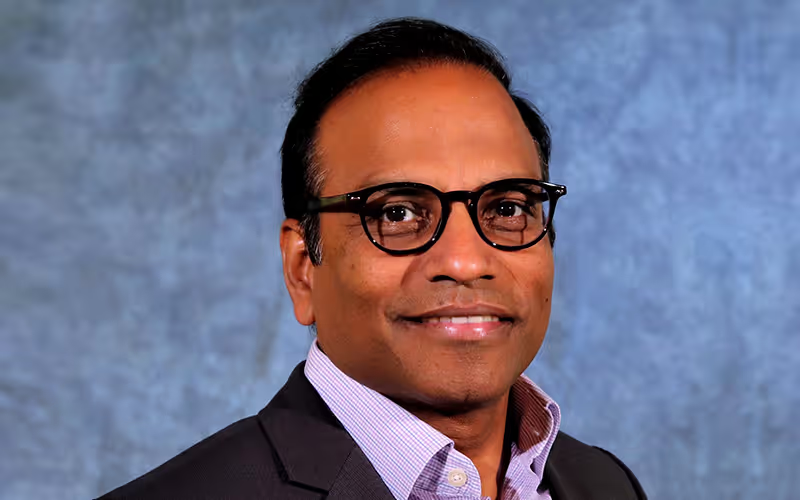
Arjun Pillai: [00:00:01] Hi, everybody. Welcome back to Rethink Revenue Podcast. I am your host, Arjun Pillai, co-founder and CEO of Docket. Today, I'm super excited. Our guest is Lax Gopisetty. He has been a startup evangelist and investor in several startups. And he has been a public speaker on several macro trends. And we have been trying to get him on this podcast for a long time. Not that he didn't say yes. We were kind of figuring out the right time and making sure we have the right topics. We requested him to take some time to speak about the latest trends and topics around what is happening in the world of AI, go-to-market revenue, things like that. He brings more than 30 years of experience in leading digital transformation across public and commercial sectors as well. He has been a leadership role at Accenture, IBM, PwC, HCL. He is currently the CEO of Infosys Public Services. If you don't know what that is, that is the North American Public Sector Arm of Infosys. With that, Laks, welcome to the show. Thank you for being here. (.)
Lax Gopisetty: [00:01:03] Thank you, Arjun. It's a privilege to be here. You know, you have a great success background. So, I'm really looking forward to learning through our conversation and great to be on this platform. Thank you for extending the invite.
Arjun Pillai: [00:01:16] Of course. Yeah, you're being very kind. I appreciate it. And specifically today, like we wanted to kind of start, you talked to a lot of enterprise sellers. And today, 2025, the selling and buying environment has changed quite a bit. What are you seeing? What are some of the changes that you are seeing? And how is, how are the people around you, you know, the companies that you advise or the people where places you have invested? How are they navigating this complex buying environment? (..)
Lax Gopisetty: [00:01:49] Yeah, the topic itself is so vast. Actually, it's always difficult to see where do you start with. Sure. And I know this topic was, you know, picked up as a revenue and a selling kind of a context, the way you cited it up.
Arjun Pillai: [00:02:03] Yeah.
Lax Gopisetty: [00:02:04] I actually will, you know, flip, start with a buying concept, a buyer concept first. You know, I always felt that that's something which it started with that, but then it moved significantly to the selling side of the equation. I said, okay, let's look at the buying side of the equation. What happened? You know, how buyer behaviors have changed, buyer demographics have changed, buyer positions have changed, what they are buying has changed, why they are buying has changed. When they are, so obviously when they are, so obviously when they are buying has changed. And this is when I say changed and when you're picking up, it's a time horizon, right? Is it a, how is it different between a five years back to now? How is it different to 20 years back to now? (.) And also the question of which industry? And also the question of which industry we are talking about. Is it a tech product? Is it an FMCG products? Is it a defense products, right? Or products or services? I think that ecosystem is what I always say is to, you know, understand that first and talk about it. [00:03:07] But then selling is a kind of a second in nature to the buyer mindset. And in the current scheme of things where the, I mean, you live in that world on the Silicon Valley world, the freemium, prosumer, the new terms, which keeps coming about, you know, you give everything for free and back and you monetize the value. So, uh, the value chains are different and the consumption layer to an innovation layer to a production layer. Uh, the, what are they buying and how are they buying? That changes to even in enterprise scale, right? So tech products are also moved into a services model and subscription model. So my view is it's, it's two sections for me. There is an entire buying construct to be, uh, understood on a continuous basis. Then the second is about the selling construct, which is acting to see what we need to, um, you know, cater to. And third is the medium of what are we buying? What are we selling? That's, that's the way I decouple. [00:04:10] So, of course, there's a fourth element, like, you know, uh, you know, kind of quarters, five forces or anything which we speak about. What is the environment we are in? Yeah. Uh, whether it's a regulatory or, you know, policy making or a tax complexity or whatnot, right? Which are, you know, so for me, these four modulates how these behaviors, both sellers and buyers and the products and services, you know, make that shift. (..)
Arjun Pillai: [00:04:38] Understood. And when you think about these different constructs that we are talking about, um, it's very difficult to find something that works across every aspect of the buying and selling cycle. But what are some of the, let's say proven strategies that you are starting to see the GTM teams adopt today? Or is that also very diverse that you see? And we can even pick a sector, right? We can pick an industry like tech. A lot of my audience is actually tech. So maybe, you know, we can kind of say that, okay, it's tech. We can say that, let's say it's somewhere between mid-market buying to like enterprise buying just to, you know, help you because your purview is also very big. So if that helps you to bring it down into something that we can talk more details about, then I guess that'll be a good, good place for us to talk about.
Lax Gopisetty: [00:05:26] No, absolutely. I think that's, that's fair. And it's appropriate to talk about tech itself, which is also good to know how much actually the changes which has happened. As much change did not happen in the FMCG product or so, but the tech and tech is significantly shifted, right? So, yes, there are standards, which I personally believe there are standards in certain formats in specifically last, you know, decade or two or so. (..) There is also diversification which has happened. So I kind of give everything, I look at it as a spectrum based on where we are catering to. So I'll give you a spectrum and then go into a specifics, right? So at the highest level of spectrum, the buyer and seller, or at least the buyer, seller could be an, you know, these days agent, AI, but buyer is a human being. (..) That's a common denominator in my mind. Right. (.) So there is a behavior, there is a human element to it, there is a decision making process, there is an, you know, Maslow's hierarchy about needs, wants, desires and whatnot. [00:06:32] And if you take in the tech world, you talk about discretionary spend versus a run spend and operational spend versus transformation spend, all those pieces, right? But I still feel there is a fundamentally, there is the final decision maker, both on a consumption and buyer perspective is a human being. That's a common denominator. Absolutely. Yeah. Then you, so first is, I look at demographics. Who are your, who are your buyers segment? I mean, the ones with services like Docket could be selling it to a different demographics versus selling, you know, ERP packages could be different, you know, even it's an enterprise or otherwise. When I said demographics, you're selling it to a different classification of your customer segments by age, by maturity, by enterprise size, by the scale, by whatnot. Right. So that's a very important classification and that classification stands as a standard today. I mean, it's there, it's been there that way, it will continue to be there because that's how the behaviors are going to be different. (.) [00:07:33] The shift is about how are they buying, right? Earlier, they were probably in the tech space, they were buying SKUs or they were buying people in a TNM construct or a fixed price construct, or they were buying packages for, you know, then these SKUs will come at this kind of license price. that is shifted into a subscription price today, which is, you know, you pay as you go model. (.) Right. (..) Same thing happened on the services side. So I'm running a parallel on product and service in the tech space, right? And some in the product space is coming with, okay, I don't charge you anything, but I know how to make, how to create value at the back end. Right. (.) So that's a different behavior which you are selling into because then you're creating a demand rather than serving a demand. (..) Yeah. I consider like Uber kind of models have probably not serving the demand, they created a demand or Airbnb models, right? Arjun Pillai: Yeah. Purely by tech. The significant shift again is earlier tech used to be a support engine for sales lifecycle or, you know, or any industry. [00:08:38] Today, tech has become core. (..) So earlier a buyer used to buy a tech kind of supporting an enterprise function. So the buyer mindset and objectives were different. Today, buyer mindset and objectives are different when they are consuming tech because that has become core to their enterprise value. So the decision making process, whether it's a IT organization buying or a business guys buying into it. If you, if you remember the core versus context language, which used to be there about 10 years back and technology was always in the context, not so much in the core. Today, tech is the core and the context. So I'm saying is these shifts which has happened helps to people to understand as need to demand people to understand how the buyer behaviors have changed. Why are they buying? What are they buying? Hence, when are they buying? Hence, you are selling mechanisms across the value chain, whether you look at a, you know, outreach programs to your lead scoring to a qualification dimension to, you know, sales lifecycle. [00:09:42] All of that shifts because of the buyer behavior is a leading indicator. (..)
Arjun Pillai: [00:09:48] Understood. Understood. And so one of the things that people struggle when we talk about, especially, you know, my, my folks who are listening, they are always thinking about selling to enterprises. That is where a lot of the things that you mentioned, whether it is the demographics, the need, the way in which they figure out the ROI, you know, all of that is very, very different and diverse. And the sales cycles tend to be super, super long there. So when you think about a sales cycle and it's a long sales cycle, how do you keep the everything that you mentioned about the buyer at the center and still you as a seller need to figure out a way to reduce the sales cycle? Are there things that you have successfully executed in the past or the advices that you give to kind of focus on reduction of the sales cycle with enterprises? Because I speak to founders who are like, it's 18 months trying to, you know, land a whale. And that's like in 18 months, I don't know if my company will be dead.
Lax Gopisetty: [00:10:46] Yeah, I mean, you mentioned a few attributes there, right? A whale hunting is a, you know, it is that life cycle. Somebody is investing or making a decision of $100 million spend or a $50 million spend needs to go through that consensus management or a convincing management or the decision process versus somebody buying a, you know, $100,000 sale. So it's one that the size certainly matters. (.) But second is, you know, and I'll make it more of a current comment, right? Today, I don't even, I don't even want to call a sellers as a sellers today in today's paradigm. I want to shift from selling mode to a advocacy mode, customer success mode, because earlier when they were buying and again, I'm staying with the tech today. They were, when you are doing a skew, skew selling, they were selling in the product and they make that incentive and they're gone. (..) [00:11:52] Now, today in the kind of a subscription mode across almost all tech is in subscription servitization mode, right? You are making your incentive or your rewards as the consumption continues, which means you are staying with the customer through the success of that life cycle versus just a selling. Hence, I consciously think all enterprises have to shift forcibly or voluntarily to a customer success dimension or advocacy dimension and a convincing dimension versus a selling dimension. So I'm changing the few words to get an emphasis about it is no more about selling a product. It is about convincing the stakeholder to consume your product and two different things. (.) Yeah. (..)
Arjun Pillai: [00:12:40] And in those cases, would you, in your world, when you look at some of these companies trying to land a big company, would you focus on like driving the sales cycle long and try to land like the biggest deal possible? Or would you think, hey, land, get in the door. Even if the deal size is slightly lower, that's fine. Do the customer advocacy and then you can grow and upsell and cross sell. (.) Would you go with that? Lax Gopisetty: Yeah.
Lax Gopisetty: [00:13:05] It's a, it's a important question which people debate about a lot. And in my lens, it is not one versus other. Again, it's a strategic direction for each organization based on what platform you're running into. My, my thesis is always been run parallel tracks. You go to the, the, the small fish entries, the land and expand model, traditional consulting structure. Whale hunting is traditional large deals structures which you go through. And why would you ignore the midsize opportunities? So my always approach is, if you can run the right amount of resource balancing, run all parallel tracks. The fundamental underpinning piece for any, you know, customer advocacy or a customer success person is, how am I able to build the trust? (..)
Arjun Pillai: [00:13:57] Understood. Understood.
Lax Gopisetty: [00:13:58] The underpinning layer is about how do you build trust? And whichever the channel you have access to, which will help you to start building trust and trust doesn't come on day one. (.) You will move, you will go from an experimentation to a trust building stage, either in a long, large deal sales cycle or a short, small sales cycle. But it is, it has to go through the trust establishment. And that measure is a significantly different measure than how many conversions you are able to make it. (.)
Arjun Pillai: [00:14:27] Got you. And there's no podcast today that happens without talking about AI. So I'm going to make a small jump into the AI just to try and tie it together. In your world, you are obviously seeing, hearing about AI and maybe even helping some of your, you know, folks around you to kind of adopt AI. Where is AI moving the needle today in the world that you are seeing? Because we saw the McKinsey's, you know, the report that came out that 95% of the AI pilots are paid. And then it also told that the back office process is the better AI optimization that's happening. What is your view of where is AI moving the revenue needle?
Lax Gopisetty: [00:15:09] Yeah. So, you know, in Infosys platform also, we have done our own AI survey. We surveyed about 3000 odd enterprises and each one is at a different stage of maturity, different side of piloting and how the survey shows about 50% of the pilots, at least our experiments, I call them, are been successful with certain level of tangible results. But on a personal front, the way I sense about AI is somebody asked actually, which projects are you doing AI? Mm-hmm. (..) I actually flipped the question answer to say, everything we do will have AI. (..) And that's the way I see AI world in the future is AI, I mean, I'm just giving a rough analogy, may not be great analogy, is AI is like an English language. Mm-hmm. (.) We all use English language, but we didn't build a career in English. Right. (..) [00:16:09] Yeah. (..) So, AI is going to be that way. I'm using my, you know, laptop now. I don't know enough technology to build that laptop, but I'm using it. Mm-hmm. So, AI is going to be that, you know, general purpose technology, everybody, pervasive technology, which will be used by everyone. And what the key topic which anybody has to think about is, instead of thinking what AI can do, the question is, what is that I want AI to do for me? (...)
Arjun Pillai: [00:16:41] And how do you go about identifying that?
Lax Gopisetty: [00:16:44] That question is being deliberated across enterprises and individuals or whatnot. And because it's a self-reflecting question, it is going through a journey of experimentation, journey of, you know, skepticism of what generally it can do. You know, you see, you know, you see, you know, LLMs being driven by across the board, you know, like the way the, in, when the internet era happened, the search engines used to come, everybody used to build a search engine. (.) Yeah. (.) Today, everybody is building an LLM. Yeah. More efficiency, fine. What are, what is it going to do for me is the question. So answer is not by what AI can do. Answer is about what is that I want it to do because it is a self-imposed question. Hence, it is taking time and it will take some time before it has more power than what you can use.
Arjun Pillai: [00:17:33] Understood. And are there frameworks or criteria that you use to prioritize some of these use cases? Because when you look into at any given company, like a small company, like Docket or like a huge company and enterprise, if you look at inward, there are so many problems that you could potentially solve. Right. How do you bring together? Here is my highest impact project. Here is where AI is very strong and probably this is a good marriage, right? What is the framework or criteria that you have seen successful?
Lax Gopisetty: [00:18:05] So, yeah, for me, it boils down to about three big buckets. (.) One, there is a market facing activities and initiatives where you are adding value to the customer, adding value to the projects we are delivering, adding value to a solution which you are offering to customer, which can bring efficiency and whatnot. Second is an inward looking operations. (.) What do you do? So, that's a clear classification of my prioritization. And third is about what is the talent? Because this is an emerging technology emerging and evolving on a rapid pace. Where is my experimentation lab? Because it is not a clear line of sight on a lot of use cases on what tangible realization you can get. So, there is an element of experimentation you go through. So, these three buckets. One is an investment bucket. Second is a go-to-market tangibility. And third is a internal operational efficiency tangibility, right? There we prioritize to see what is the outcome which you are expecting to realize. (.) And some will happen naturally. (.)
Arjun Pillai: [00:19:07] Because of, you know, if you are doing your, let's say, your back office contact center to infuse AI. (..)
Lax Gopisetty: [00:19:16] Maybe your contact center technology will anyway implement AI, so you will anyway get a benefit out of it. You don't have to take an initiative on that. If I have to look at, you know, an RFP response to be using AI, yeah, the question is about is RFP evaluation team from the client is going to use AI to evaluate before even we start writing with AI. (..) So, it's a question of speed of adoption, right? And so, those things, let's prioritize to see where we bring the use cases. But the point for me is not to negate any use case which doesn't have value from AI. The basic principle is everything will be using AI, period. (..) It's a matter of journey and maturity to get there. (..)
Arjun Pillai: [00:20:01] Understood. And in your world of, yeah, in your world of the way in which you are talking to your buyers, and you talked a lot about flipping from a seller mindset to a buyer mindset. And today, buyers are actually looking for a lot of help in terms of, you know, how do I make sense out of this complex world? So, and a lot of the things that we are selling generally as sellers are very technical in nature, right? Like, we use words that the buyers have never heard in the past. So, are there techniques that you use to kind of make it easier for them to understand, like, you know, telling it as a story? You used a couple of analogies. What are some of the effective techniques that we can adopt making some of these things easier for the buyers? (.)
Lax Gopisetty: [00:20:52] I mean, I'll simplify to extend my viewpoint, but I think this is the journey for next 30 years. I'll still continue to learn how to tell, how to, that's why it's a human element which comes and it takes longer rather than a logical element, right? And you're right. There's so much technology and options for anybody to decide because of the way the innovation has increased in rapid pace. So, I call it rapid, the pace at which innovation has been created or came into the market. Consumption has been lagging. Ideally, consumption should be demanding and innovation caters to consumption. That's what's the traditional economy. Today, innovation is far ahead than the consumption. So, which means people are lagging to consume. So, you have a lot more production and innovation which is, actually, there's no takers. Hence, the confusion and clarity requires to be coming. Another simple or oversimplified analogy I use is, all of us probably go through, spend time on sitting in front of TV with remote, not figuring out what exactly to watch.
Arjun Pillai: [00:21:59] Yeah.
Lax Gopisetty: [00:22:01] And that was not the case 20 years back, where you're only getting four or five channels and then you're comfortable with it, right? So, same analogy for me in the technology today, right? So, hence the question about advocacy, right? How can we be really an advisors to clients or stakeholders on how to unclutter, how to bring clarity on their own objectives, their own roadmaps and their own journeys and how do we bring more effective decisions so they can produce, you know, their mission objectives, right? The good part is the switching of technology is very easy today. So, your decisions can be changed in the journey compared to five, ten years back where you take a decision and you kind of have to hold it for a couple of years or three years time. While public sector is still holding the same even today, technology is allowing but their procurement guidelines, regulations doesn't allow them to switch the decisions easily. But while this, even in the commercial world, while the decision switches can happen fast enough, but doesn't mean that you can shift your decisions every three months, six months on a technology because, so still there is a value of a clear decision making longer term and shorter term decisions are important. [00:23:20] Hence, hence this advisory and customer success journey becomes more important than a selling journey. So, one, you are establishing, because you are advising, there is an element of trust established in the early stages, but you are going to be there with the customer throughout the consumption life cycle. Hence, there is a partnership life. So, hence the traditional selling mindset needs to shift into the advocacy and success mindset. (.)
Arjun Pillai: [00:23:49] You mentioned something interesting about the AI capability built out, which is going at light speed. Already more than a hundred billion or a trillion or whatever it has been invested. And the realization of that value on the enterprises are still catching up. Today, investors are obviously incentivizing a lot of the lower cost that we are receiving for all these AI services. I was wondering, do you have a sense of like how margins are going to get affected in the future? Because you are, you know, you now have to give AI into everything that you are doing and there is a hard cost for AI depending on how you are using it. Or do you think that you will be able to kind of get more from the customer because now you are able to give more? How do you think about the throughput versus efficiency versus margin question? (.)
Lax Gopisetty: [00:24:42] It's a very widely discussed topic across organizations, across, you know, corporates as well. But it is not about AI influencing margin and, you know, revenue uplift. (..) The debate is about how this current innovation, I'm clubbing all of it, right? The cloud economy, mobile economy, digital economy, AI economy, all of them, because each one is built on each other. I mean, we didn't mention about, you know, whether it's a blockchain, nanotechnology, space technologies, right? (.) I mean, imagine a communication industry which was depending on a wire line, so including fiber. Today, if Starlink is going to give you entire communication through your satellite network, what happens to the, what, I mean, how does it disrupt a traditional telecom player, right? So, I think you club all these technologies and look at how the entire industry model or operating model of an enterprise and economic model and a social model, all these three things are going to be shifted. (..) [00:25:50] So, it's just not about a margin and revenue uplift for me, in my mind. It is a combination of all these touch points, how they are going to be shifting. Hence, you will have a different enterprise model going forward. (.) I call it, you know, the framework which was defined post-industrial era or, you know, industry 4.0 or industrial era which happened post-World War. I think that entire framework is going to be disrupted, not just by AI. AI is one of the latest one, but this entire last 30 years of innovation, where I said, right, you know, producers are going to be consumers, vice versa, in the tech world. (..) The freemium construct has come through, so the actual value is only happening in the equity markets, not really on the transaction pricing constructs. And if you look at even S&P, you know, if you take the top, you know, 10 companies out, the rest of the companies are not actually yielding the value which it should be. So the S&P is driven by the only few companies. [00:26:51] So that's the, that's the shift which is happening, I'm saying, and you can take automotive industry or anywhere, right? (.) So, yes, margins will be, if you take, if you apply to the same operating model, it will give you margin, because today margin is all driven by human capital. Almost all companies, including, you know, yours, right? Earlier, it used to be a capital expenditure, then it was energy expenditure, then it went into, you know, technology expenditure. Now, human is, human capital is the highest line item in the cost. (..) Arjun Pillai: Yeah. Those, all I'm saying is, the pressure is on, it is not that it will come, it is on already. But it is not about purely the margin and revenue uplift, but it is going to force shift the operating models, redefine the operating models. And that's where actually the next set of value components will come through. And the definitions will come through. (..)
Arjun Pillai: [00:27:52] Gotcha. That's interesting.
Lax Gopisetty: [00:27:53] I have two more questions, but this, these questions are more forward looking. (.)
Arjun Pillai: [00:27:58] What part of enterprise selling do you think will look very different in the next couple of months? Couple of months? Sorry, let's, let's actually, couple of months might be too early. Let's say couple of years. That's what I meant. (..) Yeah. (..)
Lax Gopisetty: [00:28:15] So, again, it's industry dependent because of the way I'm looking at it, but I'll just throw a few examples to articulate, right? Automotive is very familiar with a lot of, a lot of people. So, in the EV construct, which is pretty, you know, eminent, a dealer based selling model will go and direct selling will come. It's a D2C. It's already there. So, the enterprise of auto sector selling into the market will change. And tomorrow, I mean, the way Waymo is coming into the picture, there's not even selling the car anymore. It is only selling transportation services. So, look at the shift from selling, manufacturing a car, sending it to a distributor and a dealer and then selling it to a consumer to selling a automotive service, transportation services to consumers. That's a shift of auto industry, right? Now, now you, as a seller of a technology to that industry, who do you sell to? You used to sell to dealer technologies, you used to sell to logistics technologies, you used to sell so many things. [00:29:17] Today, it is goes back into is the manufacturer or the insurance provider, someone OEM provider, you probably have a selling into. That's a shift into it. Same thing happens in energy sector. Same thing happens in, you know, you know, food sector, right? So, each of the sectors are actually moving significantly to D2C. (..) And in that, that's where I said each industry and enterprise is reshaping itself. So, that recognition is important to see what tech, good part is tech is the core for them in this transformation. So, which means demand for tech is going to continue to rise. (.) How we need to approach them, how we need to sell or how we need to advise them will shift. And economic principles will change. Economic models will shift into it. And more and more outcome based pricings will come. More and more shared values will come. More and more, you know, almost like a business partnerships will happen rather than a seller and a buyer relationship. (.)
Arjun Pillai: [00:30:19] And based on all of these, some of the examples that you cited as well. What are some of the things that you would suggest like a revenue leader, like a CRO start doing or stop doing to make sure that they are ahead of the curve? (....)
Lax Gopisetty: [00:30:36] So, yeah, what they should stop. I mean, it's both are corollary topics. They should certainly stop doing a traditional way of looking at qualifications, lead generations and go to market. So, first is certainly that depends on what their buyer behaviors are. They should continue to study and then, but not look at a people centric approach alone into the selling model. (.) What they should start is about, this is an ecosystem play. Any industry today is not an E to E, if I have to call it, right, an enterprise selling to another enterprise. It is an ecosystem because of the way the value chains of every industry is moved into a big interdependent ecosystems. (..) So, the buying happens through the influencers. I'm sure you, you, people will agree. The influencer category has changed. (..) Channels have changed. (..) I mean, I'll pick the same again, auto industry. [00:31:37] Who is actually buying, going and doing a test drive and buying? (.) In the future, it's all about, you know, social media interactions or the peer user group influences. If it's a peer user group influences, then how am I influencing the buyer if I'm just going and selling, you know, putting a brochure out there or sending a presentation out there? Second, you know, it is actually, as I said, it's not almost, there's no storytelling selling. (.) It is shifting to a demonstratable, it's what you see and get, you know, what I see is what I get. (.) Touch and feel, right? The selling is going to be very touch and feel construct going forward. (..) Third is about, it is not about purely the value of the product, value of the service. It is the lifetime value of what else you can do. So, people take the value of the product or service as table stakes. What else it can do? So, if you give an example of energy sector. [00:32:39] So, most of us get utility bills at home. Yeah. (.) Utility, utility by definition is supposed to only make that transactional value and you take that value. But today, you look at any of those bills, 80% of the content is actually about advising you on how to be efficient, what equipment to buy, how do you conserve energy, how do you really make your home more efficient to it. So, a lot of them becomes a value added selling. (..) So, which means you have to be stickiness to the customer through the consumption journey. (..) Good part is the technology is giving you the live feed of the data on a continuous basis today. (.) So, you can continue almost a monthly basis. You can refine to see how do I serve my customer next month better than the last month. (.) Yeah. (..)
Arjun Pillai: [00:33:27] Yeah. (.) Got it. Got it. So, basically, you're saying that it's a combination. It's not one thing that they can start or stop doing. Obviously, you have to look at the data. AI is making it easy for you to look at the data. You still have to move into your advocacy based plan and you have to do it based on the demographics and who you are serving to and look at the macro trend that's happening in your industry. Yeah, exactly.
Lax Gopisetty: [00:33:51] So, it is always a combination of parameters, but good part is judgment is judgment and choices are still with people, right? We got to make what choice we'll make using the data and using the information what we get. I don't think I'm probably a little old school in this point. I don't think a human relationship that will take away by technology. I think the relationship data can be fed information can be fed anything, but the human relationship is, I think, still is going to be a human centric and human touch, high touch area.
Arjun Pillai: [00:34:26] There you go.
Lax Gopisetty: [00:34:26] That's an amazing note to close on.
Arjun Pillai: [00:34:29] Human touches cannot be replicated, recreated by any of these technologies that we are talking about. about. I can talk another hour with you, Laks, but I got to let you go. You have been very kind with your time. I really appreciate all the time, all the insights, and I look forward to doing it at another convenient time for you. Absolutely, Arjun.
Lax Gopisetty: [00:34:47] It's a pleasure. As I said, it's a new topic. I haven't done this, but very exciting to share the perspectives and learn from you as well and how you are seeing in the talk head. So, a good conversation. Looking forward to the next one. Lax Gopisetty: Thank you very much.
Arjun Pillai: [00:34:59] You have a good day.
Lax Gopisetty: [00:35:01] Thank you, Arjun.
.webp)